




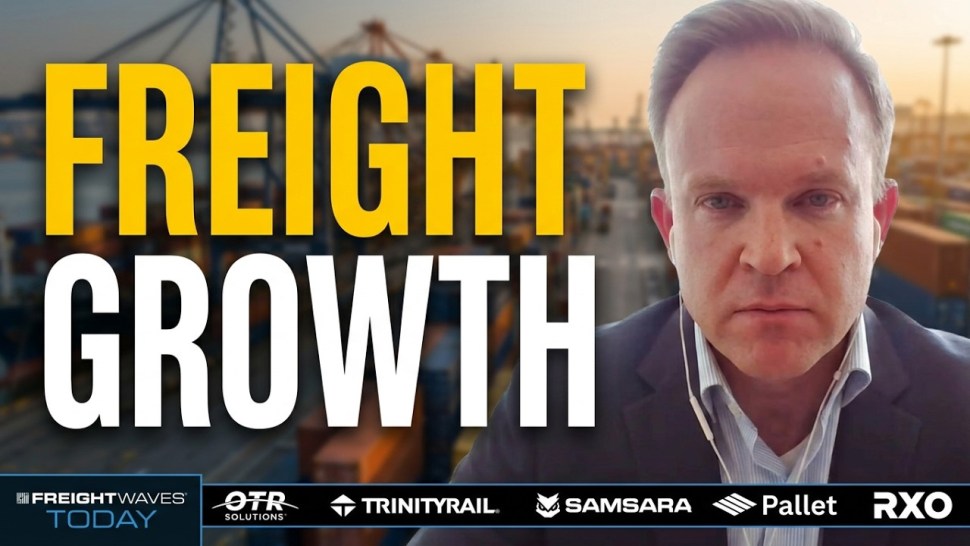
The US industrial sector is experiencing its strongest growth in years, with the ISM index hitting 55.6 for the seventh consecutive month. We dive into the surprising drivers, from AI data centers and tax incentives to resilient consumer spending. But are there risks lurking with capacity exits and grid infrastructure? Senior Industrials Analyst Ryan Farlow shares his insights on what’s ahead for manufacturing and the freight market.
The ISM Manufacturing index hit 55.6 — its highest reading in years — marking seven straight months of expanding industrial activity, RSM industrial analyst Ryan Farlow told FreightWaves. Farlow said 15 of the 18 sectors tracked within ISM Manufacturing increased in the most recent reading, a sign that demand has spread well beyond AI data center construction into aerospace and defense, semiconductors, and chemicals.
The breadth of that expansion matters to carriers and shippers because it signals durable freight demand rather than a single-sector spike. Farlow attributed the industrial rebound to several overlapping forces: data center construction, tax incentives tied to reshoring under the One Big Beautiful Act, tariff policy pushing manufacturing closer to home, and a resilient consumer. Real private demand in the most recent GDP print came in at 3.9%, and RSM projects GDP growth of roughly 2.5% in the second half of the year, with 2027 shaping up as even more favorable than 2026.
“The freight recession is over,” Farlow said, pinpointing November and December of last year as the turning point driven by regulatory and compliance enforcement. RSM works with more than 500 transportation and logistics companies, with 80% to 90% of those clients in the middle market or upper middle market. Farlow said executives across that client base are now reporting contract rate increases and stronger July results, with spot prices having risen substantially and contract rates expected to follow.
“Costs in trucking are as high as they’ve ever been,” Farlow said, citing the American Transportation Research Institute’s most recent Cost in Trucking report, released last month, and noting that middle-market carriers are running aging equipment longer while navigating elevated insurance expenses and litigation risk from cases such as Montgomery and C.H. Robinson.
On the supply side, Farlow said capacity exits that began with rising bankruptcies in 2023 and 2024 have accelerated under the crackdown on non-domiciled CDLs and the ELP mandate. The driver pool has shrunk to the point where finding qualified drivers is now the top operational concern he hears from client executives. Compounding that pressure: since 2019, registered motor carriers increased 30% while shipment volumes declined 10%, a mismatch that is now correcting as weaker operators exit.
Freight expenditures are up 12% since 2019 even as shipments are down 10%, a gap Farlow said reflects growing efficiency — carriers moving larger volumes in fewer loads across both truckload and LTL. That dynamic is helping the supply-demand imbalance self-correct, but it also means raw shipment counts understate the actual volume of freight moving through the network.
Looking ahead, Farlow flagged data center construction slowdowns as the primary risk to the industrial outlook. Birmingham itself imposed a six-month moratorium on new data centers, and roughly 500 municipalities nationwide have enacted bans or pauses. He said the core issue is grid underinvestment rather than data centers themselves, and estimated it will take at least three to five years to make meaningful progress on transmission capacity. Despite near-term friction, Farlow said RSM believes the data center buildout remains a multi-year tailwind for industrials and freight, and that private equity funds investing in transportation infrastructure are already anticipating a surge in deal activity by 2027.
- ISM Manufacturing reached 55.6, its highest level in years, with 15 of 18 sub-sectors expanding — broadening beyond AI data centers to aerospace, defense, and chemicals.
- RSM’s Farlow says the freight recession ended in November-December, with capacity exiting via bankruptcies, CDL enforcement, and a shrinking driver pool driving contract rate increases.
- RSM projects 2.5% GDP growth in the second half and sees 2027 as even more favorable, with PE funds eyeing increased M&A activity in transportation and logistics.
Speaker 1 [0:00] Oh, well, look, the industrials are super hot. To talk about those, we have our first guest, Ryan Farlow. He is the industrial analyst at RSM. Ryan, welcome to FreightWaves Today.
Speaker 2 [0:09] Thanks, Craig. Thanks, Julie. Happy to be on with you guys today.
Speaker 1 [0:14] Well, you’re coming to us from Birmingham, Alabama. There’s not a more industrial city in America than in Birmingham, Alabama. Ryan, appreciate you coming in. Tell us about the state of the industrials right now.
Speaker 2 [0:27] Well, industrials are hot. I know you guys have talked a little bit about the ISM reading that came out recently. We’re at 55.6, highest reading in years. We’re at the 7th straight month of an increase in industrial activity. And so what’s really encouraging when we think about industrials broadly is that, you know, it’s really been led by the data center buildout. And in the recent ISM reading, we’ve really seen the demand broaden out. 15 out of the 18 sectors within ISM Manufacturing increased. So now it’s not just AI data centers, it’s aerospace and defense, it’s other semiconductors. There’s other elements, chemicals and other elements that are increasing broad manufacturing demand outside of just kind of the narrower database buildout. So it’s very encouraging.
Speaker 1 [1:14] Ryan, do we think this is the catalyst? Was the catalyst really the AI data centers, the amount of capital and CapEx that went in to sort of bring the industrials out of the recession, the contraction that we saw over the last couple of years? Was it really, was that the trigger? And then you combine that with defense production and frankly higher energy prices are net positive for US industrials. But what do you attribute the economy in terms of industrials coming back?
Speaker 2 [1:43] Well, I think it’s nuanced and there’s a lot of different things. I certainly think the AI data center construction boom is certainly helping, but there’s so many other things at play here. We have the impacts of OBA, the tax bill that created some great incentives to reshore and to build new facilities that get, you know, bonus depreciation and other increases. You have kind of the tariff policy and landscape that has encouraged companies to bring manufacturing closer to home. And ultimately, you have a very strong consumer. We’ve seen consumer spending continue to increase. Private demand, which in the GDP number that just came out, real private demand was 3.9%. which tells us consumers are spending, and ultimately the manufacturing is gonna follow that. So as long as consumers keep spending and they’re healthy, we just feel like manufacturing will continue to follow and be strong. And we’ve seen that recently show up in the data.
Speaker 3 [2:39] So I wanna talk also about the capacity side of the equation, not just the demand. I think that we love, you know, hearing channel checks and confirmation of sort of this industrial revitalization that we’ve been talking about, but you all specialize kind of in that mid-market. size. So what are you seeing from a capacity exit and with that sort of size of carrier?
Speaker 2 [3:01] Yeah, so we serve— there’s over 500 transportation logistics companies that we serve here at RSM out of the US, and they’re small, mid, large cap, but 80 to 90% of our clients are in the middle market, upper middle market. They’re family-owned, they’re private equity-owned, and we are, you know, hearing consensus at this point. Obviously, the freight recession is over. You know, that happened in November, December last year with the regulatory and compliance crackdown, and we’re seeing meaningful exits of capacity leave the market. That started back in ’23 and 2024 with rising bankruptcies. And then with the, the recent crackdown on the non-domiciled CDLs and the ELP mandate, capacity continues to, to leave the market. And really what we’re hearing from our clients and talking with, you know, executives is they can’t find drivers. That’s, that’s the biggest problem right now is, is the driver pool has just shrunk. When you also think about some of the other things that are going on in freight markets from just a litigation legal perspective, perspective, that’s just going to continue to, to put a strain on companies trying to find drivers.
Speaker 3 [4:03] So I read in some of the articles, and, and, uh, I guess they’re white papers or articles that you’ve put out, um, that freight expenditures are up 12% since 2019, but shipments are down 10%. So why is that gap important? What does it tell you?
Speaker 2 [4:17] Well, so if you look at since 2019, registered motor carriers have increased 30%. Volumes have been pretty flat. Shipments have been down. That’s not a recipe for success, and we’ve seen that correct. When you look, we look at the CAS index, and although volume is flat to up, the reason shipments are down, we believe, is there’s some efficiency going on in the market. And so when you look at both truckload and LTL, you know, there’s companies that are able to find a way to move the same amount of freight with less loads. And so that distinction is important because we look at shipments from just a capacity perspective. You know, how much shipments are needed to move the freight. And to the extent that we can continue creating efficiencies in the market by transporting larger amounts of volume in the same or smaller amount of shipments is only going to help the supply and demand imbalance correct itself.
Speaker 3 [5:12] Man, Ryan, it’s like you watch the show. You’re talking about all the same stuff we’ve been talking about. It’s great.
Speaker 1 [5:18] Yeah, I mean, look, I think Cass’s Shipment Index, obviously more weighted to LTL, is showing Exactly that. We’ve done a bunch of channel checks. We had Saya’s CEO on Friday. We’ve had WebEstis. We’ve had multiple— everyone’s— the channel checks are really strong. There’s been a little bit of cooling, but we believe intermodal motor mix is really the reason for some of the truckload demand cooling a bit in the month of July and August. Ryan, let’s talk a little bit about sort of the broader state of industrials, because I think that’s really where the storyline is. Consumer activity, really, outside of a couple of sectors, housing specifically, has been pretty strong even throughout the last couple of years. But the industrial sector has been a dog. It has come back in November, started to come back in November, has continued to firm, as you’ve talked about, an expansion, a widening of the overall elements. Do we believe this is going to sustain itself into next year, or do we think there’s some things that we should be worried about?
Speaker 2 [6:18] Well, there’s a couple things that we are paying attention to in terms of risk, but I’ll start with just saying that there’s no reason to believe this won’t continue. In fact, our estimate here at RSM is GDP will continue to increase. It’ll be about 2.5% in the second half, and we believe the setup for 2027, it will be even more favorable than 2026. I mean, the things that are potential disruptions when we think about manufacturing continuing this upward trend is going to be The consumer is the consumer going to continue to spend, especially in the face of elevated borrowing costs and elevated fuel and inflation. And so far, we haven’t seen the consumer really pull back at all. A lot of the reasons we think we had a massive tax refund that hit in the spring that gave the consumers a little bit of wallet share to continue bleeding that down. Savings are coming down for consumers, but you know they haven’t shown a willingness to change their spending patterns in the face of. In the face of inflation, so as long as they keep spending, we’re looking at you know employment data. It’s really a boring labor picture. It’s kind of low, higher, low, fire. Real wages continue to be positive. We’re expecting you know a record holiday season. I think it’s four percent increase in projected holiday sales compared to last year. That would be another record. So as long as consumers continue to spend, there’s no reason to think that you know manufacturing would would. move off of its current trajectory. The other thing we mentioned, the data center AI buildout, there is some risk that we’re looking at. Is there, from just a construction standpoint, is there a risk that CapEx gets pushed out further? Is there a risk, there’s a lot of public scrutiny at this point around data centers and some moratorium and pauses on that construction. Is that going to push out that? But that really is also driving a lot of the industrial strength as well. And so that’s something we’re monitoring as well.
Speaker 1 [8:21] Yeah, I mean, there’s 500 different municipality basically bans or some type of pausing of data center construction. This has become the hot story. Really, we shifted from net zero and decarbonization to no data centers. A lot of NIMBYism is driving it. Texas, shockingly enough, put out— I wouldn’t call it moratorium, but it certainly increased environmental review and impact studies required now for data center construction. It feels like there is certainly a shift now happening towards an anti-data center movement across the country, Ryan. I do worry that that NIMBYism is just another example of where the United States tends to shoot itself when we have good things, we have momentum. What are your thoughts on that?
Speaker 2 [9:08] Yeah, Governor Abbott came out with what we call a review. It was a review, right, of going through audits of data centers And some of that may be symbolic. We have election considerations as well with that. But even in Birmingham, we put a 6-month moratorium on new data centers. And ultimately, our belief is these data centers will continue to be built out. I think there’s a bit of a lack of transparency between the consumer and the data centers. If you look at the polling, a lot of the national polling, it’s pretty clear that that consumers appear to be largely against data centers in their community. But the one concern that’s always brought up is electricity costs. The consumers don’t want to pay for increased electricity due to data centers. And why we think there’s a disconnect is because the hyperscalers met with Trump back in the spring and agreed to pay their own way on electricity and building out infrastructure. And so we think there’s just maybe a little bit of a messaging disconnect. And so a lot of these bans or pauses are really just an opportunity to come together and make sure that the consumers and the communities are not adversely impacted. We think those will get resolved, and ultimately, we think the data center buildout is going to be a multi-year tailwind for industrials and for the freight market.
Speaker 1 [10:26] Ryan, it strikes me, you’re in Birmingham, Hamilton County, Chattanooga, Tennessee’s county, there’s one in Northwest Georgia put moratoriums on data centers as well, largely due to concerns about a combination of water. By the way, we have plenty of water here. Like there is no shortage of water. In fact, ask the state of Georgia because they tried to steal it from the state of Tennessee a couple years back. But the idea is really electricity; it’s power prices. TVA is the you know the largest federal utility. It powers Birmingham, Alabama, in addition to Chattanooga, Tennessee, and they want to build more nuclear. They’ve been very proactive on this. They’re building nat gas plants. The reality is that we just have underinvested in our grid for so long. that this is really the problem. It’s not the, frankly, the data centers that’s causing it. It was the underinvestment. My concern is this NIMBYism that takes hold. And as you point out, a lack of education. I mean, I think Sam Altman is the face of the AI world. It’s not a positive thing for the AI data centers. This guy is not a very good evangelist for AI data centers in itself. Seems that we need a little bit more rationality. It also strikes me that if we go back to, remember the Amazon HQ 2.0, where Amazon was sort of the charm child of the world, and all of a sudden, there was this massive backlash, and they realized that they needed to change the way that they sort of handled the public. AI data centers are going through that right now.
Speaker 2 [11:52] Yeah, you’re exactly right. And the hard thing about this situation is that you cannot improve the grid or transmission overnight. It’s just going to take longer than some people expect. And so, You’re right, we’ve underinvested in the infrastructure with the grid. And so even the Texas review was— the precipitous of that was pausing new connection requests to the grid. I mean, that’s why that ban happened. And so it’s a grid problem, it’s a transmission problem, and those don’t fix itself overnight, just like the supply chain. We’re talking to clients all the time about diversifying their supply chains or nearshoring or bringing things into Mexico or Canada. And what we tell them, those things don’t happen overnight. And so the grid is just another example. It’s just going to take 3, 5 years at least to really get to a place where we’re able to make some meaningful progress. And in the meantime, we just need to make sure that we’re transparent with the impacts to the communities. And I think the data centers are willing to make that investment. It’s just going to take some people getting to the table and talking through it and getting the right message out to the communities because they ultimately, they do want to benefit the communities. In fact, You know, I’m born in Madison, Mississippi, and Amazon just had a huge data center being built in Madison, in my own hometown. And talked to friends who still live there, and, you know, there’s a ton of benefit to them. And I hear that they’re redoing schools, they’re getting new roads, a bunch of businesses are coming in to support the ecosystem. They’re replenishing their local and state tax coffers. I mean, there’s a lot of benefits there. I think it’s just getting everybody to the table to make sure it’s benefiting people on all sides.
Speaker 1 [13:33] And then look, these are better for the community than these old smokestack industries. Not to say that we don’t need industry, but in many ways, they’re better for the environment. The amount of money that goes into communities, whether we’re talking schools or roads, as you mentioned, infrastructure, it’s good. And look, ultimately, I think there’s been a couple of things. Texas, the Permian Basin, a lot of the hyperscalers are just going directly to those natural gas fields and building their generators right there. just to basically create a closed loop, which strikes me as a real opportunity because they’re flaring that gas right now. So why not put it to use into something we all benefit from? That’s the first thing. Second, I don’t know if you caught this, but Vikram Ramaswamy up in Ohio, one of his proposals is, look, if you’re going to build a data center, then you need to give free electricity away. If you put it in my community, I think that’s a real smart move. Because it does align the incentive base. Look, I’d love to have free power. If TVA wants to give free power away and put it as data centers, I’m all for it.
Speaker 2 [14:37] I agree. I did see Vivek’s post on X and his recommendation was, okay, if you put a data center in our community, then you pay for the community’s power. I think that seems reasonable. And I don’t know that the— I’d be curious what the hyperscalers come back and say.
Speaker 1 [14:53] Do you think it has legs?
Speaker 2 [14:56] I think that the data centers are going to be willing to ensure that consumers’ electricity bills are not increasing. I think for sure. I mean, they’ve already publicly communicated that. Now, inside of that, there’s some messaging about, is it paying for consumers’ electricity bills in lieu of state and tax incentives? Right now, a lot of the hyperscalers are getting significant tax incentives. So maybe it’s just redesigning, maybe it’s shuffling, but I do think that hyperscalers would agree to at least not have a negative impact on consumers’ electricity bills should they decide to build in those communities.
Speaker 3 [15:34] All right, Ryan, one more question. As we talked about, we like to do channel checks and you guys work with more than 500 transportation logistics companies. So what are you hearing directly from those operators regarding capacity exits around regulation, how much you think will actually exit, and anything else relevant to the freight market for the rest of the year?
Speaker 2 [15:54] Well, we’re hearing from a lot of our clients they’re making money in the freight market now, which is awesome. We love, we love to hear that they’re doing well. I talked to a couple CEOs just last week about July results. They’re doing great. They’re getting contract increases. You know, the spot prices, as you guys have talked about, have, have gone up pretty substantially, and contract rates will follow, which is awesome for especially for the asset-heavy carriers. I mean, every increase to, to a rate, you know, hits the bottom line. And so they’re excited about the future. They’re excited about what rates are. There is concern from a cost standpoint. You know, the ATRI, American Transportation Research Institute, came out with their Cost in Trucking report just last month. Costs in trucking are as high as they’ve ever been. There’s certainly concerns from an insurance perspective. Companies, especially middle market companies, are running their trucks longer. They’ll need to figure out how to replenish those trucks. We have a pre-buy that’s occurring a little bit right now. I mean, there’s just a lot of things going on, but ultimately a lot of our clients are bullish on the freight market, excited for the future. You know, they’re— the biggest concern right now is probably just from a cost perspective, some of the issues that are ongoing with the Montgomery case as well as the C.H. Robinson case. We’re having a lot of conversations with brokers about how to kind of make some changes in their business to accommodate the growing exposure there. But, you know, ultimately I’ll Conclude by saying all of these are gravitational forces towards a more consolidated industry structure. It’s going to be hard right now with, with the interest rates and borrowing costs as high as they are. But in talking with PE funds that are invested in infrastructure and transportation, they see, they see a great appetite in 2027 for increased deal activity. So we’re excited to see that take place.
Speaker 1 [17:37] Ryan, you’ll have to come visit us in Chattanooga. It’s a 2-hour drive. You’re sort of a sister city down there in Birmingham, Alabama. Feel part of the—
Speaker 2 [17:45] We’d love to.
Speaker 1 [17:46] We’d love to see you. Um, big fan of Birmingham, big fan of the New South.
Speaker 3 [17:51] Yeah.
Speaker 1 [17:51] So did you know that if you took, uh, Nashville to Atlanta and added Birmingham, Huntsville, and Knoxville, and Chattanooga, that is 11 million people? It’s the 20th largest economy in the world.
Speaker 3 [18:00] Yeah.
Speaker 1 [18:01] Pretty insane.
Speaker 3 [18:02] It is.
Speaker 1 [18:02] And it’s where the world’s coming because you’ve got power, you got batteries, you have solar, you have automotive.
Speaker 3 [18:07] Quality of life.
Speaker 1 [18:09] Industrial pulse. Yeah, great quality of life.
Brokerage Compliance Symposium
The day before F3. Every compliance issue you face - fraud exposure, carrier liability, FMCSA rules, cargo theft, insurance gaps - navigated by attorneys and operators defining best practices in a changing industry.
F3 Awards Dinner
The night before F3. FreightTech100 companies honored. FreightTech 25 and Shipper of Choice winners revealed live. Cocktail reception into dinner and live music - 300 industry leaders in one purpose-built room.
F3: Future of Freight Festival
Industry-defining keynotes, rapid-fire technology demos, and industry leaders networking in experiences across Chattanooga - plus the inaugural F3 Awards Dinner featuring the FreightTech and Shipper of Choice reveals.
The day before F3. Every compliance issue you face - fraud exposure, carrier liability, FMCSA rules, cargo theft, insurance gaps - navigated by attorneys and operators defining best practices in a changing industry.
The Signal at Chattanooga Choo Choo • Chattanooga, TN Register NowThe night before F3. FreightTech100 companies honored. FreightTech 25 and Shipper of Choice winners revealed live. Cocktail reception into dinner and live music - 300 industry leaders in one purpose-built room.
The Signal at Chattanooga Choo Choo • Chattanooga, TN Register NowIndustry-defining keynotes, rapid-fire technology demos, and industry leaders networking in experiences across Chattanooga - plus the inaugural F3 Awards Dinner featuring the FreightTech and Shipper of Choice reveals.
The Signal at Chattanooga Choo Choo • Chattanooga, TN Register Now