




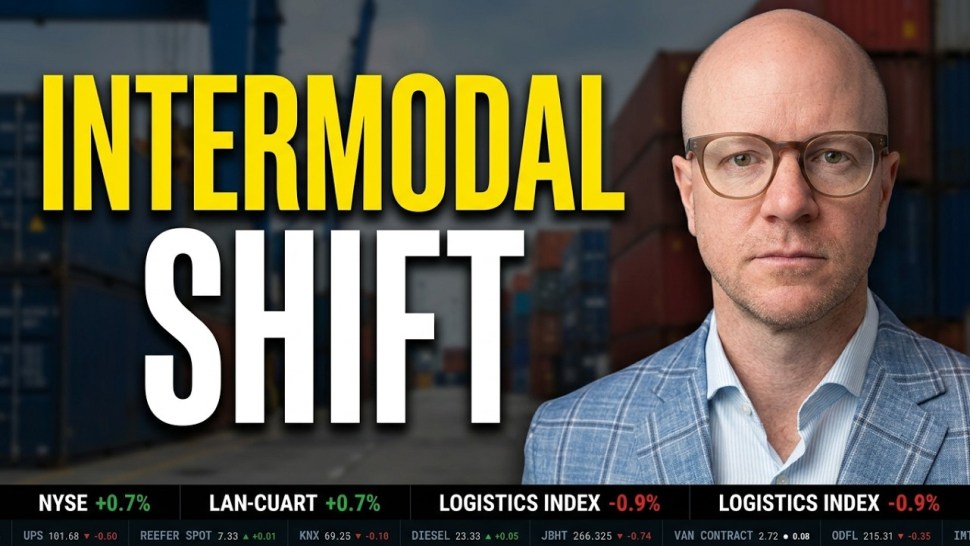
Trucking volumes are down, but it’s not a slowing economy. Discover how a significant modal shift to intermodal rail, driven by inventory rebuilding and a substantial cost advantage, is reshaping the freight market. We dive deep into SONAR data to explain exactly what’s happening and why railroads are winning share from long-haul trucks. Learn what this means for your supply chain and what to expect for Q4.
Accepted truckload volumes are down 3.3% year over year, but the culprit is not a weakening economy — it is a modal shift to rail. Domestic intermodal container volumes are up 10% year over year, while long-haul truckload volumes have remained essentially flat, according to FreightWaves SONAR data cited during a FreightWaves analysis segment. The divergence explains why brokers are seeing softer spot postings even as large asset-based carriers — both LTL and truckload — report firming volumes in channel checks.
The shift is being driven by two reinforcing factors: a 34% cost discount that rail holds over truck, as tracked by FreightWaves’ Intermodal Savings Index, and the absence of time pressure on freight moving into retailer distribution centers. With retailers rebuilding inventories for the second half of the year after a period of tight stock levels, and with ports logging strong import volumes in recent months, shippers have months before the product is needed on store shelves — making slower rail a viable and cheaper option.
“If you need the products right now, you move it by truck. If you don’t need it for a few months, you can move it by rail. And you’re taking advantage of the 34% discount of rail versus truck,” said the FreightWaves analyst.
Fuel economics are amplifying the spread. When fuel prices rise, intermodal fuel surcharges increase at a slower rate than trucking fuel surcharges, widening the cost gap. However, supply chain reconfigurations to shift freight from truck to intermodal take time — which is why the initial fuel price increases seen in March did not translate into firming intermodal traffic until June, a roughly two-month lag.
The American Association of Railroads’ weekly tonnage index, which FreightWaves covers every Wednesday, is up 4.4%, corroborating the modal shift narrative. JB Hunt’s earnings were cited as a concrete benchmark for domestic intermodal strength, with the analyst pointing to the carrier’s domestic intermodal segment — described as the lifeblood of its intermodal business — as “very robust.” Hub Group was also flagged as a comparable beneficiary.
The modal gains are not expected to last indefinitely. As the calendar moves into October and November, time pressure around fourth-quarter restocking and the holiday rush typically pushes shippers back toward truck. Truckload demand is expected to firm in that window. However, a note of caution was raised: because freight is already moving slowly by rail deeper into the country’s interior distribution centers, the usual late-year surge in trucking demand may be more muted than historical patterns would suggest.
Beyond transportation data, broader economic indicators support the view that demand itself is not deteriorating. The ISM index is described as strong, the Logistics Managers’ Index shows inventory build beginning, and CEO channel checks across roughly 10 logistics sector executives per week on FreightWaves Today are consistently positive — with softness confined largely to certain food categories within CPG and restaurant retail, attributed more to GLP-1 drug adoption changing consumer habits than to macro weakness.
- Domestic intermodal container volumes are up 10% year over year while accepted truckload volumes fell 3.3%, pointing to modal shift rather than freight demand weakness.
- A 34% rail-versus-truck cost discount tracked by FreightWaves’ Intermodal Savings Index, combined with loose inventory timelines, is steering shipper decisions toward rail.
- Truckload demand is expected to recover in October and November as fourth-quarter time pressure mounts, but the pre-positioned freight on rail may dampen the typical holiday surge.
Speaker 1 [0:07] Trucking market looks to be slowing, or is it? That’s really a question on the minds of pretty much everybody across the brokerage industry. They’re seeing spot postings drop over the last couple of weeks, and the question is, what’s really going on? I’m gonna break it down using Sonar’s data to explain exactly what is happening in the freight market. Rest assured, the economy is doing quite well right now. Our channel checks confirm that companies are seeing firming in volumes in the large asset-based side of the business. This includes both LTL providers as well as large truckload providers. So why are things slowing? In fact, when you look at the accepted truckload volumes, which is a part of our indexes inside of Sonar, We’re down 3.3% year over year. That would suggest things are soft or softening. It’s not the case. The reason that things feel softer and volumes have dropped in the truckload market is entirely to do with the railroads or intermodal. Intermodal is picking up its share. Domestic truckload volumes across the intermodal— these are domestic containers— are up 10% year over year, while long-haul truckload volumes that go by truck are basically flat. There’s been no increase in long haul. So the railroads are picking up a predominant amount of the share. They are picking off truckload volumes. Volumes that would normally go by truck are actually going by rail right now. This is exactly what’s happening. We’ve been talking about it all year, how strong the railroads are. Every Wednesday, we put out the AAR, which is the American Association of Railroads, their weekly tonnage index. We’re up 4.4%. Now, when you think about the fact that railroads, the intermodal domestic volumes really are slower than what in terms of the speed of traffic than what is going by truckload, it suggests that really companies are not feeling a lot of pressure on their supply chains. And we can know this because we can look at the total amount of inventory that they took in earlier this year. Companies were tight on inventories over the last couple of months. Imports have been flowing in. The ports have seen really strong volumes in the last couple of months as retailers start to rebuild inventories for the second half. So a lot of concern and caution about the overall state of the consumer as we ended 2025. Companies were really worried about consumers dropping off, particularly with inflationary concerns and tariff concerns. And that didn’t happen. Things have actually been pretty strong. Consumers have held in and have been quite robust. And you can see this in earnings across all major categories except for food. Some of the food categories within CPG or restaurant retail have been soft, but that’s probably related to GLP-1s and consumer habits changing what they consume more than it is anything to do with the economy. So when we look at the overall state of the economy, it looks pretty strong. Industrials are ramping. But trucking volumes, particularly in the truckload sector, have dropped. And again, it’s intermodal. Intermodal is an interchangeable fungible commodity between truckload, which goes by truck, and rail freight containers on rail that goes by the railroads. And the railroads are picking up share. We’re talking to all of the major intermodal providers. We’ve been talking to them on FreightWaves Today. And what they’re telling us is that things are incredibly robust. In fact, you can look at JB Hunt’s earnings to see just how strong intermodal is, particularly domestic intermodal, which is the lifeblood of JB Hunt’s intermodal business. It was very robust. And so what we’re seeing right now is really a very strong intermodal sector that’s taking share off of truck. And because companies are building inventories and there’s no time pressure, in other words, you’ve got months before those products need to be consumed, these are essentially warehouse on rails or warehouse on wheels. They’re moving warehouses. So what’s happening right now is large retailers are importing a lot of product from overseas, taking advantage of time, taking advantage of an advanced amount of months before their products are needed. And therefore, they’re not driving a lot of those volumes into trucking. If you need the products right now, you move it by truck. If you don’t need it for a few months, you can move it by rail. And you’re taking advantage of the 34% discount of rail versus truck. We have the Intermodal Savings Index. Tracking the contract trucking rates to intermodal rates, it’s exactly what the data says, is that that 34% discount is exactly what companies are doing right now with their freight. They’re moving it by the railroads and not by truck. This is really driven by 2 factors. One is time, more inventory, and the fact that— When fuel prices increase substantially, the intermodal fuel surcharge moves up a lot less than the trucking fuel surcharge does. And it takes a couple of months. Companies cannot immediately reconfigure the supply chains to move the mode of traffic from truck to intermodal if they’ve not done it before. So it takes some time to shift those volumes from truck to intermodal. And that’s why it’s been a lag. That’s why it’s taken some time. That’s why When we start— first started seeing fuel prices increase in March, it really wasn’t until June before we started to see a real firming in intermodal traffic. And that has continued to hold. So what we’re seeing is just a share gain, a modal shift. And this will probably play out at least until September and October when time does matter. Companies start to worry about getting freight into their supply chains for the 4th quarter and for the holiday rush. And therefore, intermodal traffic will be strong, but the modal gains will not continue through the rest of the year. And we’ll start to see truck firm up in October and in November. But one point of caution, because products have been moving and because they’ve been moving through slower modes of traffic, it means that we may not see as robust of a 4th quarter as perhaps we would’ve expected simply because the freight is moving by slower trains, and there’s more time built into it. In other words, the freight’s crawling across the United States. It’s moving closer to inland and center of the country distribution centers, and therefore there’s not as much time pressure to move it out as what you would have expected if things were less planned or there was a big surge of products at the end. Something to keep an eye on. But again, I think it’s the railroads. That’s your answer. That’s why trucking accepted volumes are down versus where they were last year.
Speaker 2 [7:40] All right, Craig. So not with tender rejections as well as volumes remaining flat to a little bit muted. The thesis is doesn’t mean that there’s capacity entering or more capacity or less freight. It means that there’s been mode conversion from van to intermodal.
Speaker 1 [8:01] It’s intermodal. There’s less intensity in terms of time. We see it in the inventory numbers. LMI started to see some inventory build as companies were preparing. That’s why the ports have been pretty strong relative to what maybe you would have expected it. And really, it’s just about— it’s about all those things. So nothing— like, there’s no sign that the economy’s slowing in any of the economic data.
Speaker 2 [8:22] Right.
Speaker 1 [8:23] ISM, we talked about that earlier with RSM’s economist, is ISM is strong. You’ve got the LMI data. It’s telling us the same thing. We talk to CEOs every, you know, on a given week, we have 10 different CEOs from the logistics sector on FreightWaves Today. And everyone is talking about, from a channel check, things are good.
Speaker 2 [8:41] Yeah. And everything that Ryan, I mean, Ryan echoed all of those same things as well, our last guest. Absolutely.
Speaker 1 [8:47] So again, I think it’s all just modal conversion. Look, I think if you’re gonna be bullish on something, be bullish on JB Hunt because they have that domestic intermodal. You could also argue that Hub Group is in the same box. So, and the railroads. Yeah, love the railroads. Yes, Wednesday is our AAR day, so we’ll cover the railroads again.
Brokerage Compliance Symposium
The day before F3. Every compliance issue you face - fraud exposure, carrier liability, FMCSA rules, cargo theft, insurance gaps - navigated by attorneys and operators defining best practices in a changing industry.
F3 Awards Dinner
The night before F3. FreightTech100 companies honored. FreightTech 25 and Shipper of Choice winners revealed live. Cocktail reception into dinner and live music - 300 industry leaders in one purpose-built room.
F3: Future of Freight Festival
Industry-defining keynotes, rapid-fire technology demos, and industry leaders networking in experiences across Chattanooga - plus the inaugural F3 Awards Dinner featuring the FreightTech and Shipper of Choice reveals.
The day before F3. Every compliance issue you face - fraud exposure, carrier liability, FMCSA rules, cargo theft, insurance gaps - navigated by attorneys and operators defining best practices in a changing industry.
The Signal at Chattanooga Choo Choo • Chattanooga, TN Register NowThe night before F3. FreightTech100 companies honored. FreightTech 25 and Shipper of Choice winners revealed live. Cocktail reception into dinner and live music - 300 industry leaders in one purpose-built room.
The Signal at Chattanooga Choo Choo • Chattanooga, TN Register NowIndustry-defining keynotes, rapid-fire technology demos, and industry leaders networking in experiences across Chattanooga - plus the inaugural F3 Awards Dinner featuring the FreightTech and Shipper of Choice reveals.
The Signal at Chattanooga Choo Choo • Chattanooga, TN Register Now