




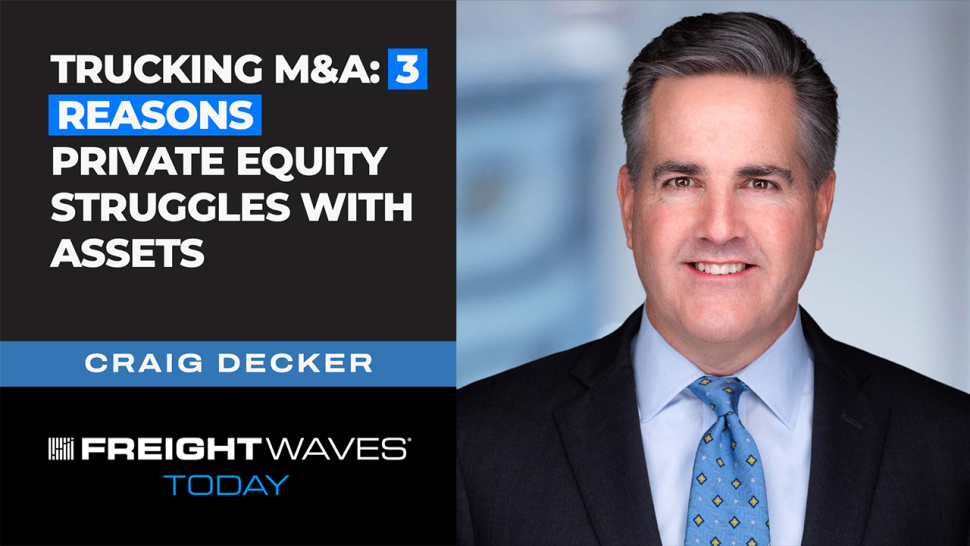
The freight market is showing signs of recovery, reigniting interest in M&A across the logistics sector. But while non-asset brokerage deals have historically attracted private equity, asset-based trucking presents unique challenges. Craig Decker, Managing Director at Brown Gibbons Lang & Company, explains why financial engineering alone isn’t enough in asset-heavy operations and how a lack of understanding of replacement cycles and operational complexities can lead to ‘miserable’ investment outcomes. Discover what investors are now looking for in the evolving M&A landscape.
Private equity’s persistent losses in asset-based trucking come down to three compounding failures: overleveraged balance sheets, misread freight cycles, and underestimated operational complexity. Speaking on FreightWaves, Decker said the industry is now seeing a resurgence in M&A interest that began in the third quarter of last year as truckload rate indexes shifted and regulatory changes began tightening capacity — but warned that old mistakes could repeat.
Strickland argued that the core financial error is leverage. Asset-intensive trucking businesses carry fleet replacement cycles of three to five years for truckload and seven years for LTL, meaning depreciation and amortization is a real cash expense, not a paper one. When PE firms load debt onto those businesses, debt service competes directly with capital expenditure. “What they might do is extend the trade cycle on their equipment or defer some maintenance,” Decker said. “When you start doing that, that just really, really deteriorates your business, whether it be from your assets not running at the right OR to your customer satisfaction rate going down.”
A decade-plus of near-zero interest rates made the leverage math appear manageable. Decker noted that investment professionals who entered PE after the 2008 financial crisis modeled businesses against LIBOR rates of around 50 basis points — effectively 1.5% to 2% all-in borrowing costs. Those same professionals are now senior decision-makers who have not been tested in a real rate environment, making the current high-cost-of-capital era a rude adjustment.
“It’s not a good business within their holding period. Part of it is that their lifespan of their investment or their thesis on that is 3 to 5 years. It’s really too short,” Decker said.
Operational unfamiliarity compounds the balance-sheet problem. Decker cited driver turnover as one variable that PE spreadsheets routinely underestimate — the industry average runs roughly 1.8 to 2 drivers per truck per year at approximately $10,000 per driver to test, seat, and train. Insurance incident rates, weather disruptions, and customer service failures cascade in ways that cannot be modeled, he said, and PE firms that try to manage trucking companies by spreadsheet rather than through experienced operators tend to spiral downward.
The cycle timing problem is equally punishing. Decker said acquirers frequently rely on trailing-12-month financials without accounting for where a carrier sits in the freight cycle. Because of the operating leverage embedded in trucking, a 12-month snapshot at the wrong point in the cycle is, in his view, essentially irrelevant for underwriting a multi-year hold.
Where PE can succeed, Decker said, is in specialized or dedicated segments — cold chain serving pharma, hazmat, or other end markets with low price elasticity and sticky margins — rather than commoditized truckload. He pointed to the growing investor interest in those niches and noted that port diversification is adding another layer of complexity for investors, with freight increasingly routing through Savannah, Gulf ports, and Norfolk rather than solely through Los Angeles-Long Beach. “66% of our population is east of the Mississippi,” Decker said, arguing that Mid-Atlantic and Southeast logistics hubs offer lower labor costs, fewer union constraints, and better highway access than California gateways. Decker said deals are now beginning to close after what he called “4 very, very long years” of a freight recession, with brokerage transactions leading and asset deals starting to follow.
- PE firms overleveraging asset-based trucking carriers — with fleet replacement cycles of 3 to 7 years — leads to deferred maintenance and deteriorating operations when debt service crowds out CapEx.
- A generation of PE professionals who modeled deals at ~1.5–2% interest rates lack experience managing heavy-asset businesses in a high-cost-of-capital environment.
- M&A activity is rebounding after four years of freight recession, with investors targeting specialized niches like cold chain pharma and dedicated transport over commoditized truckload.
This Summary is generated thanks to a transcription of the interview, for the full interview please enjoy the video above.
Brokerage Compliance Symposium
The day before F3. Every compliance issue you face - fraud exposure, carrier liability, FMCSA rules, cargo theft, insurance gaps - navigated by attorneys and operators defining best practices in a changing industry.
F3 Awards Dinner
The night before F3. FreightTech100 companies honored. FreightTech 25 and Shipper of Choice winners revealed live. Cocktail reception into dinner and live music - 300 industry leaders in one purpose-built room.
F3: Future of Freight Festival
Industry-defining keynotes, rapid-fire technology demos, and industry leaders networking in experiences across Chattanooga - plus the inaugural F3 Awards Dinner featuring the FreightTech and Shipper of Choice reveals.
The day before F3. Every compliance issue you face - fraud exposure, carrier liability, FMCSA rules, cargo theft, insurance gaps - navigated by attorneys and operators defining best practices in a changing industry.
The Signal at Chattanooga Choo Choo • Chattanooga, TN Register NowThe night before F3. FreightTech100 companies honored. FreightTech 25 and Shipper of Choice winners revealed live. Cocktail reception into dinner and live music - 300 industry leaders in one purpose-built room.
The Signal at Chattanooga Choo Choo • Chattanooga, TN Register NowIndustry-defining keynotes, rapid-fire technology demos, and industry leaders networking in experiences across Chattanooga - plus the inaugural F3 Awards Dinner featuring the FreightTech and Shipper of Choice reveals.
The Signal at Chattanooga Choo Choo • Chattanooga, TN Register Now