




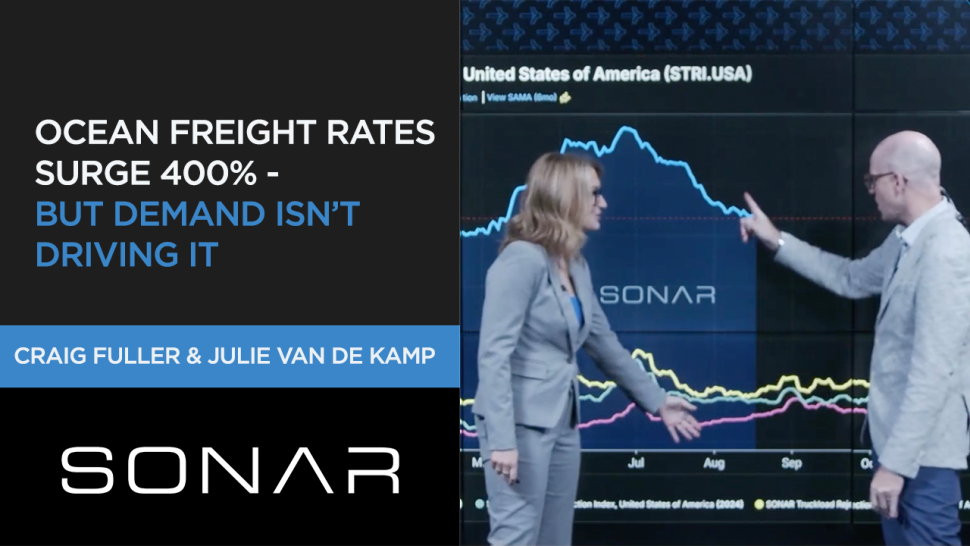
Ocean freight spot rates have skyrocketed by over 400%, but surprisingly, demand isn’t the primary cause. This SONAR Update breaks down how capacity control and strategic blank sailings by concentrated ocean carriers are driving prices. Plus, we dive into the state of trucking tender rejections, rising operating costs, and the shift towards a more regulated environment. FreightWaves experts explain what these trends mean for shippers and the broader supply chain.
Ocean spot rates have spiked dramatically even as cargo volumes out of China to the U.S. are down roughly 1%, according to FreightWaves SONAR data. The China-to-U.S. East Coast rate has reached $9,400 per TEU, with West Coast rates also posting sharp gains — particularly since early August. The disconnect between flat-to-negative demand and surging prices points squarely at supply-side management by ocean carriers, not a freight boom.
The top 10 ocean container lines control approximately 90% of global container shipping capacity — a market concentration that dwarfs OPEC’s roughly 36% share of global oil supply. Crucially, those carriers are exempt from U.S. antitrust law, meaning they can legally coordinate sailing schedules and pull capacity from the market through blank sailings and slow steaming, driving rates higher without running afoul of regulators.
“While they may not be collaborating on price, they’re actually collaborating on capacity in ways that give them pricing power. And that is really important. And I think it’s why you see U.S. consumers and U.S. businesses having to pay really high container rates,” said Julie Van de Kamp.
Taiwan-based carrier Yang Ming’s latest earnings report underscored the dynamic, reporting a 482% profit surge and citing an early peak season and firmer freight rates. The carrier also flagged trade policy uncertainty, geopolitical disruption in the Red Sea, and expectations that vessel supply additions will outpace demand growth — factors that could introduce volatility heading into the fourth quarter.
Carriers are also pointing to environmental and weather factors to justify capacity restraint. El Niño has warmed the Pacific Ocean, increasing typhoon activity, while drier-than-normal conditions have lowered water levels in the Panama Canal, further tightening effective vessel capacity. Van de Kamp framed the carriers’ posture bluntly: “No crisis left untouched.”
The dynamic mirrors what happened to ocean carriers after the 2016 collapse of Hanjin Shipping, when spot rates bottomed around $800 per TEU and carriers held no pricing power. Since then, the industry has shifted from fighting for market share to defending profitability — a strategic pivot that has rewarded investors and fundamentally altered how rates behave. “It’s no longer about he who has the most ships win,” Van de Kamp said. “It’s who has the highest profitability.”
For shippers planning fourth-quarter freight budgets, Craig Fuller advised expecting continued turbulence. Port delays are already increasing, with carriers attributing them to weather disruptions. With blank sailings keeping capacity tight and carriers motivated to sustain elevated rates, shippers should anticipate volatility in both rates and available capacity through the end of the year.
- China-to-U.S. East Coast ocean spot rates hit $9,400 per TEU even as China export volumes declined about 1%
- Top 10 container lines control 90% of global container capacity and are exempt from U.S. antitrust law, enabling legal coordination of sailing schedules
- Yang Ming reported a 482% profit surge and warned of trade policy uncertainty and excess vessel supply heading into Q4
This Summary is generated thanks to a transcription of the interview, for the full interview please enjoy the video above.
Brokerage Compliance Symposium
The day before F3. Every compliance issue you face - fraud exposure, carrier liability, FMCSA rules, cargo theft, insurance gaps - navigated by attorneys and operators defining best practices in a changing industry.
F3 Awards Dinner
The night before F3. FreightTech100 companies honored. FreightTech 25 and Shipper of Choice winners revealed live. Cocktail reception into dinner and live music - 300 industry leaders in one purpose-built room.
F3: Future of Freight Festival
Industry-defining keynotes, rapid-fire technology demos, and industry leaders networking in experiences across Chattanooga - plus the inaugural F3 Awards Dinner featuring the FreightTech and Shipper of Choice reveals.
The day before F3. Every compliance issue you face - fraud exposure, carrier liability, FMCSA rules, cargo theft, insurance gaps - navigated by attorneys and operators defining best practices in a changing industry.
The Signal at Chattanooga Choo Choo • Chattanooga, TN Register NowThe night before F3. FreightTech100 companies honored. FreightTech 25 and Shipper of Choice winners revealed live. Cocktail reception into dinner and live music - 300 industry leaders in one purpose-built room.
The Signal at Chattanooga Choo Choo • Chattanooga, TN Register NowIndustry-defining keynotes, rapid-fire technology demos, and industry leaders networking in experiences across Chattanooga - plus the inaugural F3 Awards Dinner featuring the FreightTech and Shipper of Choice reveals.
The Signal at Chattanooga Choo Choo • Chattanooga, TN Register Now