




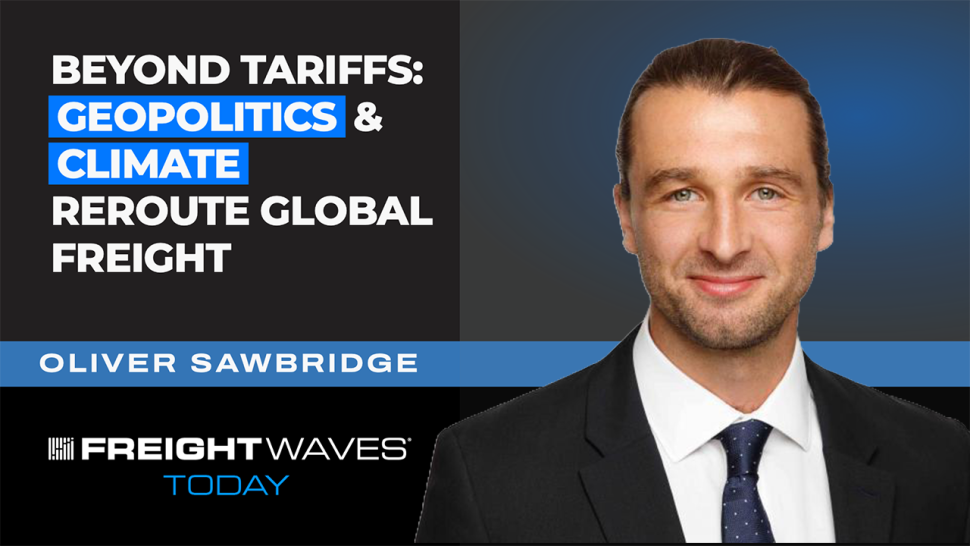
Global supply chains are facing a “double whammy” of disruptions at critical choke points like the Red Sea and Strait of Hormuz. Oliver Sawbridge of Zero100 explains how these simultaneous crises are compounding challenges, leading to increased costs, extended transit times, and infrastructure strain. Learn why resilience must become the bedrock of supply chain planning to navigate these unprecedented geopolitical and climate-driven shifts.
Simultaneous disruptions to the Red Sea and the Strait of Hormuz are creating compounding — not merely additive — pain for global shippers, according to Oliver Sawbridge, senior director at Zero One Hundred, a peer networking group focused on AI disruption and supply chain resilience. Unlike past chokepoint crises where companies could pivot to an alternative corridor, both major routes between Asia and Europe are now compromised at the same time, eliminating the usual fallback options.
“When a chokepoint is disrupted, it quietly assumes that another one is still open,” Sawbridge said. “But at the moment, we’re getting a double whammy and it’s more than double the pain.”
The knock-on effects are measurable. Rerouting cargo around the Cape of Good Hope adds roughly three weeks of additional travel time each way between Asia and Europe, driving up fuel consumption, inflating working capital tied up in longer-in-transit cargo, and straining insurance markets. Cargo insurance rates have surged from 0.6% to as much as 2%, with a war risk premium layered on top. Ports along the Cape of Good Hope route are reporting traffic increases exceeding 100%, yet lack the infrastructure to handle the volume — a problem measured in years to fix, not days.
“One food and drink company we’re working with reported that containers are not consistently landing at the intended ports that they’re going to. So that’s what I mean by these alternative routes are sort of constantly degrading,” Sawbridge said.
Sawbridge cautioned that businesses focused on individual disruption events risk misallocating their attention. He pointed to companies that were advised to prioritize the South China Sea as the highest-risk corridor — and consequently were unprepared when disruptions escalated in the Gulf. He identified climate change and geopolitics as the two structural forces that most consistently elevate chokepoint risk and argued that planning frameworks should be built around those persistent drivers rather than specific incidents.
The Northern Sea Route, increasingly viable as Arctic ice recedes due to climate change, illustrates that geopolitics shadows even emerging alternatives. Russia controls access to the Bering Strait and operates more icebreakers than any other country, meaning a vessel that becomes stuck during that passage would likely depend on Russian assistance — a geopolitical dependency that cannot be planned away.
Sawbridge used a client case study to underscore where resilience strategies break down. One company responded to Middle East disruptions with a dual-sourcing strategy, using supply chain visibility platform Altana to identify its 100 riskiest suppliers and diversify away from them. The effort succeeded at the supplier level but failed to map the physical chokepoints those suppliers sat behind — and both alternative suppliers turned out to ship through the same disrupted corridors: the Red Sea and the Strait of Hormuz. “It definitely needs to be a joined-up process throughout the supply chain and an integrated process for the business,” Sawbridge said.
- Cargo insurance rates have jumped from 0.6% to as much as 2% plus war risk premiums as Red Sea and Strait of Hormuz disruptions coincide, eliminating each other as fallback routes.
- Cape of Good Hope rerouting adds roughly three weeks of transit time each way between Asia and Europe, with ports along that route seeing traffic surges above 100% that their infrastructure cannot support.
- A dual-sourcing resilience strategy at one unnamed company failed because supplier-level visibility never mapped physical chokepoints — both alternative suppliers shipped through the same disrupted corridors.
This Summary is generated thanks to a transcription of the interview, for the full interview please enjoy the video above.
Brokerage Compliance Symposium
The day before F3. Every compliance issue you face - fraud exposure, carrier liability, FMCSA rules, cargo theft, insurance gaps - navigated by attorneys and operators defining best practices in a changing industry.
F3 Awards Dinner
The night before F3. FreightTech100 companies honored. FreightTech 25 and Shipper of Choice winners revealed live. Cocktail reception into dinner and live music - 300 industry leaders in one purpose-built room.
F3: Future of Freight Festival
Industry-defining keynotes, rapid-fire technology demos, and industry leaders networking in experiences across Chattanooga - plus the inaugural F3 Awards Dinner featuring the FreightTech and Shipper of Choice reveals.
The day before F3. Every compliance issue you face - fraud exposure, carrier liability, FMCSA rules, cargo theft, insurance gaps - navigated by attorneys and operators defining best practices in a changing industry.
The Signal at Chattanooga Choo Choo • Chattanooga, TN Register NowThe night before F3. FreightTech100 companies honored. FreightTech 25 and Shipper of Choice winners revealed live. Cocktail reception into dinner and live music - 300 industry leaders in one purpose-built room.
The Signal at Chattanooga Choo Choo • Chattanooga, TN Register NowIndustry-defining keynotes, rapid-fire technology demos, and industry leaders networking in experiences across Chattanooga - plus the inaugural F3 Awards Dinner featuring the FreightTech and Shipper of Choice reveals.
The Signal at Chattanooga Choo Choo • Chattanooga, TN Register Now