




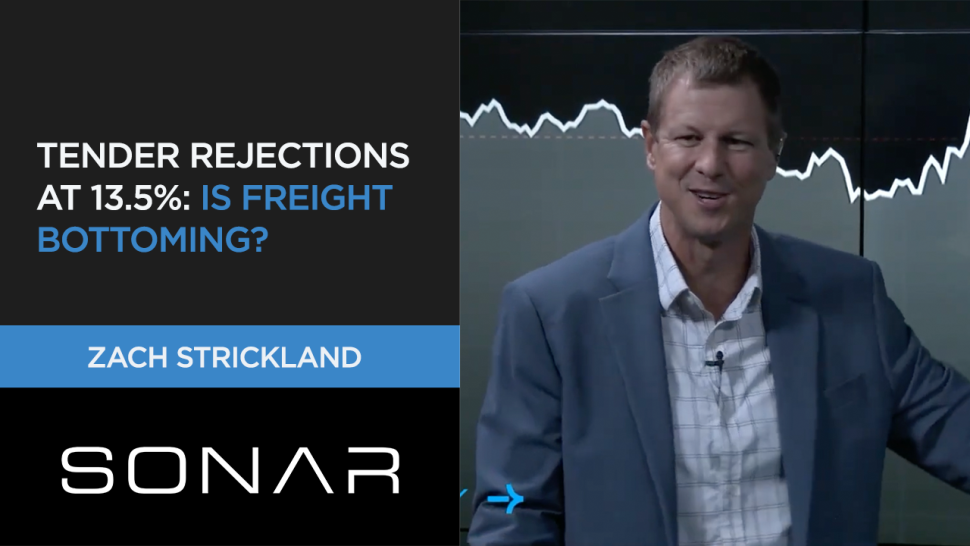
Tender rejections are still running near 13.5% — and that could mean the freight market has found a short-term bottom ahead of Labor Day. In this SONAR update, we break down what stalled rejection declines mean for capacity, why this still looks like a supply-led cycle, how intermodal pulled pressure off truckload this summer, and where dry van, reefer and flatbed spot rates are heading next. If you run a fleet, broker freight or buy transportation, this is the signal to watch right now.
Tender rejection rates have stalled around 13.5% after a July decline, a potential signal that the spot freight market has found a temporary bottom, according to Zach Strickland in FreightWaves’ Thursday SONAR update. The halt in the downward trend matters to carriers, brokers, and shippers because it suggests available capacity has tightened enough to stabilize rejection activity — even as demand has not materially recovered.
Strickland attributed the pause in the July decline largely to modal shifting, with shippers moving freight to intermodal not just as overflow storage but as a deliberate slower-transit option during a period of low urgency. “It’s July, August, not a lot of sense of urgency on that freight right now,” said Strickland, adding that the intermodal shift “seems to have really not made as much of an impact in the last couple of days.”
Looking ahead, Strickland said rejection rates are likely to tick higher into Labor Day — a pattern he called “almost a foregone conclusion” based on the past two years — before the next seasonal floor arrives around October. He expects the pre-Labor Day uptick to be somewhat stronger than it has been over the last three years, citing reduced available capacity and growing urgency as the holiday approaches.
“We’ve got a long ways to go and we probably won’t get there this year,” Strickland said, referring to the roughly 7% rejection rate he characterized as the equilibrium point where capacity stabilizes and rate inflation moderates.
Strickland framed the current cycle as supply-led rather than demand-driven, using SONAR’s Accepted Volume Index alongside the Tender Rejection Index to make the case. Accepted volumes are down over the past five years while rejection rates are up — a combination that points to capacity contraction rather than a demand surge. He noted that carrier earnings reports last year were “abysmal,” with many carriers losing money, which accelerated capacity exits from the market. Regulatory pressure also contributed to the contraction, he said.
On the rate side, dry van spot rates are “falling relatively quick” and flatbed rates are beginning to edge lower, while refrigerated rates are tracking in line with seasonal expectations. Strickland flagged that reefer operators in particular should pay close attention, as spot rates are increasing across a large portion of the country outside the southern tier. Dry van and flatbed lane maps showed a mixed picture, with pockets of rate increases — likely tied to pre-Labor Day demand — amid the broader downward trend.
Strickland cautioned that a meaningful end to the current cycle will unfold slowly unless demand drops sharply. The one demand-side development this summer was volumes falling faster than seasonal norms, driven by freight diverting to rail. For now, the market remains tight by historical standards at 13.5% rejections, still well above the 7% threshold Strickland identified as the point where the market reaches true equilibrium.
- Tender rejections are holding near 13.5% after a July decline, suggesting a potential short-term bottom before a Labor Day uptick.
- The cycle is supply-led: accepted volumes are down over five years while rejection rates are up, reflecting capacity contraction rather than a demand surge.
- Refrigerated spot rates are rising broadly, dry van rates are falling quickly, and the market equilibrium target of ~7% rejections is unlikely to be reached this year.
This Summary is generated thanks to a transcription of the interview, for the full interview please enjoy the video above.
Brokerage Compliance Symposium
The day before F3. Every compliance issue you face - fraud exposure, carrier liability, FMCSA rules, cargo theft, insurance gaps - navigated by attorneys and operators defining best practices in a changing industry.
F3 Awards Dinner
The night before F3. FreightTech100 companies honored. FreightTech 25 and Shipper of Choice winners revealed live. Cocktail reception into dinner and live music - 300 industry leaders in one purpose-built room.
F3: Future of Freight Festival
Industry-defining keynotes, rapid-fire technology demos, and industry leaders networking in experiences across Chattanooga - plus the inaugural F3 Awards Dinner featuring the FreightTech and Shipper of Choice reveals.
The day before F3. Every compliance issue you face - fraud exposure, carrier liability, FMCSA rules, cargo theft, insurance gaps - navigated by attorneys and operators defining best practices in a changing industry.
The Signal at Chattanooga Choo Choo • Chattanooga, TN Register NowThe night before F3. FreightTech100 companies honored. FreightTech 25 and Shipper of Choice winners revealed live. Cocktail reception into dinner and live music - 300 industry leaders in one purpose-built room.
The Signal at Chattanooga Choo Choo • Chattanooga, TN Register NowIndustry-defining keynotes, rapid-fire technology demos, and industry leaders networking in experiences across Chattanooga - plus the inaugural F3 Awards Dinner featuring the FreightTech and Shipper of Choice reveals.
The Signal at Chattanooga Choo Choo • Chattanooga, TN Register Now