




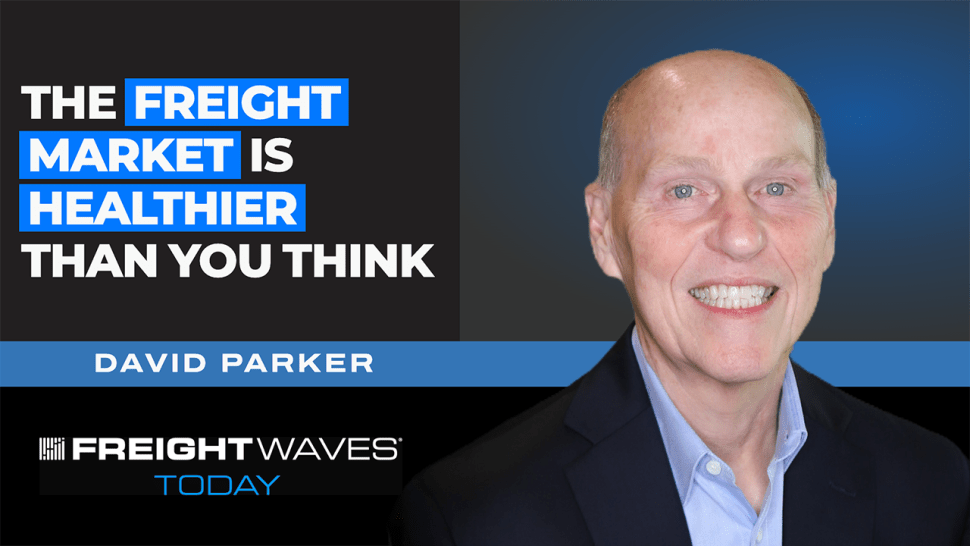
David Parker, CEO of Covenant Logistics Group, discusses the evolving freight landscape, including the impact of emissions standards, the move away from commoditized OTR, and surprising insights into specialized markets like live chicken hauling. He shares his views on the future of electric and autonomous trucks, and how economic factors like GLP-1 drugs are affecting consumer freight.
The U.S. freight market is in better shape than many carriers believe, according to Covenant Logistics Group founder and CEO David Parker. Speaking in a live studio interview, Parker said load-to-truck ratios cooled from roughly 2-to-1 in the first half of 2025 to 1.3-to-1.5 starting in July and August — a shift he called healthier and more sustainable heading into peak season.
“This is not a bad environment and probably a healthy environment — more so than it was in the first 6 months. And so yeah, our customers are really excited about what they’re expecting for peak season,” Parker said.
Parker said the moderation matters because it is still tight enough to support rate increases without triggering a flood of new market entrants. He noted that in the second quarter, most truckload carriers posted double-digit rate increases, yet operating ratios as a group improved only about 1 point because costs rose just as fast. “We need another double-digit rate if this industry’s gonna stay healthy,” he said. Shippers, Parker added, are more focused on securing capacity than resisting rate hikes, provided pricing remains fair.
On the supply side, Parker reiterated that 2% to 3% of industry capacity has already exited and said more is still leaving, crediting FMCSA enforcement for removing bad actors. He said he will be in Washington, D.C., to get an updated read on regulatory activity. Looking further out, Parker forecast a 3-to-4-year supercycle anchored by domestic manufacturing investment and data center construction, with data centers projected to be under development through at least 2032 and servers requiring replacement every 3 to 5 years.
Covenant’s own growth strategy centers on exiting commoditized over-the-road freight — the company has roughly 100 solo OTR trucks remaining — in favor of high-service niches. A notable example is its 2023 acquisition of Lou Thompson, a live-haul chicken carrier that ran about 230 trucks at purchase and has since grown to 800 trucks. The division hauls birds an average of 48 miles from farms to processing centers, primarily in Arkansas, Delaware, South Carolina, and Georgia, where on-time delivery and weight preservation are critical metrics. Covenant’s fleet is now approximately 60% Freightliner and 40% Peterbilt.
Parker identified AI data centers as another high-value target, describing a new partnership with a large international freight forwarder that operates 400 solo trucks but has no experience with team operations. Covenant is working inside that company to match freight and maximize asset utilization. He said team operations must run in the mid-80s operating ratio to generate an acceptable return, a threshold that also requires trading trucks every 18 months due to high mileage accumulation.
On electric vehicles, Parker said Covenant tested Tesla Semis in California with strong results, but questioned the economics at an estimated purchase price of roughly $350,000 compared to $160,000–$200,000 for a conventional truck. “I have not found one customer willing to pay for that electric truck yet — not one, unless it’s California,” he said. He also flagged structural headwinds in food and beverage freight, noting that some bakery customers are reporting volumes down 10%, which he attributed in part to GLP-1 weight-loss medications changing consumer purchasing behavior.
- Load-to-truck ratios eased from ~2-to-1 in early 2025 to 1.3-to-1.5 in July–August, which Parker called a healthier market headed into peak season.
- Covenant’s Lou Thompson chicken-hauling unit grew from 230 to 800 trucks since its 2023 acquisition, with an average length of haul of just 48 miles.
- Parker sees no customer willing to pay for a ~$350,000 Tesla Semi outside of California incentive programs, citing the cost gap vs. conventional trucks.
This Summary is generated thanks to a transcription of the interview, for the full interview please enjoy the video above.
Brokerage Compliance Symposium
The day before F3. Every compliance issue you face - fraud exposure, carrier liability, FMCSA rules, cargo theft, insurance gaps - navigated by attorneys and operators defining best practices in a changing industry.
F3 Awards Dinner
The night before F3. FreightTech100 companies honored. FreightTech 25 and Shipper of Choice winners revealed live. Cocktail reception into dinner and live music - 300 industry leaders in one purpose-built room.
F3: Future of Freight Festival
Industry-defining keynotes, rapid-fire technology demos, and industry leaders networking in experiences across Chattanooga - plus the inaugural F3 Awards Dinner featuring the FreightTech and Shipper of Choice reveals.
The day before F3. Every compliance issue you face - fraud exposure, carrier liability, FMCSA rules, cargo theft, insurance gaps - navigated by attorneys and operators defining best practices in a changing industry.
The Signal at Chattanooga Choo Choo • Chattanooga, TN Register NowThe night before F3. FreightTech100 companies honored. FreightTech 25 and Shipper of Choice winners revealed live. Cocktail reception into dinner and live music - 300 industry leaders in one purpose-built room.
The Signal at Chattanooga Choo Choo • Chattanooga, TN Register NowIndustry-defining keynotes, rapid-fire technology demos, and industry leaders networking in experiences across Chattanooga - plus the inaugural F3 Awards Dinner featuring the FreightTech and Shipper of Choice reveals.
The Signal at Chattanooga Choo Choo • Chattanooga, TN Register Now