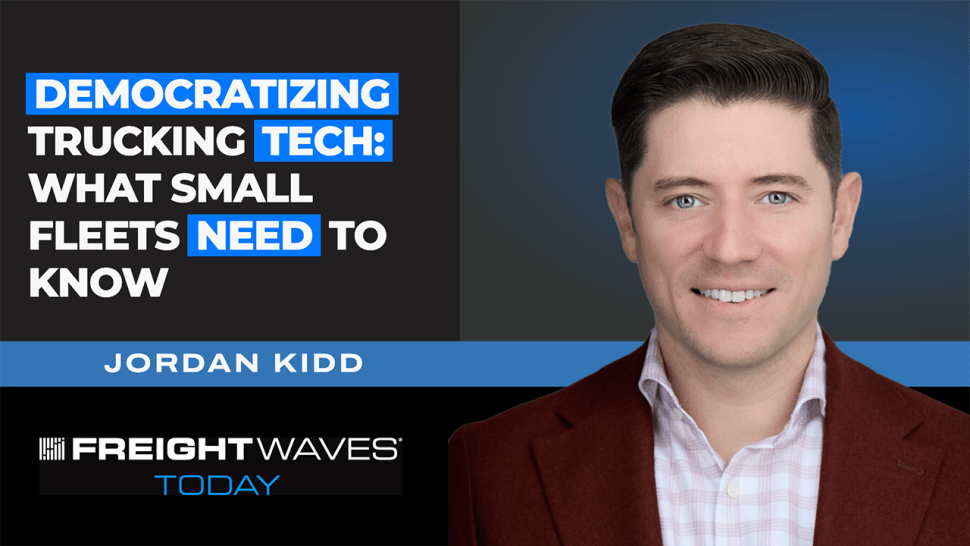
The trucking industry is rapidly evolving, making cutting-edge technology a must-have for carriers of all sizes. Learn how Datatruck is transforming the landscape for small and mid-sized fleets, offering advanced TMS solutions that help them boost profits, cut costs, and gain unparalleled operational visibility. Jordan Kidd, Head of Product at Datatruck, explains why legacy systems are failing to adapt and how AI-native solutions are creating new opportunities for growth and efficiency. Discover how these innovations are democratizing freight tech, ensuring even the smallest operators can scale and thrive without massive overhead.
DataTruck is building a carrier-focused transportation management system aimed at small and mid-size fleets that have historically been priced out of sophisticated software — a segment the company’s head of product, Jordan Kidd, calls “an overlooked space.” The company recently earned a spot on the FreightWaves Freight Tech 100 and is now competing for the Freight Tech Top 25, with an awards ceremony planned at F3.
Kidd argued that running a trucking operation on email, spreadsheets, and QuickBooks is no longer viable for even the smallest carriers. Real-time tracking mandates from shippers and tighter integration requirements from invoice factoring companies are forcing operators to adopt formal software — whether they want to or not. “It’s becoming a requirement to have tracking, real-time tracking,” Kidd said. “There’s just so many parts of the operation that are basically enforcing a requirement for some sort of software.”
The TMS market has long been split between stripped-down free tools for small carriers and enterprise platforms that can cost millions of dollars per year to purchase and operate, Kidd said. AI-assisted development is compressing that gap, making it feasible for a single platform to serve a broader slice of the market. DataTruck’s stated goal is to help a five- or ten-truck fleet acquire software that enables it to scale to 25 trucks — growth that Kidd said “wouldn’t have been possible before.”
“Some of the moat that the large carriers had was systems to undergird customer requirements, driver requirements, just all of the parts of the operation. They could run really well on these large established systems. But as we see technology and TMS progressing, that technology is being democratized down to the smaller carriers.”
Kidd also pointed to the 2017 ELD mandate as a structural inflection point that the TMS industry has largely failed to address in the nearly ten years since. Before the mandate, a TMS was essentially a digital clipboard — a place to log loads, invoices, and driver pay. After the mandate, asset location data began flowing into systems automatically, shifting the architecture entirely. Despite that shift, Kidd said most TMS providers have not reinvented their core paradigm to match the new data flows.
On legacy incumbents applying AI to aging infrastructure, Kidd was skeptical. “I think it’s difficult to take an infrastructure that’s 20 or 30 years old and bolt on AI and really see the value that you need to see out of an AI investment,” he said. He also raised concerns about the proliferation of point-solution AI add-ons — AI billers, AI callers, and similar tools — that bolt onto existing systems but do not share a common data layer, creating integration friction that erodes their individual value.
DataTruck’s pitch centers on being both a system of record and a system of action, with end-to-end cohesion across dispatching, billing, and asset visibility. Kidd framed operational blind spots — such as loads that fall through the cracks when billing responsibilities are shared across multiple staff members — as the kind of margin leak that software can systematically close as a carrier grows beyond the point where a single person can hold all operational context in their head.
- DataTruck is targeting carriers as small as five trucks with a carrier-focused TMS it says can support scaling to 25 trucks, a threshold previously out of reach without costly enterprise software.
- Jordan Kidd says the 2017 ELD mandate fundamentally shifted TMS data flows, but most providers have not updated their core architecture in the nearly ten years since.
- DataTruck is a Freight Tech 100 honoree competing for the Freight Tech Top 25, with winners to be announced at the F3 conference.
This Summary is generated thanks to a transcription of the interview, for the full interview please enjoy the video above.
Brokerage Compliance Symposium
The day before F3. Every compliance issue you face - fraud exposure, carrier liability, FMCSA rules, cargo theft, insurance gaps - navigated by attorneys and operators defining best practices in a changing industry.
F3 Awards Dinner
The night before F3. FreightTech100 companies honored. FreightTech 25 and Shipper of Choice winners revealed live. Cocktail reception into dinner and live music - 300 industry leaders in one purpose-built room.
F3: Future of Freight Festival
Industry-defining keynotes, rapid-fire technology demos, and industry leaders networking in experiences across Chattanooga - plus the inaugural F3 Awards Dinner featuring the FreightTech and Shipper of Choice reveals.
The day before F3. Every compliance issue you face - fraud exposure, carrier liability, FMCSA rules, cargo theft, insurance gaps - navigated by attorneys and operators defining best practices in a changing industry.
The Signal at Chattanooga Choo Choo • Chattanooga, TN Register NowThe night before F3. FreightTech100 companies honored. FreightTech 25 and Shipper of Choice winners revealed live. Cocktail reception into dinner and live music - 300 industry leaders in one purpose-built room.
The Signal at Chattanooga Choo Choo • Chattanooga, TN Register NowIndustry-defining keynotes, rapid-fire technology demos, and industry leaders networking in experiences across Chattanooga - plus the inaugural F3 Awards Dinner featuring the FreightTech and Shipper of Choice reveals.
The Signal at Chattanooga Choo Choo • Chattanooga, TN Register Now