




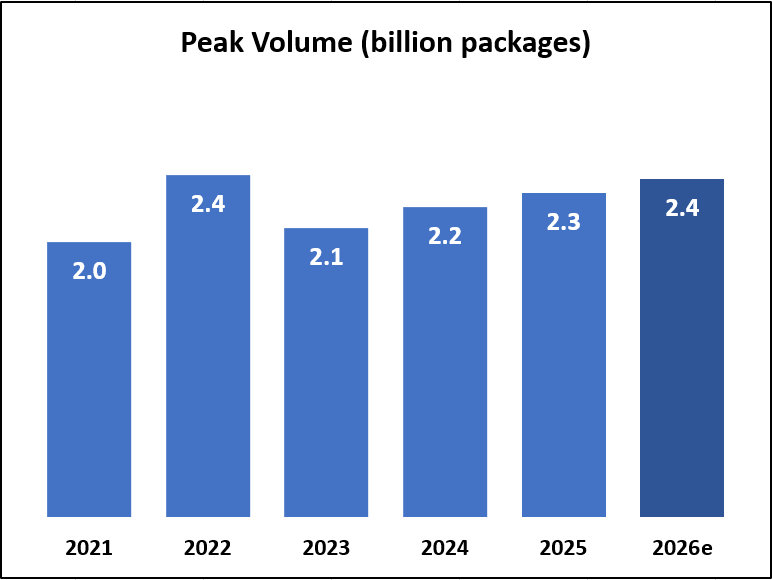
Parcel carriers will deliver about 2.4 billion packages during the current peak shipping season, up 4% from the same period last year, despite high inflation, according to an estimate from ShipMatrix.
The increase in parcel demand is aided by an extra shopping day this holiday season, said ShipMatrix, which helps shippers get more out of their FedEx (NYSE: FDX), UPS (NYSE: UPS) and regional carrier agreements.
The projected volume would be the highest level for the parcel industry since 2022, when the Covid-triggered spike in e-commerce reached its peak.
Consumers have remained resilient so far this year in the face of rising fuel costs and overall inflation, which have diminished discretionary income. But analysts worry that the cumulative impact of tightening household budgets eventually could trigger a pullback in retail sales.
Retailers have also experienced a 16% jump in parcel shipping rates compared to last year, largely driven by broad fuel surcharges, other new fees and general rate increases. Fuel surcharges currently represent about 30% of the transportation rate and most of the spike is the result of carriers adjusting the formula used to calculate the fee rather than the actual rise in fuel costs, according to the latest TD Cowen/AFS Freight Index. FedEx and UPS implemented 5.9% general rate increases this year and recently announced plans to repeat the price increase in 2027.
Higher shipping charges have led some retailers to raise the minimum amount spent at checkout to qualify for free shipping.
UPS recently highlighted how its delivery network is better equipped this year to handle increased volumes thanks to new automation and RFID tracking technology. It said it will hire 100,000 temporary workers, down from 109,000 last year, to help keep packages flowing smoothly through distribution centers. Amazon, for its part, is hiring 300,000 seasonal workers, a 20% increase from last year. The U.S. Postal Service recently said it was ready for the upcoming peak season and plans to hire 10,000 seasonal workers.
The hiring differences reflect UPS’s decision to relinquish 50% of its Amazon (NASDAQ: AMZN) business because it wasn’t making money providing last-mile delivery service, UPS deploying more automated sorting machinery, and the broader shift of B2C parcel volume from legacy carriers to large retailers’ own delivery networks.
UPS has recently concentrated on high-margin, end-to-end logistics services for customers in many industry verticals, leading some to question whether it can maintain the parcel network for those deliveries without the density to offset the costs and generate sufficient margins.
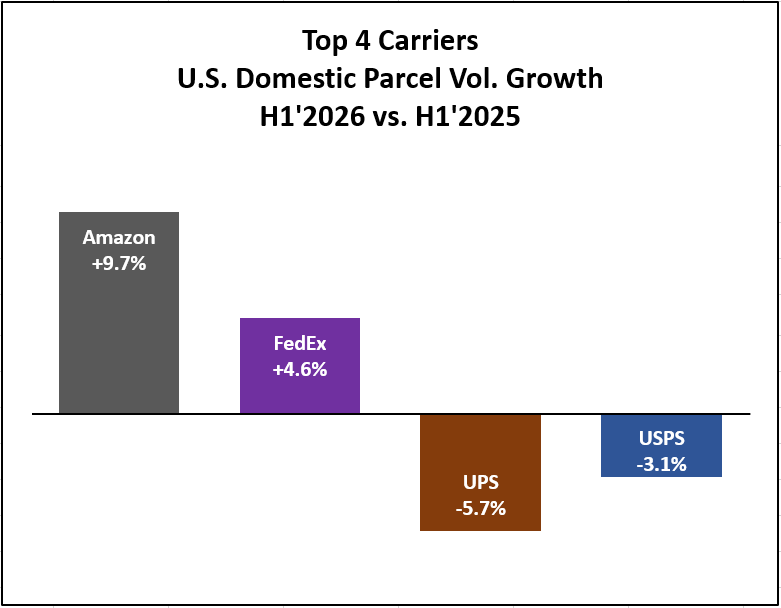
In the first-half of 2026, total U.S. domestic parcel volumes increased for Amazon by 9.7% percent, thanks to the decoupling from UPS and its own delivery expansion into rural areas, according to the ShipMatrix analysis. FedEx volume increased 4.6%.
However, volume for UPS and the U.S. Postal Service decreased by 5.7% and 3.1%, respectively. The volume lost by UPS and USPS was more than the gain by Amazon and FedEx, with those additional 145 million packages being diverted by shippers to private networks of large retailers like Walmart, as well as alternate carriers like GoFo, Uni-Uni, SpeedX, Doordash, Jitsu, Veho, OnTrac, and Better Trucks, who have expanded their coverage area in the past two years, ShipMatrix said.
FedEx and UPS continued to head in opposite directions in terms of volume during the third quarter.
FedEx’s average daily domestic package volume increased 2% during the third quarter, according to its earnings report. Drilling down further, during the past two quarters, average daily domestic volume for FedEx priority and deferred service increased 2.16% year over year, while average daily volume for more economical ground home and commercial delivery increased 3.5%.
UPS reported a 3.3% decline in average daily package volume. Year-to-date daily volume through September fell 4.9% compared to the same period last year.
Click here for more FreightWaves/American Shipper stories by Eric Kulisch.
Write to Eric Kulisch at ekulisch@freightwaves.com.
RELATED STORIES:
U.S. Postal Service prepared for peak season surge
UPS automates 4 additional facilities ahead of peak shipping season
Parcel shipping costs approach record high as extra charges stack up
