





An October survey of supply chain executives confirmed what truckload carriers said on recent quarterly calls—that rates are likely to remain on the rise for the foreseeable future. The Logistics Managers’ Index, released Tuesday, showed further capacity declines alongside surging pricing.
Q3 reports show carriers gearing up for big rate increases
The LMI’s transportation capacity dataset registered a reading of 38 for October, an 11th straight month in contraction, albeit at a pace that was 3.6 percentage points slower than September’s rate of decline. (The LMI is a diffusion index in which a reading above 50 indicates expansion, while one below 50 signals contraction.)
Transportation utilization (63.5) continued to increase, but at a pace that was 2.6 points slower sequentially. Upstream companies (manufacturers and wholesalers) returned a 69.3 utilization reading, which was 16 points higher than downstream retailers.
Transportation prices (88) continued “expanding at a highly significant rate,” but at a pace that was 4.7 points slower. (Diesel fuel prices were down 1% sequentially during the month, up 70% y/y.)
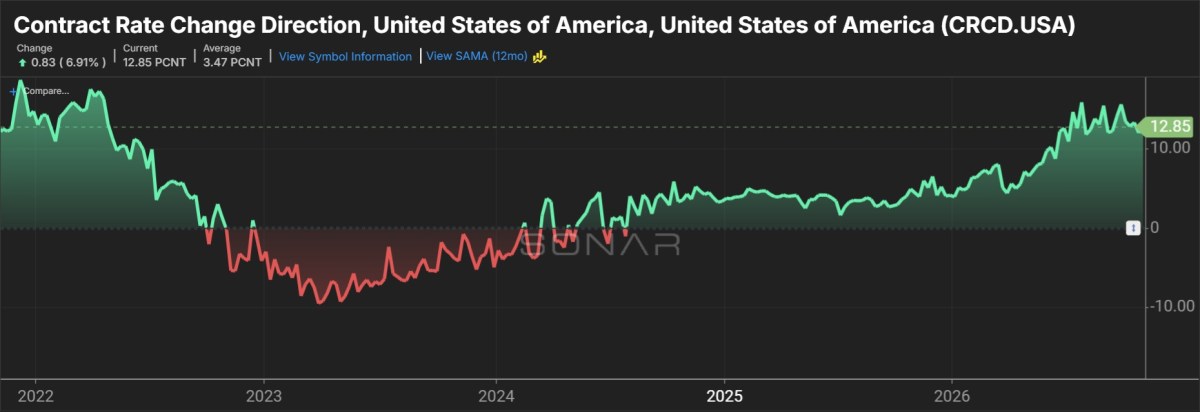
While cost pressures tamped down truckload carriers’ earnings in the third quarter, the group expects to capture double-digit rate increases in the upcoming bid season.
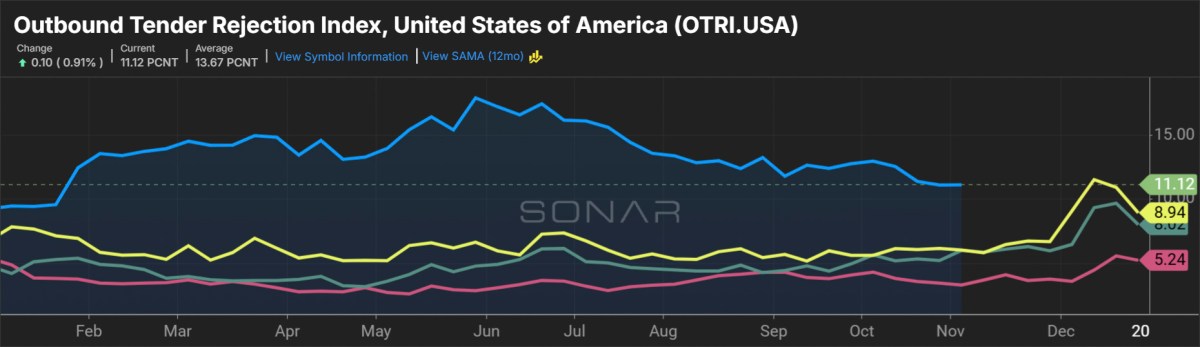
Knight-Swift Transportation (NYSE: KNX), which has roughly 70% of its TL fleet operating under non-dedicated agreements, is targeting “at least double-digit [rate] increases” in annual contractual negotiations that just began. The company decided to lean into the spot market earlier this year, which led to tender rejections that were two to three times higher than the industry average during the third quarter.
A widespread crackdown on noncompliant capacity has carriers betting that the recovery is just beginning. Some carriers recently said that they would look to grow their one-way fleets after years of repositioning this equipment under dedicated agreements or disposing of it altogether in order to improve asset utilization.
Logistics managers surveyed expect the transportation market to remain very tight over the next 12 months, returning future readings of 49.3 for capacity, 67.6 for utilization and 90 for pricing. While the group now expects capacity contraction to slow over the next year (September’s outlook on capacity was 37.9), it expects transportation rates to surge faster (pricing forecast up 3.9 points sequentially).
Inventories up on hopeful holiday expectations
The overall LMI (70.7) was up 50 basis points in October to the second-highest level in over four years. June’s 71.1 reading was the highest level recorded over that period. Year-to-date, the index average is the second-highest in the dataset’s 10-year history, and approximately 9 points above last year.
October inventory levels (66.9) jumped 8 points from September, logging the fastest growth rate in four years. A 72.1 growth rate in the second half of the month was approximately 10 points higher than the first half.
“After a year of playing things very cautiously due to doubts about the consumer and the high costs of tariffs and transportation, firms are now pulling inventories in as quickly as they can – often at high costs – in an effort to capitalize on what they hope will be a blockbuster holiday season,” the report said.
Knight-Swift said it is seeing the most peak-season project freight in its network since the pandemic.
Inventory Costs (88.8) increased 8.9 points to the highest reading for the dataset since March 2022.
The change in inventories was evident in the warehousing metrics.
The rate of decline in warehouse capacity (43.5) slowed 4.2 points, but remained firmly in contraction territory. There was no change to capacity in January and February; however, the index has contracted in six of the past eight months. Upstream companies reported severe contraction (37.5) while downstream firms saw no change in space availability.
Warehouse utilization (58.8) increased at a rate that was 5.5 points slower, but warehouse prices (80.7) surged 7.2 points.
Aggregate logistics costs (inventory, warehousing and transportation) totaled 257.5, up 11.4 points sequentially, and the fastest growth rate since March 2022—the end of pandemic-fueled consumer spending and the start of the war in Ukraine. The all-in costs index was 55 points higher year over year in October.
The LMI is a collaboration among Arizona State University, Colorado State University, Florida Atlantic University, Rutgers University and the University of Nevada, Reno, conducted with the Council of Supply Chain Management Professionals.
Why it matters? The Logistics Managers’ Index provides a look at all major supply chain costs. The latest report signals a difficult operating environment for shippers characterized by limited capacity and rapidly rising costs.
