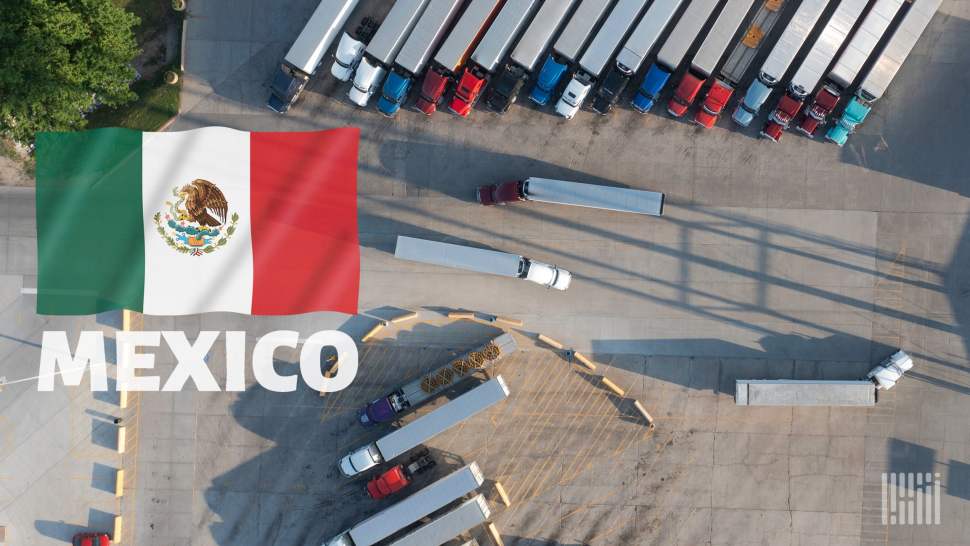
Mexico has begun construction on a 645-acre intermodal cargo terminal in Cancún that will link to the country’s $7.5 billion Interoceanic Corridor of the Isthmus of Tehuantepec (CIIT).
The $430 million Cancún Multimodal Terminal will be the first cargo facility along the Mayan Train, the massive rail project connecting Chiapas, Tabasco, Campeche, Yucatán, and Quintana Roo.
While the train’s primary aim is boosting tourism, officials say freight operations like the Cancún terminal will help spur regional economic growth.
Plans for the terminal include 28 support facilities, such as public and bonded warehouses, hazardous waste storage, fuel stations, truck access booths, and weigh stations.
Mexico’s Secretariat of Environment and Natural Resources approved the project’s environmental impact permit on Sept. 1.
Additional multimodal cargo hubs are slated for Palenque, Poxilá, and Progreso, with freight including fuel, steel, cement, grains, perishables, and automobiles expected to move through the network.
The long-term goal is to connect the Mayan Train system with the CIIT to streamline cargo flows across Mexico and into the U.S.
The CIIT project is upgrading a 188-mile rail line across the Isthmus of Tehuantepec, the country’s narrowest point between the Gulf of Mexico and the Pacific Ocean. Once complete, it could handle up to 1.4 million TEUs annually, offering shippers an alternative to the Panama Canal by linking the ports of Coatzacoalcos and Salina Cruz.
“This is a very important project,” Mexican President Claudia Sheinbaum said in June. “The southeast was the least connected region of the country. Now, the interoceanic corridor not only links Veracruz and Oaxaca, but also connects the Pacific and Atlantic oceans — an alternative to the Panama Canal.”
The CIIT will feature 10 inland ports to attract shippers serving U.S. East and West Coast markets. Several rail sections are already operating, moving more than 514,000 tons of cargo last year. Full completion is expected by 2026.
Still, the Cancún project has drawn backlash from environmentalists, including Greenpeace Mexico, which warns that clearing 645 acres of rainforest threatens 12 native species.
Brokerage Compliance Symposium
The day before F3. Every compliance issue you face - fraud exposure, carrier liability, FMCSA rules, cargo theft, insurance gaps - navigated by attorneys and operators defining best practices in a changing industry.
F3 Awards Dinner
The night before F3. FreightTech100 companies honored. FreightTech 25 and Shipper of Choice winners revealed live. Cocktail reception into dinner and live music - 300 industry leaders in one purpose-built room.
F3: Future of Freight Festival
Industry-defining keynotes, rapid-fire technology demos, and industry leaders networking in experiences across Chattanooga - plus the inaugural F3 Awards Dinner featuring the FreightTech and Shipper of Choice reveals.
The day before F3. Every compliance issue you face - fraud exposure, carrier liability, FMCSA rules, cargo theft, insurance gaps - navigated by attorneys and operators defining best practices in a changing industry.
The Signal at Chattanooga Choo Choo • Chattanooga, TN Register NowThe night before F3. FreightTech100 companies honored. FreightTech 25 and Shipper of Choice winners revealed live. Cocktail reception into dinner and live music - 300 industry leaders in one purpose-built room.
The Signal at Chattanooga Choo Choo • Chattanooga, TN Register NowIndustry-defining keynotes, rapid-fire technology demos, and industry leaders networking in experiences across Chattanooga - plus the inaugural F3 Awards Dinner featuring the FreightTech and Shipper of Choice reveals.
The Signal at Chattanooga Choo Choo • Chattanooga, TN Register Now