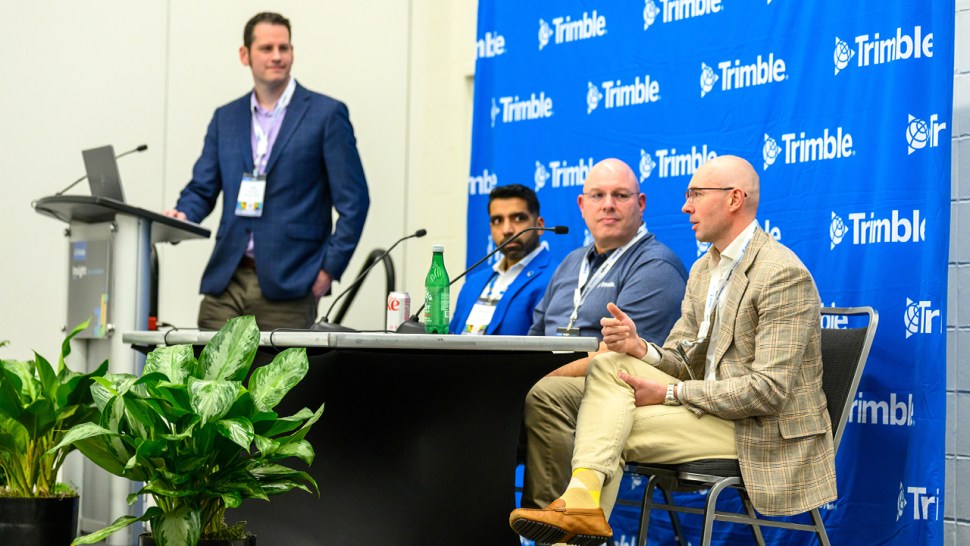
NEW ORLEANS–It was toward the end of a panel at the Trimble Insight conference here that the three executives pondering AI’s future needed to confront the elephant that waddled into the room.
After discussing various approaches and philosophies companies should pursue in deciding how to implement AI in the operations of their various transportation companies, the question on everybody’s minds emerged: what is this going to mean for employment?
Jonah McIntire, chief product and technology officer at Trimble who came to Trimble through its acquisition of Transporeon, pulled no punches in his response.
“I think it’s going to be a jobs apocalypse,” McIntire said.
McIntire tried to describe the change in terms of what humans can do versus what AI can do.
He likened what he called the “current generation of AI tools” as being “like 18-year-olds. They’re pretty intelligent, they have no work experience, and they need to be supervised at a fine grain level. Like you could give them a task for up to an hour.” After that hour is up, McIntire said, a manager would need to check in on them.
Equating AI to workers’ age groups
But the progress that is being made with those tools means that a year from now, the AI process might need to be checked only once a day, so the AI tool is more like a 24- or 25-year old employee with a few years under their belt. Next up would be AI mimicking a 30-year-old employee that needs to get checked on just once a week, McIntire said.
“It’s going to happen pretty fast, and it costs a fraction of a human worker,” McIntire said. “Plus it’s diligent, it doesn’t need to have constant job promotions to stay motivated.”
“I don’t see why this doesn’t turn into a significant reduction in jobs in our industry,” McIntire added.
He put numbers behind his theory. Total expenditures in logistics increases about 3% to 4% a year on average, he said. “Is AI more efficient than 3% or 4%?” McIntire asked. “Yes. So where is that efficiency going to be absorbed? It’s going be absorbed by a reduction in costs. How does that translate? It’s a reduction of people.”
(C.H. Robinson (NASDAQ: CHRW) was only mentioned by name briefly during the panel, but it is the poster company for a logistics operation that has embraced AI, seen its profitability rise and cut its workforce, the specifics of which are disclosed publicly each quarter in its earnings release. Here’s a chart of what has happened to the employee pool at the company).
Eric Lambert, the vice president for legal and employment counsel for Trimble (NASDAQ: TRMB), addressed how companies need to face up to the fact that employees, looking over the future, are going to be legitimately concerned about how they might be hit by the AI wave.
“If you want to realize those efficiencies from AI, you need your employees to buy into it,”: Lambert said. “If they think AI is coming for their jobs, they’re going to be ambivalent and actively resist it.”
Management’s goal, Lambert said, should be to “position it with your workforce such that they understand this is a net benefit for the business, and they should do everything to find opportunities to reskill and upskill.”
If that is handled the right way, he added, “ I think a lot of employees will view that as a net positive. You’ve gotta have people buy in.”
Asking the right questions
Lambert also said there are companies looking at the use of AI that are “starting with the question of, what can we do with AI? I don’t think that’s the right question.”
Instead, Lambert said, the question needs to be “what business problems am I trying to solve, and how can I use data to solve it. Because really, it’s a data-driven solution.”
Once that question is answered, Lambert said, there needs to be a combination of uses–he cited the Gemini generative AI solution as an example–with “a wealth of training on how to use it effectively.”
“It allows people to be more efficient and generate better answers,” Lambert said. “It is an accelerant. It multiplies efficiency.”
“For years, everybody said ‘do more with less,’” Lambert said. “Now it’s ‘do more with AI,’ and you can leverage a tool like generative AI to do that.”
McIntire stressed that the latest iterations of generative AI are “not data intensive.” He contrasted that with systems of machine learning, which he described as more data intensive because they can not do the sort of thinking-like processes that AI can.
“You can ask AI for a joke about a wagon going to California and it will invent one,” McIntire said. “That is not the same as machine learning, which is essentially looking for patterns or seeking outcomes via processing of data. (AI) is creativity and intelligence.”
Clean up that data
Shaman Ahuja, the deputy CEO of Optym, whose primary offering is greater efficiency in transportation planning, noted the need for “clean data” to make AI work efficiently. But he also stressed that having clean data is “not a one time exercise. It’s more of a cultural shift.”
“It’s not like the data is clean, now I’m good for the next 10 years,” Ahuja said.
Even if the data is clean, Lambert said there may not be enough of it for AI to be fully utilized.
“Companies are looking to see what data-driven insights can they generate from the data they have,” Lambert said. “But they need to step back and look at the data they need.”
Many companies lack the data needed to fully take advantage of AI’s capabilities, Lambert said. “They need to create a map of where they have data, where there are gaps, and then figure out how can you partner within the data ecosystem to ensure you’re fleshing out the data you have available to generate those insights and and and results that you need from AI.”
Since many companies are not in that sweet spot of clean and full data to most efficiently utilize AI, Ahuja said that has directed investment toward capabilities that don’t require such a full load of data. “So what we’re seeing is investment in areas like routine tasks, call a driver, inform them of the load, call a broker, get a quote,” he said “These things don’t really rely on having your entire EMS having perfect data and that’s where it’s making the biggest impact right now.”
More articles by John Kingston
Beautiful women, open doors and drivers: trucking cybersecurity risks proliferate
Likely 1st AB5 trucking enforcement action in California snags 3 companies
Trucking takeaways from Trimble: volume down, driver population sliding
Brokerage Compliance Symposium
The day before F3. Every compliance issue you face - fraud exposure, carrier liability, FMCSA rules, cargo theft, insurance gaps - navigated by attorneys and operators defining best practices in a changing industry.
F3 Awards Dinner
The night before F3. FreightTech100 companies honored. FreightTech 25 and Shipper of Choice winners revealed live. Cocktail reception into dinner and live music - 300 industry leaders in one purpose-built room.
F3: Future of Freight Festival
Industry-defining keynotes, rapid-fire technology demos, and industry leaders networking in experiences across Chattanooga - plus the inaugural F3 Awards Dinner featuring the FreightTech and Shipper of Choice reveals.
The day before F3. Every compliance issue you face - fraud exposure, carrier liability, FMCSA rules, cargo theft, insurance gaps - navigated by attorneys and operators defining best practices in a changing industry.
The Signal at Chattanooga Choo Choo • Chattanooga, TN Register NowThe night before F3. FreightTech100 companies honored. FreightTech 25 and Shipper of Choice winners revealed live. Cocktail reception into dinner and live music - 300 industry leaders in one purpose-built room.
The Signal at Chattanooga Choo Choo • Chattanooga, TN Register NowIndustry-defining keynotes, rapid-fire technology demos, and industry leaders networking in experiences across Chattanooga - plus the inaugural F3 Awards Dinner featuring the FreightTech and Shipper of Choice reveals.
The Signal at Chattanooga Choo Choo • Chattanooga, TN Register Now