




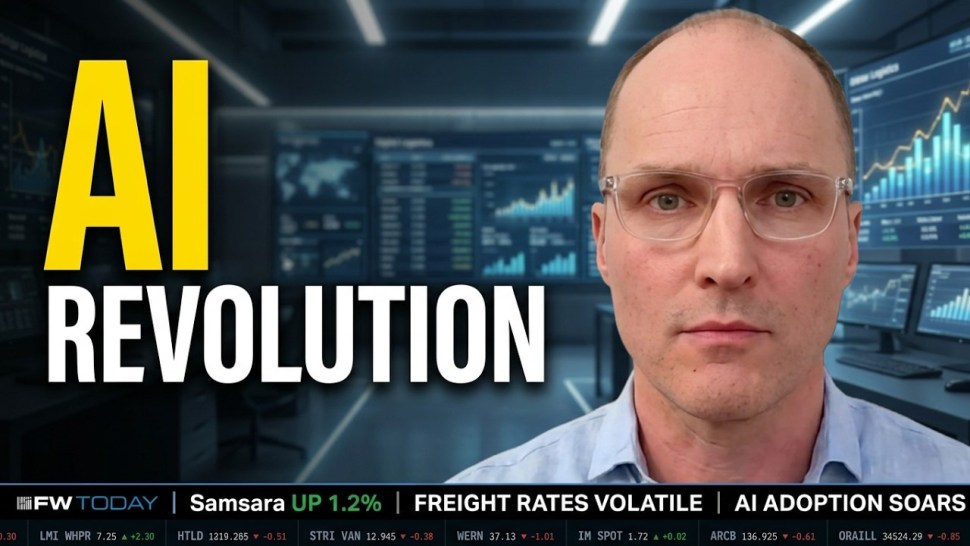
Adrian Smith, CEO of Ripple, discusses how AI is revolutionizing supply chain operations, driving efficiency and freeing up valuable resources. Learn about the real-world impact of their AI solutions, including a 95% reduction in manual effort for a key client. Discover how businesses are leveraging generative AI for audit, vendor, and incident management across vast global networks.
Ripple, a UK-based agentic AI startup, has partnered with JAS Worldwide to automate compliance workflows across the freight forwarder’s global network of more than 100 countries and 500 locations. The deal targets audit management, incident management, vendor onboarding, and ESG reporting — functions that JAS leadership is repositioning from administrative cost centers into revenue protection and customer retention tools.
The partnership reflects a broader push by large logistics providers to eliminate manual overhead in governance and compliance operations. For JAS, that means replacing spreadsheet-based audits, manual document reviews, and fragmented policy tracking with an automated platform built on what Ripple describes as a modular enterprise-grade architecture developed over more than 20 years.
The scale of efficiency gains Ripple cites is notable. A drayage client operating across 10 terminals in Houston reported that a quote-to-cash workflow that previously consumed 95% of staff time now consumes just 5%. Separately, freight forwarder Pendragon Freight Services was able to redeploy 20 staff members away from manual customs extraction, classification, and submission to customer-facing revenue work after implementing Ripple’s platform.
“What used to take us 95% of their time now is taking up 5%, and they’re off and driving further revenue with that spare time,” said Ripple co-founder Adrian Smith, relaying feedback from the Houston drayage client.
Smith said Ripple operates on two-week development and user-acceptance-testing cycles, allowing the company to deploy customized solutions — not off-the-shelf products — within weeks of signing a new customer. The company is currently running iterative build waves with JAS under that same cadence, according to Smith.
On the question of AI energy consumption — a tension for a company selling ESG compliance tools — Smith said Ripple actively caps token usage to minimize both cost and environmental footprint. “We restrict that and optimize the use of AI so that the energy consumption and also the token cost is minimized for our customers,” he said, adding that unchecked “vibe coding” by enterprise technology teams has driven exponential token growth industry-wide.
Ripple remains bootstrapped with no outside investment, with Smith describing the U.S. as its primary market. The company did not disclose revenue figures or contract values. Smith said the company would consider external funding only if growth demands it, noting that staying self-funded has allowed the team to remain focused exclusively on customer needs rather than investor priorities.
- Ripple’s AI platform cut manual workflow time by 95% for a Houston drayage operator running across 10 terminals, and freed 20 staff at Pendragon Freight Services from manual customs work.
- JAS Worldwide is deploying Ripple across audit, incident, vendor, and ESG functions spanning 100-plus countries and 500 locations, targeting compliance as a revenue protection tool rather than a cost.
- Ripple uses two-week development and UAT cycles to deliver customized implementations and actively limits AI token usage to control both cost and energy consumption.
Speaker 1 [0:00] We’re going to talk AI and supply chain. Supply chains are being disrupted, but also are primed for disruption through AI. Adrian Smith is the co-founder of Ripple, a company that is implementing AI agentic solutions across the entire supply chain. Welcome, Adrian. Welcome to FreightWaves Today.
Speaker 2 [0:20] Pleasure to be here, Craig and Julie. Thank you so much for having me as a guest.
Speaker 1 [0:25] We’re excited to have you. AI is obviously a big topic. There’s both the demand, as we talked on earlier on the show, that it’s driving, ’cause these AI data centers are a big piece of it, but also supply chains and logistics and forwarders are implementing AI to improve their operations. You guys are at the forefront of that. You got a big announcement with JAS. Tell us about what the news is.
Speaker 2 [0:49] So thank you for teeing us up. We are absolutely thrilled to be able to be partnering with Jazz Worldwide and focusing specifically on a space of QHSE, audit management, incident management, vendor management, and ESG reporting with EIMS. Now, this is essentially supporting a visionary strategy that Jazz are implementing where that function within the organization does not necessarily have to be an administrative or compliance cost. But rather with the right governance from JAS and the right structures and technology that we are partnering with them to deliver, it becomes a revenue protection mechanism and a growth engine. You know, they’re attracting new customers, new high-value customers, and retaining those governance and compliance-focused customers that they have. So it’s a real visionary leadership from JAS that we are supporting on that journey.
Speaker 3 [1:49] Adrian, can you tell us kind of exactly what workflows Ripple is actually taking over?
Speaker 2 [1:56] Yeah, so we’re looking at helping them with their audit management. So internally understanding how they can structure their internal audits and external audits through an automated platform that takes out the manual effort associated with that, tracking in spreadsheets, manually auditing documents, issuing policies, etc., and adhering and managing the compliance within staff, etc., within the organization. We’re also looking at their supply chain management and onboarding. So their whole vendor network across over 100 countries, 500 locations for Jazz worldwide, and all of the suppliers that are providing valuable service to Jazz, making sure that that relationship is de-risked by understanding things like the dangerous goods certification, insurance documentation, et cetera, et cetera. And we go on to incident management within the organization Jazz has globally. So understanding when an incident happens, how that’s properly triaged, investigated, and then lessons learned from that, which obviously then enhance the quality of the organization because near misses, for example, are indicators of accidents. If you avoid accidents, then the culture of the organization improves and improves. And that’s a great metric that Jazz have asked us to keep track on. But this over 100 countries, managing that through manual processes, and expert people takes up a lot of their time. So what we’re partnering with Jazz on, and they’ve been, again, I say visionary in leading this charge, is freeing up that talented resource to focus on real customer value for Jazz’s customers, which really enhances their reputation in the market, and we’re happy to support them on that.
Speaker 1 [3:36] Adrian, quality, health, safety, and the environment, QHSE, is a term that, you know, American audiences may not be familiar with, but it’s been something that, particularly in the UK, has been moving even before ESG. You know, these are controversial— shouldn’t be, but they’re controversial terms in the United States that become sort of polarizing and lightning rods for attention. Tell us a little bit about why this is important for particularly European and global organizations more so than maybe it gets the appreciation in the United States.
Speaker 2 [4:10] Sure. And you’re right, Craig, to break that down. So there are many different aspects to QHSE, but fundamentally it’s about quality, And it’s quality from the context of avoiding, as I mentioned, those incidents within an organization. So is your operation being run in a qualitative manner? Are you providing the right service to your customers globally, necessarily in the EU or the UK? And then also from an audit perspective, making sure that you have the right policies in place to then support and be a foundation for that quality. The environment or the ESG aspect of that is also making sure that you’re open and honest about what you’re doing. from an environmental perspective, a social and governance aspect, but having the data there, often large organizations struggle with having to aggregate that data, manage it, and understand what it’s telling them. Now, if you’re doing that globally across the scale that Jaz have across 100 countries, 500 locations, it becomes very challenging. And I mean, I’m a big advocate of Lean Six Sigma. And as soon as variation creeps into any business process, whether it’s your quota cash, whether it’s your customs compliance, or whether it’s QHSE or the ESG aspect, there is rework inserted. I think the lean technical term is Jidoka, right? You have to stop it as soon as you find an issue, improve it, and then move on from that. And I think that’s what we are trying to support, Jaz, across all of those different processes, including the ESG aspect. And it’s all about data management and informing decisions based on that data.
Speaker 1 [5:42] There’s been a lot of conversation about the environmental impact of AI data centers. You guys are implementing AI or helping companies implement AI. There’s, feels like a little bit of con— I wouldn’t say a contradiction, but how do you balance this conversation from a UK perspective of what the impact of AI data centers are on the overall environmental footprint, but still are delivering solutions to help companies achieve compliance?
Speaker 2 [6:09] Sure, I mean, it’s a great question. And I think there have been various conversations around the consumption of energy, And the use of data centers and particularly certain types of chip consuming energy. But what we do at Ripple, we have 3 main focus points for our AI platform. It is agentic AI, but we build it on top of a modular enterprise-grade technical architecture that we’ve been building for over 20 years. And what that enables us to do is to control the AI. We put strict controls in the process as it develops, and that means We control, as everybody will know these days, hallucination, which is essentially variation in AI, but also the use of AI itself. We’re agnostic to the model that we use. And as soon as AI starts to become token hungry and starts consuming lots and lots of what would be, in your question’s context, data center usage, we restrict that and optimize the use of AI so that the energy consumption and also the token cost is minimized for our customers. So we’re very focused on controlling AI use to only when it’s needed. Now, any organization out there that has enabled their technology team to start vibe coding will have felt the pain of exponential growth in token usage, and that correlates directly to that energy consumption in the data centers that you mentioned, Craig. But our fundamental— one of our key fundamental focuses is on controlling that AI both from a token cost But also, energy is a byproduct of that.
Speaker 1 [7:40] Yeah. So it’s just— I mean, there’s been so much of the— there’s been these great stories. I don’t know if they’re great for the companies having to pay them. But essentially, these sort of ghost processes in the machine, if you will, that are sort of left there on auto, but they’re not generating any sort of outcome. But companies, by default, are burning through tokens. Is really the goal here, as part of the way you guys are viewing compliance with QHSE is really about just making sure that the processes that are driving are actually achieving outcomes. Is that the primary goal?
Speaker 2 [8:16] Yeah, I mean, I think it’s twofold. It’s ensuring that we’re enabling Jazz to scale their organization in order to meet those customer demands and making sure that their customers have the right surety and data to help in those business processes. But also, it is ensuring that we have the right technology in place that enables scaling of that because it’s a critical key aspect for Jazz’s focus.
Speaker 1 [8:43] So what about— one of the things I’m curious to get your take on is building an AI startup in Europe. And we’ll call it— sorry, I know that you’re not in Europe. You’re in the UK. And I know that that could be a lightning rod for our fellow British fans. But, you know, the environment, particularly the funding environment, is quite different. What is it like for you as founder of this business in terms of these businesses are capital intensive? Are you coming to the United States to raise venture capital? What does that look like for you guys?
Speaker 2 [9:15] Well, I mean, we are currently absolutely focused on our customers because one of our key tenets in the organization is understand exactly what the customer needs and deliver that with a white glove service treatment. We are in the States. We’re working across a huge number of locations across the States already. And our focus at the moment is delivering that value. We haven’t— we bootstrapped to date and we haven’t taken on any funding. And at the moment, what we’re doing, especially with our partnership with Jazz, is focusing on driving that value for the customer to their specific requirements. Because a lot of our conversations with our customers have focused on off-the-shelf platforms not giving them exactly what they need. So our key focus is actually delivering their specific requirements because everybody’s nuanced in how they deliver these systems and then giving that value to our customers so that our product is absolutely right for them. And that’s kind of our mantra going forwards. If at some point in the future we then need to look at investment, we’re, as I said, we’re already working across the States. It’s our key market at the moment and we’ll make that decision as it comes along.
Speaker 1 [10:22] Well, I think the great thing is you can fund it through cash flows of revenue. That’s always the least dilutive and frankly keeps you in charge as founder. Someone who’s raised venture capital, I can tell you I’m a little jealous of founders that are able to self-fund because just, you know, it’s your business and you’re in control. And I think that’s pretty remarkable and admirable.
Speaker 2 [10:45] It enables you to focus exactly on your customer rather than be distracted by a paymaster as well, I find.
Speaker 1 [10:51] Yeah, for sure. I mean, it’s quite different. I think in the US, it may be a little bit easier to raise venture capital than in the UK. I think it’s also, maybe it’s more acceptable in the US from just a perception standpoint. I think customers here, there’s no judgment. Whereas my understanding, talking to European and British and really businesses that are not based in the States, there’s almost a narrative to it. raising outside investors versus it being your business. It just creates a little bit more optics for customers, whereas here it’s totally socially acceptable, maybe even expected that companies do it.
Speaker 2 [11:28] As soon as I need it, don’t you worry, I’ll be out there knocking on the door.
Speaker 1 [11:32] We’ll welcome you with open arms here in the United States. Our venture capital markets are open. VCs love funding AI companies. So Adrian, consider America open for business. And open for investment. And we promise we’re not going to judge you for taking venture capital. We will support you.
Speaker 2 [11:50] Well, I don’t worry. I won’t be, uh, worried at all about judgment. As long as it gives me that liquidity and I’m off, that’d be great.
Speaker 1 [11:57] It’s great for investment.
Speaker 3 [11:58] So Adrian, I wanna talk a little bit more about the product. And you, uh, have said that Ripple can cut manual effort by 95%. How do you actually measure that kind of improvement, um, and, and show those results to your customers?
Speaker 2 [12:11] Sure, great question. I mean, the results typically come from our customers. So that exact metric came from a drayage client of ours down in Houston who operate across 10 terminals, who we helped with a quote-to-cash process. And they came back to us and said, you know, what used to take us 95% of our time now is taking up 5%, and they’re off and driving further revenue with that spare time. And it’s released those really bright, sharp individuals who know the business inside and out to then go and focus on driving that top line of their balance sheet, which is a great accolade for them. And equally, we’ve got a freight forwarder, Pendragon Freight Services, who we’re running a customs extraction and submission process for. They were able to release 20 of their staff to focus on driving revenue. And these are expert freight forwarder, people who’ve got decades of experience previously doing a lot of manual admin on customs extraction, classification, and submission are now able to focus on that customer value, which is a real key catalyst for growth in these organizations.
Speaker 3 [13:24] So speaking of that value, you’ve said the goal is speed to value, not necessarily a multi-year build. So when you sign a new deal with someone like Jaz or a new customer, how quickly do they actually start seeing results and what does that process look like?
Speaker 2 [13:40] So, I mean, we, as I mentioned, have built this platform over 20+ years. I’ve been deploying enterprise-grade software and my technical team have been doing the same for over 20 years. And what we’re able to do is leverage agentic AI now to create a speed not only just an off-the-shelf product, but a customized product for our clients within weeks. So we’re going through that exercise now with Jazz, and iterative waves of requirements are coming in, and we have a 2-week development and UAT cycle where we’re able to deploy this to exactly their requirements in that kind of timeframe. And, you know, they’re thrilled and are hugely supportive in giving us the right level of detail that we need so that we can then accelerate those build cycles accordingly.
Speaker 1 [14:33] Adrian, I gotta ask, we cover a lot on FreightWaves today about AI, the AI question is the, is this a bubble? I think everyone’s sort of wondering. Make your case on why AI is not a bubble, unless you believe it’s a bubble, we’ll accept that as an answer. But I suspect you don’t believe it’s a bubble, but love to get your take on it.
Speaker 2 [14:52] I think, I’ve heard the stories about AI being a bubble, but I think anybody who has deployed AI, particularly into operations, and have seen the operational benefit in the time that it is released, and then the peripheral benefits around revenue generation from staff being released from some of these burdensome activities to actually focusing on some of the value-add, aspects that they’ve always been skilled to do, but were possibly not able to focus on. And then the beneficial downstream impact is they actually are starting to enjoy what they’re doing more because it’s that sort of more face-to-face client engaging aspect. I think those things to me say that the benefits of AI aren’t going to go away, whether you call it a bubble, whether there’s some hype in some of the the models that have been developed rather than the specific use cases. I don’t know, but the use cases we see, the benefits are undeniable, and I don’t think they’re going to go away.
Speaker 1 [15:58] So, Adrian, the last question we have for you is, okay, so corporations are trying to implement AI. I think management teams would like to move a lot faster than even the comfort of their own people. What do you see in terms of how can management Really bridge the gap to where the teams will embrace the technology versus sort of feel like it’s the fear that it’s going to replace them?
Speaker 2 [16:20] I think you— there’s any change management exercise you need to communicate with your staff, right? You need to understand what motivates them. You need to make sure that you communicate why you’re doing this. And often if you sit down with staff and tell them this is actually to empower you rather than take away a job, we don’t see that at Ripple. We see that this is actually going to help Certainly the logistics companies that we’re working with drive top line. And I, from my— I worked at General Electric way back in my past, great company, great US company. And I think one of the— it was Jack Welch has an adage where he was talking to one of his work assembly line staff and they were talking about adopting Lean Six Sigma. I think it may have been workout at the time, an improvement technique. And he said, you know, for 20 years I’ve been using my hands, my brain came for free. It’s the first time I’ve been asked. But actually, If you engage with your staff, those guys are the ones where, where they, or they know where the actual pain points are, and you tap into that knowledge, then you can release the pain, which motivates them, and it just becomes exponential benefit for your business.
Speaker 1 [17:26] Well, Adrian, really appreciate your time here. We’re gonna keep an eye on this AI conversation and have you back. Best of luck as you implement JaaS as well as just overall helping solve automation. Appreciate it.
Brokerage Compliance Symposium
The day before F3. Every compliance issue you face - fraud exposure, carrier liability, FMCSA rules, cargo theft, insurance gaps - navigated by attorneys and operators defining best practices in a changing industry.
F3 Awards Dinner
The night before F3. FreightTech100 companies honored. FreightTech 25 and Shipper of Choice winners revealed live. Cocktail reception into dinner and live music - 300 industry leaders in one purpose-built room.
F3: Future of Freight Festival
Industry-defining keynotes, rapid-fire technology demos, and industry leaders networking in experiences across Chattanooga - plus the inaugural F3 Awards Dinner featuring the FreightTech and Shipper of Choice reveals.
The day before F3. Every compliance issue you face - fraud exposure, carrier liability, FMCSA rules, cargo theft, insurance gaps - navigated by attorneys and operators defining best practices in a changing industry.
The Signal at Chattanooga Choo Choo • Chattanooga, TN Register NowThe night before F3. FreightTech100 companies honored. FreightTech 25 and Shipper of Choice winners revealed live. Cocktail reception into dinner and live music - 300 industry leaders in one purpose-built room.
The Signal at Chattanooga Choo Choo • Chattanooga, TN Register NowIndustry-defining keynotes, rapid-fire technology demos, and industry leaders networking in experiences across Chattanooga - plus the inaugural F3 Awards Dinner featuring the FreightTech and Shipper of Choice reveals.
The Signal at Chattanooga Choo Choo • Chattanooga, TN Register Now