Are you paying twice for soaring fuel price increases driven by the Iran war?
While negotiators try to work out a permanent end to the conflict that all but shut down Persian Gulf shipping and put a chokehold on global crude oil supplies, Drewry says shippers may still be in for a nasty postwar surprise.
It’s an ocean transport two-fer the maritime analyst says shippers would be well-advised to avoid.
“Fuel-related charges more than doubled following the escalation of the Iran conflict, as carriers introduced emergency bunker surcharges while standard BAF (Bunker Adjustment Factor) mechanisms gradually adjusted to higher bunker prices,” Drewry said today. “This created a challenging environment for shippers, who faced not only rising transportation costs but also the risk of paying twice for fuel price increase.”
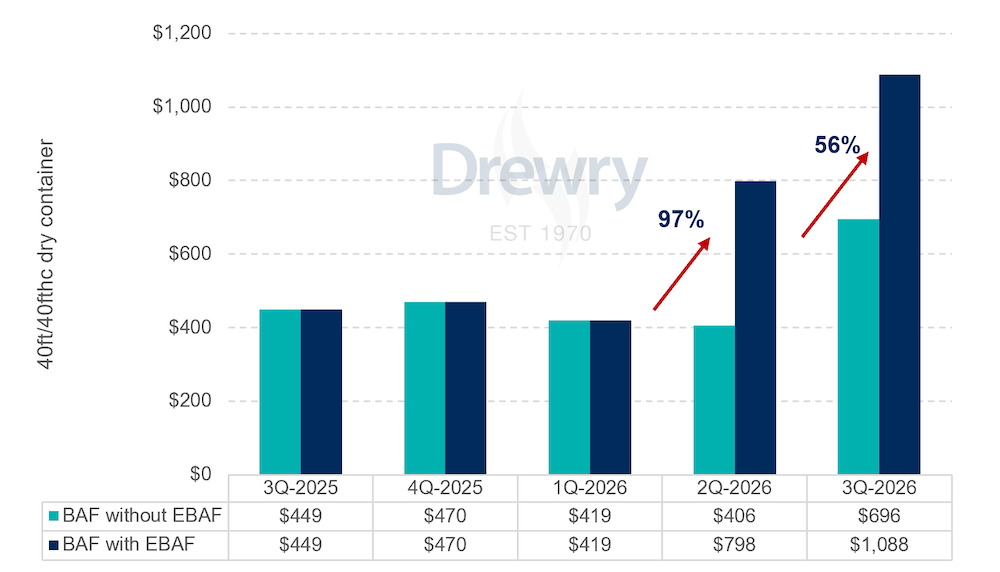
Average BAF Values: East-West Headhaul Trades
The price of benchmark diesel fuel rose from $506 per metric ton on February 27 – the day before the U.S. attacked Iran – to $961.5 per ton on March 19 March 2026, an increase of approximately 90% in less than three weeks.
“Faced with rapidly rising fuel costs and increased uncertainty, ocean carriers responded by introducing the Emergency Bunker Adjustment Factor surcharges (eBAFs),” said London-based Drewry.
BAFs that were mostly stable prior to the war on the east-west headhaul trades increased modestly on average from $449 per 40-ft. dry container in the third quarter of 2025 to $470 in the fourth quarter of that year, before declining to $419 the first quarter of 2026. Drewry cited data from Ship & Bunker.
The impact of the conflict became evident in 2Q2026.
Drewry noted that while standard BAF fell to $406 as the fuel adjustment formulas had not yet fully reflected the surge in bunker prices, “the introduction of eBAF increased total fuel-related charges to $798, almost double the underlying BAF level.”
Since BAF calculations lag behind real prices, the full impact of the spike became visible in the third quarter, Drewry said, with the standard BAF increasing to $696, while the total BAF including eBAF soared to $1,088.
“This development raised a concern for shippers,” the analyst said. “Standard BAF mechanisms are designed to capture increases in bunker and oil prices, albeit with a time lag. However, the introduction of eBAFs creates the potential for duplicate fuel cost recovery, whereby carriers recover higher fuel costs immediately through emergency surcharges and subsequently through increased standard BAF levels as bunker price movements were incorporated into quarterly calculations.”
Drewry said Hapag-Lloyd agreed to withdraw emergency fuel surcharges once the higher BAF takes effect in July, to avoid duplicate recovery of fuel costs.
The justification for eBAFs appears to be weakening, said Drewry, as the temporary ceasefire agreement has eased concerns over further disruption to oil and bunker fuel markets.
“The benchmark average bunker price has retreated significantly from its March peak, falling from $961.50 per ton March 19 to $764.50 on June 18,” Drewry said, according to Ship & Bunker.
“As a result, shippers are likely to be in a stronger position to negotiate the removal of eBAFs and a return to normal indexed quarterly BAF mechanisms. With the underlying BAF already capturing fuel price movements through established adjustment formulas, maintaining emergency surcharges in the current environment would be increasingly difficult to justify.”
Drewry advised shippers to closely monitor surcharge structures and ensure that emergency measures do not remain in place after the underlying BAF has adjusted to market conditions.
Read more articles by Stuart Chirls here.
Flexport: New tariff wave could replace expiring trade duties by late July
Coming weeks will see multiple factors reset ocean rates
U.S.-Iran peace deal reopens Strait of Hormuz
Shippers say renewed tax on Chinese ships could put some U.S. ag producers out of business
Brokerage Compliance Symposium
The day before F3. Every compliance issue you face - fraud exposure, carrier liability, FMCSA rules, cargo theft, insurance gaps - navigated by attorneys and operators defining best practices in a changing industry.
F3 Awards Dinner
The night before F3. FreightTech100 companies honored. FreightTech 25 and Shipper of Choice winners revealed live. Cocktail reception into dinner and live music - 300 industry leaders in one purpose-built room.
F3: Future of Freight Festival
Industry-defining keynotes, rapid-fire technology demos, and industry leaders networking in experiences across Chattanooga - plus the inaugural F3 Awards Dinner featuring the FreightTech and Shipper of Choice reveals.
The day before F3. Every compliance issue you face - fraud exposure, carrier liability, FMCSA rules, cargo theft, insurance gaps - navigated by attorneys and operators defining best practices in a changing industry.
The Signal at Chattanooga Choo Choo • Chattanooga, TN Register NowThe night before F3. FreightTech100 companies honored. FreightTech 25 and Shipper of Choice winners revealed live. Cocktail reception into dinner and live music - 300 industry leaders in one purpose-built room.
The Signal at Chattanooga Choo Choo • Chattanooga, TN Register NowIndustry-defining keynotes, rapid-fire technology demos, and industry leaders networking in experiences across Chattanooga - plus the inaugural F3 Awards Dinner featuring the FreightTech and Shipper of Choice reveals.
The Signal at Chattanooga Choo Choo • Chattanooga, TN Register Now