Diesel consumers can be excused if they are exhausted from trying to project where the prices they pay at the pump will be going after the events of the past few days and weeks.
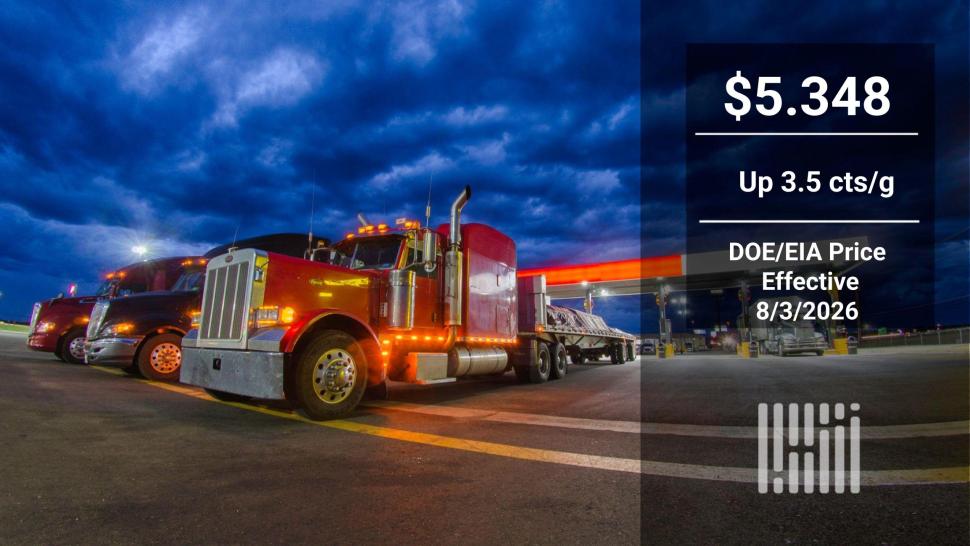
The weekly Department of Energy/Energy Information Administration average retail diesel price that is the basis for most fuel surcharges fell Monday, published Tuesday, to $5.348/gallon, up 3.5 cts/g. It’s the fourth consecutive week the benchmark has increased, up 77 cts/g during that time.
The increase came as prices are rapidly falling in the futures market on the latest news that a deal to reopen the Strait of Hormuz is imminent. That decline came after a sharp slide in the prior three trading days on that same hope, as the market quickly embraces any prospect of an end to the closure of the strait.
Price movement in the ultra low sulfur diesel (ULSD) contract on the CME commodity exchange during those three days, and into Tuesday, have been some of the most volatile since the U.S. and Israel launched their attacks on Iran at the beginning of March.
With the market latching on to any talk of some sort of settlement that would reopen the Strait of Hormuz, the price of ULSD on CME fell, respectively, 3.68%, 2.09% and 5.93% in the three trading days ending Monday.
The day before that streak, the price was up 5.28%.
The end result is that the Monday settlement of $3.8772/g was the lowest settlement since July 13. It was also a significant drop since a $4.3416/g settlement on July 23.
At approximately 9:40 a.m. Tuesday, ULSD on CME was down 4.34%, or 16.81 cts/g, to $3.7091/g. If it settled there, it would be the lowest settlement since July 10.
A call for lower retail prices
That’s the futures market. But the retail market now also has the uncertainty of what sort of reaction there will be, if any, to President Trump’s call on oil companies to lower their retail prices, spurred by a not surprising string of earnings reports showing profitability soared during the second quarter.
The problem is that it’s not all that simple.
First, there is the definition of what is an oil company. ExxonMobil and Chevron are fully integrated oil companies, producing crude and other hydrocarbons and refining it into finished products like gasoline and diesel. They sell their wholesale products through a distribution system known as “the rack,” and set prices daily based on market fluctuation, often multiple times a day if markets are volatile, which they have been.
Where the price is set
But they do not set prices at the pump, which are controlled by the station owner, who might own one station or 100.
An independent refiner like Valero or Marathon is not integrated. They buy 100% of their inputs (mostly crude) off the open market or through contracts and turn it into products, an activity that at present is highly profitable as refining spreads have blown out during the Iran war. They also sell their products through their rack systems.
But there is no one entity that can reduce the price of crude at will, even if large oil companies choose to seek to satisfy the Trump call for lower prices and slow increases in wholesale product prices. Beyond that, there is no one entity that can reduce the price of all sorts of blendstocks that go into the manufacture of gasoline or diesel, products like ethanol, reformate or raffinate.
The conundrum then for a company under pressure from the White House is that while they can try to take steps to limit increases or accelerate decreases in their wholesale prices, that would be independent of input prices which they do not control.
How it works
Supplying a wholesale system does not take place just with output from a refinery. A company like Valero at all times will be selling gasoline and diesel into the spot and wholesale market, but the supply for that could be coming from open market purchases of finished products, not just what their refineries had produced. The systems are constantly selling and buying inputs and outputs to balance their needs and take advantage of market opportunities.
The independent refiners would be paying free-market prices for those supplies. But they would be squeezed if political pressure resulted in wholesale prices that did not justify the cost of the products purchased to help supply those wholesale systems. And that sort of situation can lead to tightening supplies, the precise opposite of a push to lower prices.
There are other potential pitfalls. A company like Chevron will sell at the rack product referred to as “branded,” which would be sold to retailers operating under the Chevron brand name. They would also be selling “unbranded,” which can go to any retailer, some of which might be fairly large like a Wawa or Racetrac.
But even if Chevron acquiesces to a Presidential call for lower prices, it would do so on its branded output. That leaves the unbranded customers at a disadvantage. Even if an oil company reduces both branded and unbranded, an independent retailer probably wouldn’t get all their supplies from that large company. They would need to turn to lesser known suppliers without a public persona who would be under no pressure to reduce their prices, because nobody knows who they are.
The result again is a squeeze on significant-sized retailers who buy unbranded fuel at the rack. Ultimately, that can not go on forever.
More articles by John Kingston
Werner CEO Leathers: just the 3rd inning in driver attrition
C.H. Robinson earnings call shifts to nuclear verdict as key topic
Brokerage Compliance Symposium
The day before F3. Every compliance issue you face - fraud exposure, carrier liability, FMCSA rules, cargo theft, insurance gaps - navigated by attorneys and operators defining best practices in a changing industry.
F3 Awards Dinner
The night before F3. FreightTech100 companies honored. FreightTech 25 and Shipper of Choice winners revealed live. Cocktail reception into dinner and live music - 300 industry leaders in one purpose-built room.
F3: Future of Freight Festival
Industry-defining keynotes, rapid-fire technology demos, and industry leaders networking in experiences across Chattanooga - plus the inaugural F3 Awards Dinner featuring the FreightTech and Shipper of Choice reveals.
The day before F3. Every compliance issue you face - fraud exposure, carrier liability, FMCSA rules, cargo theft, insurance gaps - navigated by attorneys and operators defining best practices in a changing industry.
The Signal at Chattanooga Choo Choo • Chattanooga, TN Register NowThe night before F3. FreightTech100 companies honored. FreightTech 25 and Shipper of Choice winners revealed live. Cocktail reception into dinner and live music - 300 industry leaders in one purpose-built room.
The Signal at Chattanooga Choo Choo • Chattanooga, TN Register NowIndustry-defining keynotes, rapid-fire technology demos, and industry leaders networking in experiences across Chattanooga - plus the inaugural F3 Awards Dinner featuring the FreightTech and Shipper of Choice reveals.
The Signal at Chattanooga Choo Choo • Chattanooga, TN Register Now