




Editorial Commentary
The views expressed in this article are the author’s own and do not necessarily reflect those of FreightWaves or its staff.
2025 is almost behind us, and it has been a tumultuous year for the American trucking industry, as major policy changes coming from the Trump Administration have shaken it to the frame rails.
The public, fed up with a near-constant stream of needless crashes and chaos on our highways, are now connecting the dots between the failures of border control and immigration policy under the Biden Administration, and the many consequences of our interstates becoming like a scene out of the Mad Max films.
Likewise, the advocacy of groups like American Truckers United, and the relentless drive of independent researchers to fix the trucking industry, along with great reporting here at FreightWaves, have clarified for those paying attention just exactly what is going on here.
US DOT Secretary Sean Duffy has taken note, and begun investigations into the issue of ‘non-domiciled’ CDLs to all of the newcomers who are involved in many of these high-profile incidents.
This new attention on the trucking industry, however, has also drawn some attention from the mainstream media.
As to be expected, they are failing to get the story straight about exactly what is going on, and are also failing to correctly identify the responsible parties that brought the trucking industry into such high-profile disrepute.
In a number of recent mainstream media pieces, certain communities over-represented in high-profile and deadly collisions, specifically recent arrivals from the Punjab, a state in northwestern India, have been given a sympathetic ear, as drivers from those communities come under scrutiny from both the US DOT, and those states which have issued so many recent-arrival drivers a CDL which may not have complied with Federal Regulations.
Given that so many of these newly arrived Indian drivers are economic migrants pretending to be ‘refugees’, and paying South American smugglers to get them into America, they are also of significant interest to the officers of ICE.
A December Seattle Times article tells us about a Sikh-owned company called Roadies:
“It is supposed to be the busiest time of year for the Roadies trucking company, but dozens of its trucks sit idle — unlikely casualties of a surprise scrutiny of laborers from India. The Bakersfield, Calif., company has 200 big rigs but a dearth of drivers after authorities canceled thousands of commercial driver’s licenses in California, forcing more than 20 Roadies drivers out of the business and scaring others into quitting. CEO Avninder Singh says he has doubled pay, but still can’t recruit enough drivers. He says he is now losing more each month than he usually makes in a year.”
“My trucks are sitting” with no one to drive them, he said. “It has put my livelihood in danger.”
Perhaps Roadies’ problem is more about a safety rating that shows a vehicle OOS rate higher than the national average, which might dissuade potential customers.
And what was his original pay scale like that doubling it still did not attract drivers?
Further in the article we hear from American Trucking Associations’ economist Bob Costello, who appears to have changed his tune regarding the ATA’s decades-long claim to a shortage of truckers.
Advocacy groups such as the American Trucking Assn., which in the past has lobbied for looser licensing rules to address driver shortages, have backed the tighter restrictions.
Regulators need to enforce rules requiring truckers to be well-trained and qualified, said ATA Chief Economist Bob Costello:
“Qualified means you can speak English, read road signs, understand safety rules and respect our laws,” he said. “Qualified means you earned your CDL the right way, not through a rubber-stamped process in a state that looks the other way.”
The New York Times, of all places, has waded into the world of apologia for replacing American truckers’ jobs with migrant workers, and likewise quotes from ATA President Chris Spear in this December 21 piece:
“Chris Spear, president of the American Trucking Associations, the industry’s largest trade association, supports the proposed changes. If you are here illegally, you cannot have a commercial driver’s license. Period,” Mr. Spear said in a written statement. In 2021, the American Trucking Associations claimed the country needed 80,000 more drivers. But Mr. Spear said that shortage had largely evaporated.”
And in a December piece from the Epoch Times titled “Safer Roads, More Work: Truckers Welcome Crackdown on Illegal Drivers,” we are also treated to a quote from Chris Spear:
“The American Trucking Associations (ATA), the country’s leading voice for truckers, hailed the removal of 3,000 CDL training providers and the warning issued to 4,000 more. Training someone to operate an 80,000-pound vehicle is not a weekend hobby,” ATA President and CEO Chris Spear said in a Dec. 1 statement. “It is a profession built on standards, discipline, and responsibility. The Trump administration has sent the right message: if you’re running a CDL Mill or if you’re issuing certificates to anyone who can fog a mirror, you’re on notice.”
The kicker with this article from the Epoch Times, however, is that it starts off by citing the long-debunked driver shortage:
“Despite an estimated nationwide shortage of 115,000 big rig drivers, industry leaders say these regulatory changes are necessary to promote road safety, better wages, and more job opportunities for U.S.-born drivers.”
What the writers of these pieces and the outlets they work for do not understand, is that Spear and the ATA are doing a very abrupt ‘about-face’ on the driver shortage narrative, which the ATA is primarily responsible for promulgating.
Back in 1987, the ATA commissioned a study by JF Casey in an attempt to understand the ‘changing demographics of trucking’, but what has happened is that a new meme was born, the “truck driver shortage”.
Member carriers of the ATA quickly found that their new meme was very useful in unlocking free taxpayer money to subsidize the operations of what we now call CDL Mills.
In what I have dubbed ‘a system of stealth corporate welfare masking itself as a jobs program’, these monies obtained by schools owned or associated with ATA member carriers had created an Ouroboros, the infamous snake eating its own tail.
Carriers could now rely on the taxpayer to assist in the training of new drivers, which removed any incentive for them to pay their safe and competent drivers enough to stick with the job.
This cycle is why we see driver turnover rates in excess of 90% across carriers operating in the truckload market, of which ‘mega’ carrier members of the ATA are the primary guilty parties.
This system, which is so pervasive that there is an association explicitly called “The National Association of Publicly-Funded Truck Driving Schools”, also produces an awful lot of CDLs, which puts yet another lie to the ‘shortage’ narrative.
The ATA, in a moment of oblique honesty, admitted as such in a 2019 paper they put out which was otherwise an exercise in ever more fatuous whining about the shortage.
Buried in a notation, the ATA reports that there are 10 million active CDLs in circulation; at any given time there are roughly 3.5 million jobs in America which require a CDL, many of them not even in trucking, which typically only employs 1.8 to 2.5 million drivers, depending on the state of the economy.
In essence, the ATA admitted that there were 5 times as many drivers available to their carriers than jobs on offer. Some shortage.
The fun really starts, however, in 2021, when demand for truckers spiked during the depths of the Covid Regime, and our decrepit ruling class tried to shut society down.
Setting the government money printer on high BRRRRRRR to placate the population, they paid millions of people to stay home.
Those millions took to online shopping with gusto, and for a short while there was a brief spike in demand for truckers, which saw the spot market become red hot, and saw plenty of players get back in the game — as markets ought to work.
ATA member carriers who already suffered very high turnover rates from failing to do anything about the issues which cause drivers to quit, began to lose even more drivers to their competition on the red-hot spot market.
After many decades of advocating for the government to help get them drivers, they once again raised the fake threat of an imminent driver shortage, and again the government was played like a fiddle.
The Biden Administration responded with the 2021 Trucking Action Plan which heard from many industry stakeholders, experts, trucking company owners, advocacy organizations, and academics — many of whom brought studies and statistics to bear showing that there was no truck driver shortage at all.
Though some claim that this task force had the correct ‘intentions’, we can see in their first press release what was really going on here:
“At the same time, the industry reports historic demand for its services. Reflecting that demand, wages for employed drivers in all trucking segments have increased 7-12% in the last year alone …. Take steps to reduce barriers to drivers getting CDLs …. FMCSA will provide over $30 million in funding to help states expedite CDLs. Today, FMCSA is sending all 50 states a toolkit detailing specific actions they can take to expedite licensing and will work hand-in-hand with states to address challenges they are facing.”
Instead of letting the market do its thing, the Biden Administration worked with a number of states to dilute the requirements to obtain a CDL, and within a year they bragged about adding an additional 876,000 CDLs to the market.
Instead of honoring the sacrifices of America’s truckers and allowing the market to pay them the wages they have been steadily losing in the decades post de-regulation, the Biden Administration flooded the market with new ‘drivers’, many of them issued the ‘non-domiciled’ CDLs we have been hearing so much about this year.
This flooding operation is the subject of ongoing investigations by US DOT, and has resulted in public fights between Transportation Secretary Duffy and those states who have been found to be breaking Federal rules in issuing so many of these sub-par CDLs.
The ATA’s paw prints are all over the Biden Administration’s ‘Action Plan’, and even with 4 years worth of loosened CDL requirements, and all of the carnage many new ‘drivers’ have caused on our highways, as recently as July of 2025 Chris Spear of the ATA was still out there going on about this fake shortage of drivers.
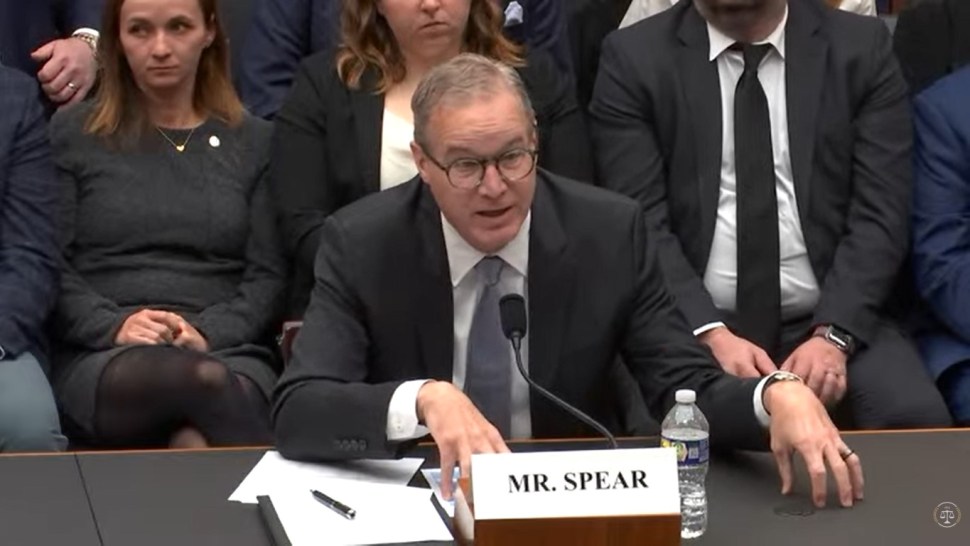
In testimony given to the Senate Committee on Commerce, Science, and Transportation, Spear tells the esteemed hall of power:
The trucking industry, which serves as the backbone of our nation’s economy and supply chain, continues to face driver shortages … Over the next decade, trucking companies will need to hire roughly 1.2 million new drivers to keep pace with growing freight demand and an aging workforce.
Didn’t Biden just produce 75% of those drivers in one year? How about every year these programs of giving CDLs to recent arrivals to the country, many of whom came here illegally?
What of the hundreds of American trucking companies who have gone out of business and laid off thousands of drivers over 3 years of the Great Freight Recession?
Spear couldn’t keep his story straight earlier this year; in one ATA press release, they denied the existence of the excessive amounts of questionable CDLs they had got out of the Biden Administration and only a few weeks later they were praising President Trump for closing the English Language Proficiency loophole opened up during the Obama Administration, which greatly assisted in allowing so many recent arrivals to illegally acquire a CDL.
Instead of the ATA doing anything to advocate for improvement to driver pay and the conditions of the job, they have been the primary authors of the debasement of the American trucker, and are largely responsible for setting the political conditions which allowed for so many untrained and unsafe drivers to enter the industry.
Mainstream media outlets need to take everything the ATA says with a huge pinch of salt, and understand that in their supposed job of holding power to account, they ought to be more critical of grossly overpaid corporate lobbyists like Chris Spear, who are responsible for the problems Spear now claims to be on the side of solving.
It would be a much merrier Christmas for America’s truckers if the media listened to truckers directly instead of lobbyists like Spear.
Brokerage Compliance Symposium
The day before F3. Every compliance issue you face - fraud exposure, carrier liability, FMCSA rules, cargo theft, insurance gaps - navigated by attorneys and operators defining best practices in a changing industry.
F3 Awards Dinner
The night before F3. FreightTech100 companies honored. FreightTech 25 and Shipper of Choice winners revealed live. Cocktail reception into dinner and live music - 300 industry leaders in one purpose-built room.
F3: Future of Freight Festival
Industry-defining keynotes, rapid-fire technology demos, and industry leaders networking in experiences across Chattanooga - plus the inaugural F3 Awards Dinner featuring the FreightTech and Shipper of Choice reveals.
The day before F3. Every compliance issue you face - fraud exposure, carrier liability, FMCSA rules, cargo theft, insurance gaps - navigated by attorneys and operators defining best practices in a changing industry.
The Signal at Chattanooga Choo Choo • Chattanooga, TN Register NowThe night before F3. FreightTech100 companies honored. FreightTech 25 and Shipper of Choice winners revealed live. Cocktail reception into dinner and live music - 300 industry leaders in one purpose-built room.
The Signal at Chattanooga Choo Choo • Chattanooga, TN Register NowIndustry-defining keynotes, rapid-fire technology demos, and industry leaders networking in experiences across Chattanooga - plus the inaugural F3 Awards Dinner featuring the FreightTech and Shipper of Choice reveals.
The Signal at Chattanooga Choo Choo • Chattanooga, TN Register Now