




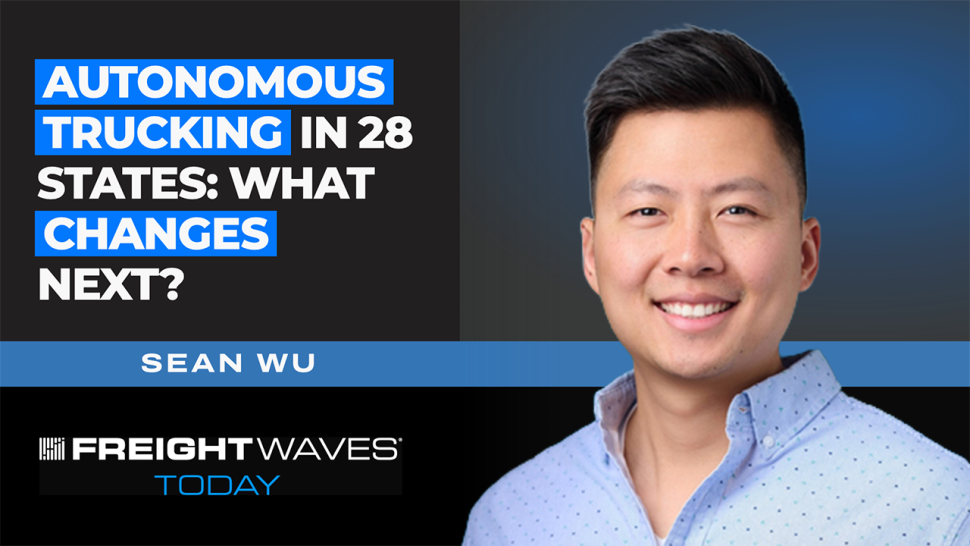
Autonomous trucks are already operating in 28 states—and that changes how freight leaders should think about the market right now. uShip CEO Sean Wu breaks down what autonomy could mean for consolidation, where standardization wins, and why bulky, nonstandard freight still needs human coordination. He also explains where marketplaces fit, why oddball freight gets pushed out of standardized networks, and how uShip handles trust and security in a fraud-heavy environment. #AutonomousTrucking #FreightTech #Logistics
Autonomous trucking is already operating across 28 states, but the freight economy has yet to feel its full weight. When it does, uShip CEO Sean Wu predicts a wave of consolidation that will reshape the logistics industry from top to bottom — touching publicly traded companies and smaller mid-market players alike.
Wu drew a direct parallel to his early career in accounting. “I started my career, I was a bean counter 15 years ago. And before that, there was a Big 8 in the accounting firms. And right now we have Big 4,” he said. “I think consolidation is going to happen no matter what.” The key variable, he added, is what regulation does to the pace of that shift — particularly given the 3 to 4 million truck drivers whose livelihoods are at stake.
“Whoever’s in the top 10 logistics companies today, we’re probably going to see a lot of that in the very high, even public companies, and definitely in the smaller mid-market as well.” — Sean Wu, CEO, uShip
Wu noted that autonomy’s efficiency gains depend heavily on standardization and repeatability — conditions that don’t apply to uShip’s core business. The 22-year-old marketplace specializes in non-standard, large and bulky freight: household goods, heavy equipment, boats, antiques, and cars. As an example, Wu cited a 3-ton hot tub the platform moved roughly a month ago, requiring multiple coordinated parties. “There’s no amount of standardization that’s gonna get that thing on autonomous driving,” he said.
On market conditions, Wu said uShip is seeing mixed signals across its freight categories. Secondary-market household goods volume is ticking up and prices have risen meaningfully, tracking diesel costs at the pump. In the automotive segment, carriers and brokers are reporting capacity constraints. Household move volume, however, remains soft as the housing market stays subdued — with the platform expecting the traditional springtime surge, historically the busiest period for residential moves, to be a key indicator of demand ahead.
Wu also addressed fraud and cargo security, perennial concerns on open marketplaces. He pointed to uShip’s 22 years of carrier profile data, accumulated reviews, and platform trust-and-safety procedures — combined with shipper protection plans — as the primary tools for vetting carriers. For shippers navigating the post-Montgomery liability environment, Wu argued uShip’s model offers a structural buffer: the platform surfaces choices and lets shippers select their own carrier rather than assigning one, which he said reduces the platform’s exposure compared to traditional brokerage arrangements.
On the safety case for autonomy, Wu acknowledged the data favors driverless systems — pointing to Waymo’s lower accident rates, lower injury rates, and fewer claims as a template for what autonomous trucking could deliver. Distracted driving, he noted, has surpassed alcohol and drugs as a leading risk predictor — a point he said underscores why removing the human variable matters to carriers, brokers, and shippers focused on on-time performance and predictability.
- uShip CEO Sean Wu predicts autonomous trucking will trigger broad logistics consolidation, comparing the likely industry shake-out to accounting’s collapse from a Big 8 to Big 4 firms.
- uShip, a 22-year-old marketplace for large and bulky freight, is deliberately leaning into non-standardized shipments that autonomy cannot efficiently handle, such as a 3-ton hot tub moved last month.
- The platform is seeing rising prices in secondary household goods and capacity constraints in automotive transport, while household move volume remains soft amid a slow housing market.
This Summary is generated thanks to a transcription of the interview, for the full interview please enjoy the video above.
Brokerage Compliance Symposium
The day before F3. Every compliance issue you face - fraud exposure, carrier liability, FMCSA rules, cargo theft, insurance gaps - navigated by attorneys and operators defining best practices in a changing industry.
F3 Awards Dinner
The night before F3. FreightTech100 companies honored. FreightTech 25 and Shipper of Choice winners revealed live. Cocktail reception into dinner and live music - 300 industry leaders in one purpose-built room.
F3: Future of Freight Festival
Industry-defining keynotes, rapid-fire technology demos, and industry leaders networking in experiences across Chattanooga - plus the inaugural F3 Awards Dinner featuring the FreightTech and Shipper of Choice reveals.
The day before F3. Every compliance issue you face - fraud exposure, carrier liability, FMCSA rules, cargo theft, insurance gaps - navigated by attorneys and operators defining best practices in a changing industry.
The Signal at Chattanooga Choo Choo • Chattanooga, TN Register NowThe night before F3. FreightTech100 companies honored. FreightTech 25 and Shipper of Choice winners revealed live. Cocktail reception into dinner and live music - 300 industry leaders in one purpose-built room.
The Signal at Chattanooga Choo Choo • Chattanooga, TN Register NowIndustry-defining keynotes, rapid-fire technology demos, and industry leaders networking in experiences across Chattanooga - plus the inaugural F3 Awards Dinner featuring the FreightTech and Shipper of Choice reveals.
The Signal at Chattanooga Choo Choo • Chattanooga, TN Register Now