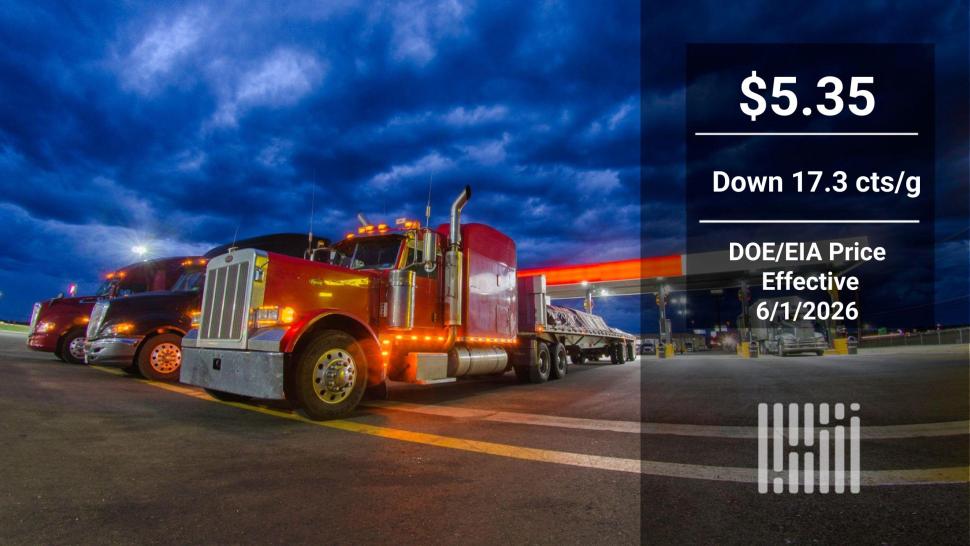
The benchmark diesel price used for most fuel surcharges is now down to a level not seen since a few weeks after the military confrontation between Israel and the U.S./Israel coalition began.
The Department of Energy/Energy Information Administration average retail diesel price fell 17.3 cents/gallon to $5.35/g. It’s the lowest price since March 23, when prices were surging following the start of hostilities between the two sides. On that date, the DOE/EIA price was $5.375/g.
The price was $3.897/g on March 2, in the last number published just as the war was beginning two days before that date.
Second-biggest drop
In this highly volatile market, the 17.3 cts/g decline this week was only the second biggest weekly fall. Only on April 20, soon after the ceasefire was announced, did the benchmark record a larger decline than this week, sliding 20.5 cts/g.
The volatile market can be seen in some of the regional diesel prices published Tuesday, effective Monday, for various parts of the region. While the U.S average was down 17.3 cts/g, it was only down 6.8 cts in New England and 7.7 cts/g in the West Coast excluding California. Meanwhile, the price fell 23.1 cts/g in the Midwest, which had been affected by refinery issues that are now largely fixed.
That volatility could be a reason why the DOE/EIA price and the average daily price of the AAA were so different for Monday, the effective day of the DOE benchmark. The AAA price for Monday was $5.448/g, almost a full 10 cents more than the DOE/EIA price.
The drop in the benchmark comes against a background of a decline in the price of ultra low sulfur diesel (ULSD) on the CME commodity exchange as talk of some sort of peace deal and a reopening of the Strait of Hormuz have been the key focus of traders.
From a settlement of $4.1625/g on May 19, ULSD fell to a settlement Friday of $3.4886/g, a decline of more than 67 cts/g.
Recent reversal
But as has happened so many times in this up and down market that waits on every development regarding a reopening of the strait, the trend in commodity markets the last two days has been solidly upward.
ULSD for July delivery–that month is now the front month contract on the CME–rose more than 15 cts/g between Friday and Monday after a weekend of news reports that suggested peace and a reopening of the international waterway was becoming less likely, not more.
In trading Tuesday, prices pushed up again, though at a slower rate. At approximately 10:40 a.m. EDT, ULSD was up 2.23 cts/g to $3.6617/g.
Execs seeing a tipping point
The overall downward trend in prices is occurring even as two leading oil market executives last week, at the Sanford Bernstein 42nd Annual Strategic Decisions Conference in New York, put forth a scenario for the coming weeks that was anything but bearish.
There have been analyst discussions recently of a term known as “tank bottoms.” It’s essentially the minimum level of inventories needed for the oil system to operate. It doesn’t mean inventories go to zero, but they are down at a level where to pull on them further could cause operational issues.
Chevron CEO Mike Wirth was interviewed by Bob Brackett of Sanford Bernstein. Wirth didn’t use the term “tank bottoms,” but Brackett did.
Wirth noted that global inventories at the start of the war were at extremely high levels. Those stocks served as a buffer from the lost supply out of the Strait of Hormuz, which he estimated at about 12 million to 13 million b/d out of a global oil market of just over 100 million b/d.
“You’ve got all this inventory that sits in between the ins and the outs, and that has been able to buffer the pressure,” Wirth said.
But then he warned: “The buffers and the shock absorbers are being steadily drawn down and the ability for the market to absorb this imbalance is drastically diminished today versus where we started.”
Neil Chapman, a senior vice president at ExxonMobil, echoed a similar sentiment.
“We’re approaching unheard of inventory levels,” Chapman said, also in a fireside discussion with Brackett. “I mean, really, really low levels. You can debate whether that’s going to hit those really low levels in 2 weeks or 3 weeks. But once you get to that point, then you’ll see prices shoot up.”
More articles by John Kingston
Texas court nixes shipper liability in Home Depot/Werner case
Carrier Nussbaum sets driver pay increase; others popping up more quietly
Intrastate delivery worker can be ruled interstate in dispute: SCOTUS
Brokerage Compliance Symposium
The day before F3. Every compliance issue you face - fraud exposure, carrier liability, FMCSA rules, cargo theft, insurance gaps - navigated by attorneys and operators defining best practices in a changing industry.
F3 Awards Dinner
The night before F3. FreightTech100 companies honored. FreightTech 25 and Shipper of Choice winners revealed live. Cocktail reception into dinner and live music - 300 industry leaders in one purpose-built room.
F3: Future of Freight Festival
Industry-defining keynotes, rapid-fire technology demos, and industry leaders networking in experiences across Chattanooga - plus the inaugural F3 Awards Dinner featuring the FreightTech and Shipper of Choice reveals.
The day before F3. Every compliance issue you face - fraud exposure, carrier liability, FMCSA rules, cargo theft, insurance gaps - navigated by attorneys and operators defining best practices in a changing industry.
The Signal at Chattanooga Choo Choo • Chattanooga, TN Register NowThe night before F3. FreightTech100 companies honored. FreightTech 25 and Shipper of Choice winners revealed live. Cocktail reception into dinner and live music - 300 industry leaders in one purpose-built room.
The Signal at Chattanooga Choo Choo • Chattanooga, TN Register NowIndustry-defining keynotes, rapid-fire technology demos, and industry leaders networking in experiences across Chattanooga - plus the inaugural F3 Awards Dinner featuring the FreightTech and Shipper of Choice reveals.
The Signal at Chattanooga Choo Choo • Chattanooga, TN Register Now