The sharp reversal in the benchmark price of diesel this week is being accompanied by growing warnings of a potential coming crisis in supplies that so far has been mostly avoided through the use of inventories.
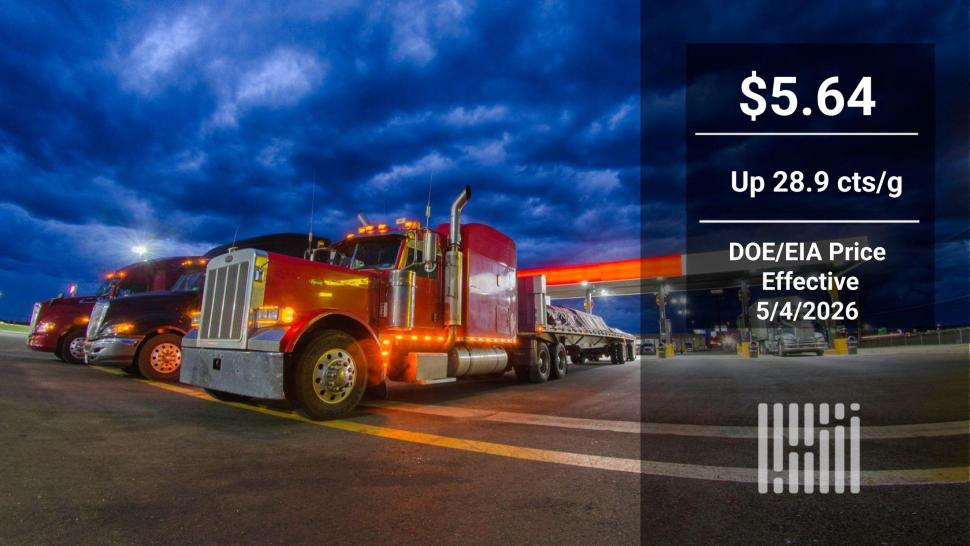
The Department of Energy/Energy Information Administration weekly average retail diesel price surged 28.9 cents/gallon to $5.64/g. With this increase, the price used as the basis for most fuel surcharges has now regained virtually all of the decline recorded over the last three weeks. The DOE/EIA price was $5.643/g on April 6. That was the post-war high. With this week’s increase, it is now just 3/10 of a cent less than that.
The latest price increase comes even as it has not had a chance to fully reflect gains in the futures market. Ultra low sulfur diesel on the CME commodity exchange for June delivery settled at $3.7943/g on April 27, the recent low water mark. On Monday, May 4, just five trading days later, it settled at $4.0723/g, 27.8 cts/g more than that, as the early April ceasefire was increasingly falling apart and there was little relief from blockages in the Strait of Hormuz.
The latest jump in prices in futures and at the retail level is coming as some analysts are predicting that conditions for consumers are more likely to get worse before they get better.
S&P Global Energy, in a recent analysis, said the oil market now features two things that theoretically should not happen in parallel: a decline in inventories and a drop in demand.
As S&P Global Energy said in the analysis, those “seemingly contradictory developments occurring in tandem shows that the full severity of the greatest supply disruption in history is yet to come.”
Biggest fall in demand since COVID
The demand decline in the second quarter is expected to total about 5-million barrels/day off a base of 103- to 104-million barrels of global demand, according to S&P. It’s the largest decline since COVID hit in 2020. That collapse in consumption was likely to have been as much as 20-million b/d.
As a result of the second quarter decline, and possibly more beyond that, global petroleum liquids demand (a figure that includes such products as propane and biofuels) is likely to decline by 2-million b/d this year, S&P Global said. Declines in that number on an annual basis are extremely rare; it fell about 8 million b/d between 2019 and 2020 because of the pandemic, but has been positive since then.
Even as demand is falling, the S&P Global Energy report said April had a “record-settling decline in global crude inventories.” That decline was about 6.6 million b/d and will average about 5.5 million b/d for the quarter, S&P Global Energy said.
“While there have been significant impacts to date, the oil market has remained somewhat cushioned from the full impact of the loss of 15 million barrels per day in supply,” Jim Burkhard, S&P Global Energy’s vice president and global head of crude oil research, said in the report. “That the cumulative supply loss is now approaching 1 billion barrels is a staggering figure that inventories cannot cover indefinitely. An inevitable market reckoning is coming.”
No immediate relief from a strait opening
Reopening the Strait of Hormuz would not produce immediate relief, the report said.
“S&P Global Energy expects that, if Hormuz were to be reopened, it would take an additional seven months at minimum to fully restore upstream production, assuming no permanent damage and supply chains operate smoothly,” the report said. “A recovery could take longer if there is damage to ports or other transport and loading infrastructure. The longer the strait remains closed, the more likely the supply crisis extends into late 2026 and into 2027.”
Burkhard’s warning to consumers was ominous. “What is a tremendous curtailment of demand is still being outstripped by the loss of supply,” he said. “That means that higher crude oil and refined product prices are still to come.”
More articles by John Kingston
Motus steps up: what carriers need to know about new FMCSA system
After CBS report, C.H. Robinson seeks to deflect safety responsibility to FMCSA
Card provider WEX reaches deal with activist investor; CEO Smith to stay
Brokerage Compliance Symposium
The day before F3. Every compliance issue you face - fraud exposure, carrier liability, FMCSA rules, cargo theft, insurance gaps - navigated by attorneys and operators defining best practices in a changing industry.
F3 Awards Dinner
The night before F3. FreightTech100 companies honored. FreightTech 25 and Shipper of Choice winners revealed live. Cocktail reception into dinner and live music - 300 industry leaders in one purpose-built room.
F3: Future of Freight Festival
Industry-defining keynotes, rapid-fire technology demos, and industry leaders networking in experiences across Chattanooga - plus the inaugural F3 Awards Dinner featuring the FreightTech and Shipper of Choice reveals.
The day before F3. Every compliance issue you face - fraud exposure, carrier liability, FMCSA rules, cargo theft, insurance gaps - navigated by attorneys and operators defining best practices in a changing industry.
The Signal at Chattanooga Choo Choo • Chattanooga, TN Register NowThe night before F3. FreightTech100 companies honored. FreightTech 25 and Shipper of Choice winners revealed live. Cocktail reception into dinner and live music - 300 industry leaders in one purpose-built room.
The Signal at Chattanooga Choo Choo • Chattanooga, TN Register NowIndustry-defining keynotes, rapid-fire technology demos, and industry leaders networking in experiences across Chattanooga - plus the inaugural F3 Awards Dinner featuring the FreightTech and Shipper of Choice reveals.
The Signal at Chattanooga Choo Choo • Chattanooga, TN Register Now