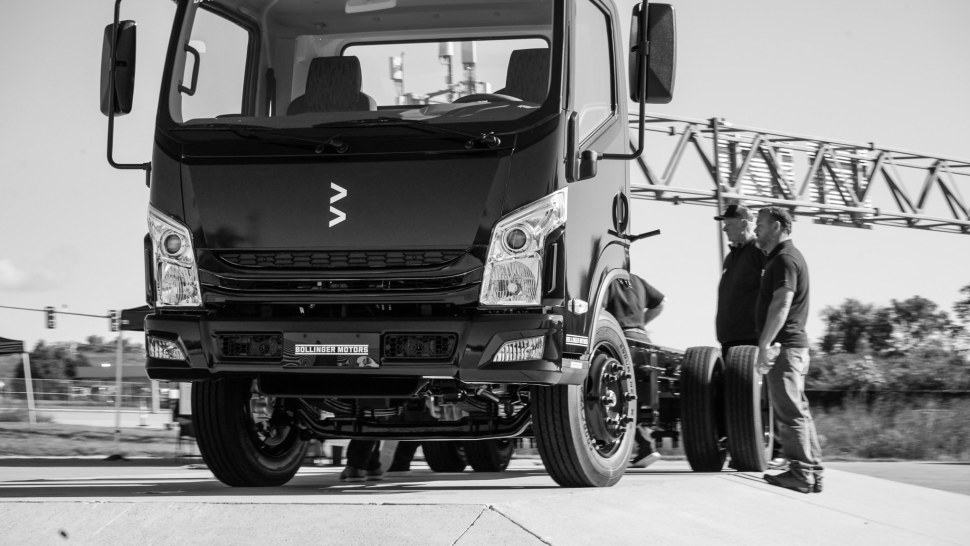
Michigan-based EV truck maker Bollinger Motors has ceased operations, and it is unclear what lies ahead for its parent company, Bollinger Innovations, formerly known as Mullen Automotive. Months-long financial challenges came to a head on Nov. 19 when the Detroit Free Press reported that the Oak Park, Michigan-based company had missed payroll for at least two pay periods. By Nov. 21, the Detroit Free Press reported that the company had ceased operations, effective Friday, Nov. 21, according to company emails.
FreightWaves has reached out to Bollinger Motors and Bollinger Innovations for comment. The phone number for Bollinger Innovations is no longer in operation at the time of writing. The most recent update from Bollinger Innovations is in an 8-K filing dated Nov. 25, in which the company initiated on Nov. 21 a cost reduction plan “intended to streamline operations and preserve liquidity.”
As part of that plan, Bollinger Innovations reduced its workforce and is in the process of closing its Troy, Michigan, office. “These actions are designed to consolidate the remaining staff into its Oak Park facility and align its cost structure with current operating conditions. The actions do not involve the disposal or discontinuation of any business line,” the company said.
Additional information for current customers: As part of the restructuring, Bollinger Innovations began notifying its dealer networks of the changes in its support model, “including the discontinuation of factory service and warranty support and the consolidation of operations into a single Oak Park location.”
Bollinger is also evaluating potential dealer-driven programs relating to parts and vehicle purchases and may provide further updates as these initiatives develop, according to the filing.
The closure of Bollinger Motors was announced to employees through an internal email from the company’s human resources director, Helen Watson, obtained by the Detroit Free Press. Watson wrote: “We received word late last night that the day has arrived. We are to officially close the doors of Bollinger Motors, effective today, Nov. 21, 2025.” Watson indicated that David Michery, CEO of parent company Bollinger Innovations, would attempt to make employees “whole with regard to the remaining monies” from missed payrolls.
Bollinger Motors’ payroll issues were further highlighted in an Oct. 31 email sent by Walter Collins, chief operating officer of Bollinger Motors, who wrote, “Unfortunately, we could not process this week’s payroll on schedule due to a delay in receiving the expected funds.” The lack of payment led employees to file 70 claims with the Michigan Department of Labor and Economic Opportunity, according to Luke Ramseth of The Detroit News.
The shutdown caps a turbulent year for the manufacturer, which had positioned itself as building “the most bad-ass electric commercial trucks on the planet.” In May 2025, Bollinger was placed into receivership following a legal dispute with founder Robert Bollinger over unpaid compensation and financial control. Though the company exited receivership in June under the leadership of Mullen Automotive, which held approximately a 95% controlling stake, financial pressures intensified through the latter half of the year.
The company had pivoted from its original focus on consumer-oriented vehicles to commercial electric vehicles in recent years. Jim Connolly, who served as chief revenue officer at Bollinger, explained the strategic shift in a podcast interview with FreightWaves earlier this year: “We started with Robert Bollinger with a B1, B2, which if you look online, it’s kind of an SUV. And so we were developing that product, saw a hole in the commercial market in the class 4, 5 space, and we pivoted over to commercial about three years ago.”
The closure comes amid broader consolidation in the EV space. In June 2025, Mullen Automotive rebranded as Bollinger Innovations and consolidated operations under the Bollinger name. Bollinger Innovations delisted from Nasdaq in October after dropping below the $1-per-share threshold, following at least six reverse stock splits in the preceding 12 months.
Bollinger’s failure raises questions about the future of its intellectual property and assets, including designs for the B4 chassis cab truck that was available for order at the time of closure, as well as planned B5 and B6 models that were slated for future release. The company had established manufacturing relationships with Roush Industries in Livonia, which it had terminated in September amid cost-cutting measures. The company had recently announced plans to move production to a facility in Tunica, Mississippi.
Brokerage Compliance Symposium
The day before F3. Every compliance issue you face - fraud exposure, carrier liability, FMCSA rules, cargo theft, insurance gaps - navigated by attorneys and operators defining best practices in a changing industry.
F3 Awards Dinner
The night before F3. FreightTech100 companies honored. FreightTech 25 and Shipper of Choice winners revealed live. Cocktail reception into dinner and live music - 300 industry leaders in one purpose-built room.
F3: Future of Freight Festival
Industry-defining keynotes, rapid-fire technology demos, and industry leaders networking in experiences across Chattanooga - plus the inaugural F3 Awards Dinner featuring the FreightTech and Shipper of Choice reveals.
The day before F3. Every compliance issue you face - fraud exposure, carrier liability, FMCSA rules, cargo theft, insurance gaps - navigated by attorneys and operators defining best practices in a changing industry.
The Signal at Chattanooga Choo Choo • Chattanooga, TN Register NowThe night before F3. FreightTech100 companies honored. FreightTech 25 and Shipper of Choice winners revealed live. Cocktail reception into dinner and live music - 300 industry leaders in one purpose-built room.
The Signal at Chattanooga Choo Choo • Chattanooga, TN Register NowIndustry-defining keynotes, rapid-fire technology demos, and industry leaders networking in experiences across Chattanooga - plus the inaugural F3 Awards Dinner featuring the FreightTech and Shipper of Choice reveals.
The Signal at Chattanooga Choo Choo • Chattanooga, TN Register Now