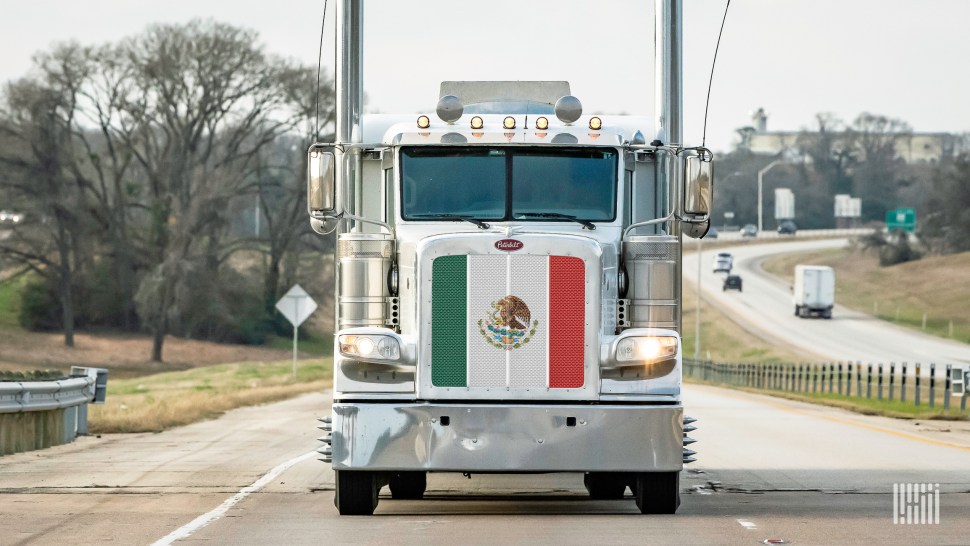
Borderlands Mexico is a weekly rundown of developments in the world of United States-Mexico cross-border trucking and trade. This week: Cross-border boom collides with rising security risks; Mexico sets new quarterly FDI record with nearly $41B in Q4; and La Bonanza Avocados breaks ground on logistics hub in Pharr.
Cross-border boom collides with rising security risks
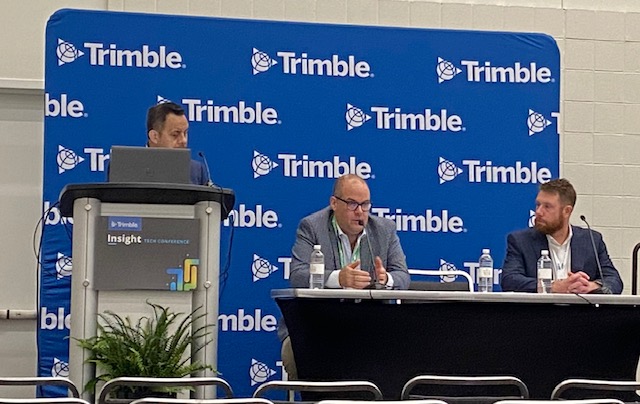
NEW ORLEANS — Cross-border freight volumes between the U.S. and Mexico continue to surge, but infrastructure gaps, rising cargo theft and tightening compliance requirements are creating a more complex operating environment for shippers, according to industry experts at the 2025 Trimble Insight Tech Conference.
The Monday panel discussion, “Cross-Border Evolution: Tech, Infrastructure and the Future of US–Mexico Freight,” featured Mark Vickers, EVP and head of international logistics insurance at Reliance Partners, and Ricardo Malacara, sales director at Overhaul. The session was moderated by FreightWaves cross-border reporter Noi Mahoney.
The Trimble Insight Tech Conference held Sunday through Tuesday, included 1,260 attendees and featured more than 200 information sessions and product demonstrations.
Vickers and Malacara said the current boom in U.S.–Mexico trade was years in the making — accelerated by global shocks.
“We had a number of things all happening at the same time, and it ended up being kind of the perfect storm,” Vickers said, citing USMCA, COVID-era congestion at the Port of Los Angeles, and the U.S.–China trade war. With Asian imports backing up on the West Coast, he added, many shippers rerouted freight through Manzanillo, then Guadalajara, then Laredo, to reach U.S. markets.
Malacara said the tariff environment continues to push manufacturing south.
“Countries that … have a huge tariff may find it cheaper just to set up a factory in Mexico and start shipping from Mexico,” he said. Laredo alone could see 6% to 7% more traffic this year, he added.
A major theme was the liability gap and lack of regulatory parity between the U.S. and Mexico — a pitfall Vickers said many first-time cross-border operators overlook.
“In Mexico, the law is the wild South, where there’s almost no law,” he said. Under current UMA-based formulas, Mexican carriers are only liable for roughly $2,000 on a typical 40,000-pound load. “If you’re growing your footprint in Mexico and you don’t know that, you shouldn’t be in Mexico.”
Vickers said brokers must be prepared to offer cargo insurance, document refusals, and proactively brief shippers on coverage risks.
Vickers also noted that carrier vetting is no longer optional. Unlike the U.S., “there’s no FMCSA in Mexico,” he said, and brokers that unknowingly tender freight to cartel-linked carriers could face legal exposure.
Malacara said Overhaul sees two types of customers: “those that have gotten robbed and those that are going to get robbed.” He described a dramatic escalation in criminal tactics.
“Criminal organizations are prepared. They’re professionals … they even have inside information,” he said. “We’ve seen fake military checkpoints, and they will check your cargo and see what you have to find which cargo to take.”
Roughly 80% to 85% of thefts Overhaul tracks in Mexico involve violence, Malacara said.
While Mexico still sees more over-the-road hijackings, Malacara cautioned that U.S.-style fraud — double brokering, TMS hacks, stolen DOT identities — is rapidly spreading south.
“Those bad guys are learning from the bad guys in the U.S. … you’re going to start seeing these double-brokering scenarios” and cyber-enabled theft targeting cross-border networks,” Vickers said.
Malacara said the biggest mistake among new entrants is failing to plan routes and ignoring real-time risk signals.
“They stop where they shouldn’t stop … next thing you know, cargo’s gone,” he said. Overhaul uses AI-driven risk scoring, driver compliance checks and coordination with Mexican federal authorities to steer shipments away from active hotspots.
“We know where the low cellphone coverage areas are. We meet every Friday with the federal government to tell them where the hotspots are,” he said.
Looking ahead, both experts said that freight flows will continue growing faster than the infrastructure that supports them.
“Cross-border operations are going to continue to grow. Cargo theft is going to continue to grow,” Malacara said. “The problems are not going away.”
Vickers noted that with USMCA renegotiation, the U.S. is “tightening the screws on origin compliance,” making documentation more critical than ever.
Despite rising risks, Vickers said the trade relationship remains durable: “I’d go all out in Mexico right now.”
Mexico sets new quarterly FDI record with nearly $41B in Q4
Mexico closed out the fourth quarter with a historic surge in foreign direct investment (FDI), attracting almost $41 billion in new capital — the highest quarterly FDI total in the country’s history, according to Mexico Business News.
The figure represents a 15% increase over 2024, driven largely by a jump in new investments, which climbed from $2 billion to $6.5 billion as companies accelerated nearshoring and industrial expansion.
Mexican Economy Minister Marcelo Ebrard said the investments reflect a stronger-than-expected investor confidence despite global economic pressures and new tariff regimes.
Mexico also reported continued export growth during the quarter, underscoring the country’s growing role in North American manufacturing and supply chains. Ebrard added that cumulative FDI between 2018 and 2025 has grown nearly 70%, reinforcing Mexico’s long-term momentum as a top global investment destination.
La Bonanza Avocados breaks ground on logistics hub in Pharr
La Bonanza Avocados has begun construction on a new 110,000-square-foot refrigerated distribution center in Pharr, Texas, according to Texas Border Business.
Local leaders said the project will strengthen agricultural trade between the Mexican state of Michoacán and the U.S.
The facility will feature more than 30 loading docks and expanded office space, serving as a major connection point for Mexican avocado producers entering the U.S. market.
La Bonanza President Gabriel Villaseñor called the project “a strategic point to connect our fields with new markets,” emphasizing the company’s commitment to sustainable growth and cross-border collaboration.
Brokerage Compliance Symposium
The day before F3. Every compliance issue you face - fraud exposure, carrier liability, FMCSA rules, cargo theft, insurance gaps - navigated by attorneys and operators defining best practices in a changing industry.
F3 Awards Dinner
The night before F3. FreightTech100 companies honored. FreightTech 25 and Shipper of Choice winners revealed live. Cocktail reception into dinner and live music - 300 industry leaders in one purpose-built room.
F3: Future of Freight Festival
Industry-defining keynotes, rapid-fire technology demos, and industry leaders networking in experiences across Chattanooga - plus the inaugural F3 Awards Dinner featuring the FreightTech and Shipper of Choice reveals.
The day before F3. Every compliance issue you face - fraud exposure, carrier liability, FMCSA rules, cargo theft, insurance gaps - navigated by attorneys and operators defining best practices in a changing industry.
The Signal at Chattanooga Choo Choo • Chattanooga, TN Register NowThe night before F3. FreightTech100 companies honored. FreightTech 25 and Shipper of Choice winners revealed live. Cocktail reception into dinner and live music - 300 industry leaders in one purpose-built room.
The Signal at Chattanooga Choo Choo • Chattanooga, TN Register NowIndustry-defining keynotes, rapid-fire technology demos, and industry leaders networking in experiences across Chattanooga - plus the inaugural F3 Awards Dinner featuring the FreightTech and Shipper of Choice reveals.
The Signal at Chattanooga Choo Choo • Chattanooga, TN Register Now