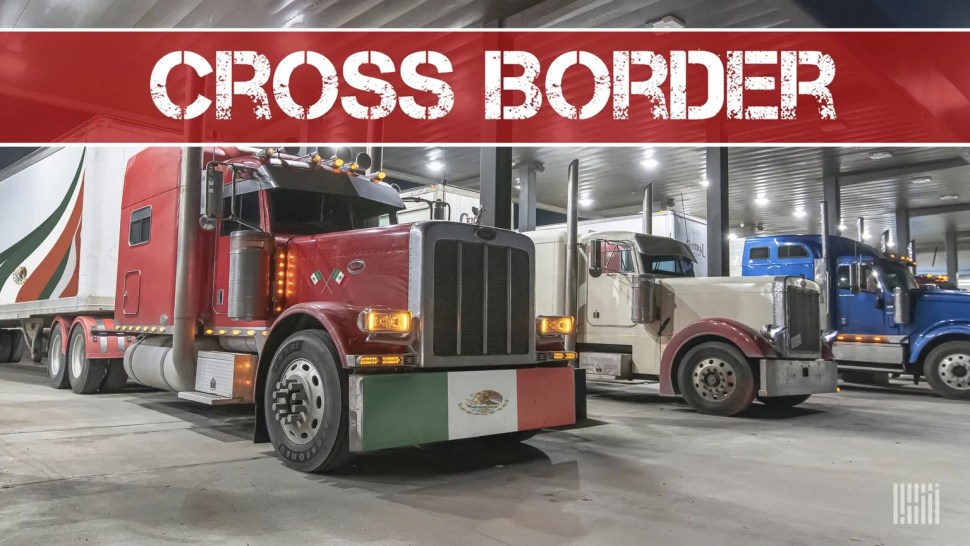
Borderlands Mexico is a weekly rundown of developments in the world of United States-Mexico cross-border trucking and trade. This week in Borderlands Mexico: Podcast series focuses on high-stakes US–Mexico trade conversations; Mexico begins tariffs of up to 35% on Chinese imports; and Chihuahua becomes Mexico’s top exporting state in 2025.
Podcast series focuses on high-stakes US–Mexico trade conversations
As U.S.–Mexico trade volumes continue to expand amid nearshoring shifts and policy uncertainty, a new podcast series is carving out a niche by focusing almost exclusively on the operational, regulatory and political realities of cross-border trucking.
The Borderless Coverage Series by Trucking Matters Podcast, hosted by Mark Vickers, executive vice president and head of international logistics at Reliance Partners, is designed to deliver what Vickers calls “consultant-level answers” to companies moving freight between the U.S. and Mexico.
Reliance Partners is a specialized insurance agency for the trucking industry.
“Reliance Partners started the Trucking Matters podcast, and within that — which is owned by Reliance Partners — I have my own Borderless Coverage series,” he said. “I’ve already recorded seven episodes.”
Vickers said he started the podcast series after repeated requests from industry peers and cross-border organizations, Trucking Matters has quickly attracted senior executives, policymakers and legal experts willing to speak candidly about what works — and what breaks — in international trucking.
“It really started when members of the Laredo Motor Carriers Association asked me to start a podcast,” Vickers said. “Then, after speaking on several panels at the Transportation Intermediaries Association conference, people kept asking for a podcast focused specifically on U.S.–Mexico cross-border logistics. I’d been hearing that for years.”
The Borderless Coverage Series aims to dive deep into the world of cross-border trucking and logistics, Vickers said.
“My questions are typically the ones you’d have to pay a consultant to get answers to,” he said. “The goal is high-value, action-oriented content from the best people in the business.”
Vickers said the core audience includes automotive, food and beverage, and electronics shippers, along with large U.S. logistics providers and freight brokerages already operating — or planning to expand — in Mexico.
Vickers said he looks almost exclusively for leaders with decades of hands-on experience who have taken real risks in cross-border logistics — and lived through failures.
“I want people who have invested heavily, failed in certain ways, figured out solutions, and can share that process,” he said. “If someone doesn’t have a deep logistics background, I’m not bringing them on.”
Recent and upcoming guests include Derek Leathers, chairman and CEO of Werner Enterprises Inc. (Nasdaq: WERN); Roberto Perez, founder and CEO of Forza Transportation; and Ernesto Gaytan Jr., general manager of Super Transport International.
Vickers said future episodes will address potential changes to the USMCA ahead of its 2026 review window, as well as how political rhetoric, tariffs and enforcement shifts could impact cross-border supply chains.
Despite ongoing uncertainty, Vickers remains bullish on U.S.–Mexico trade, saying that structural forces like nearshoring, labor costs and geographic proximity continue to outweigh political friction.
“Nearshoring or friend-shoring is hotter than ever, and it’s not stopping,” he said. “The cost dynamics still favor Mexico over China, and companies are increasingly asking why manufacturing shouldn’t be closer to the U.S.”
The Trucking Matters podcast and its Borderless Coverage series are available on Apple Podcasts, Spotify, Amazon Music, iHeartRadio and Pandora.
Mexico begins tariffs of up to 35% on Chinese imports
Mexico began enforcing sweeping new tariffs on imports from China and other Asian countries on Thursday, Reuters reported.
The move significantly raises trade barriers on thousands of products and aligns the country more closely with recent U.S. trade policy. The measures, approved by Mexico’s Congress earlier this month, raise tariffs — most up to 35% — on goods from nations without free trade agreements with Mexico — including China, India, South Korea, Thailand and Indonesia.
The tariffs will apply to a broad range of products, including automobiles, auto parts, textiles, apparel, plastics and steel, with Chinese goods expected to bear the largest impact. Mexican officials said the policy aims to protect roughly 350,000 domestic jobs, bolster local manufacturing and reduce trade imbalances, while generating an estimated $3.76 billion in additional government revenue in 2026.
China has criticized the tariffs, and some Mexican industries have warned of higher input costs.
Chihuahua becomes Mexico’s top exporting state in 2025
Mexico’s northern border state of Chihuahua emerged as the country’s largest exporting state in 2025, driven by strong growth in advanced manufacturing and technology-based industries, according to state government data, according to Mexico Business News.
Exports from Chihuahua totaled about $76.5 billion during the first nine months of the year, a 38.3% increase compared with the same period in 2024, outpacing national export growth and signaling a countercyclical trend amid a volatile global trade environment.
State officials attributed the surge primarily to rising foreign demand for computer equipment, electronics and high-value industrial goods.
Brokerage Compliance Symposium
The day before F3. Every compliance issue you face - fraud exposure, carrier liability, FMCSA rules, cargo theft, insurance gaps - navigated by attorneys and operators defining best practices in a changing industry.
F3 Awards Dinner
The night before F3. FreightTech100 companies honored. FreightTech 25 and Shipper of Choice winners revealed live. Cocktail reception into dinner and live music - 300 industry leaders in one purpose-built room.
F3: Future of Freight Festival
Industry-defining keynotes, rapid-fire technology demos, and industry leaders networking in experiences across Chattanooga - plus the inaugural F3 Awards Dinner featuring the FreightTech and Shipper of Choice reveals.
The day before F3. Every compliance issue you face - fraud exposure, carrier liability, FMCSA rules, cargo theft, insurance gaps - navigated by attorneys and operators defining best practices in a changing industry.
The Signal at Chattanooga Choo Choo • Chattanooga, TN Register NowThe night before F3. FreightTech100 companies honored. FreightTech 25 and Shipper of Choice winners revealed live. Cocktail reception into dinner and live music - 300 industry leaders in one purpose-built room.
The Signal at Chattanooga Choo Choo • Chattanooga, TN Register NowIndustry-defining keynotes, rapid-fire technology demos, and industry leaders networking in experiences across Chattanooga - plus the inaugural F3 Awards Dinner featuring the FreightTech and Shipper of Choice reveals.
The Signal at Chattanooga Choo Choo • Chattanooga, TN Register Now