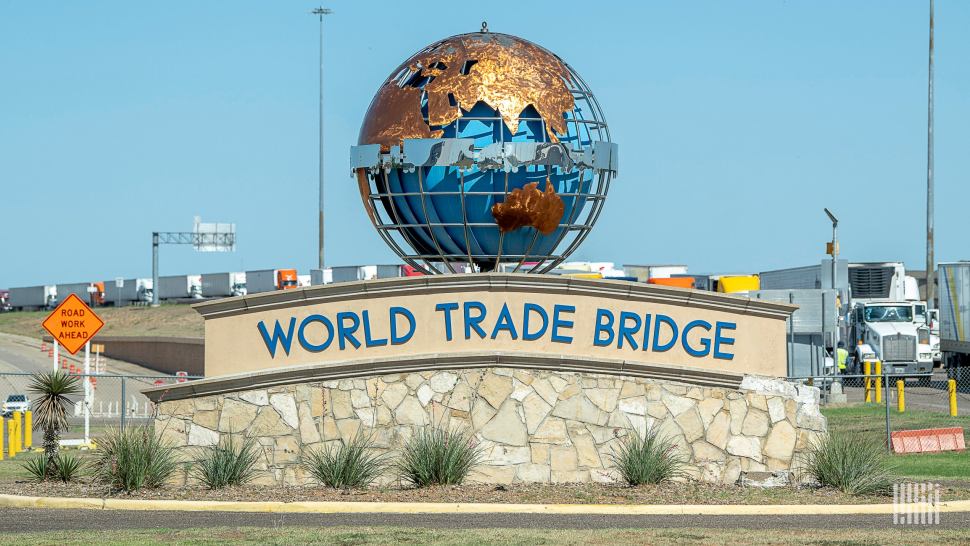
Borderlands Mexico is a weekly rundown of developments in the world of United States-Mexico cross-border trucking and trade. This week: USMCA review to reshape North American supply chains; Amazon to open 116K-square-foot last-mile facility in Beaumont; and Nissan opens internal logistics terminal in Aguascalientes.
USMCA review to reshape North American supply chains
Former U.S. Trade Representative Katherine Tai said the upcoming review of the United States-Mexico-Canada Agreement represents a critical turning point for North American trade, as the region faces rising geopolitical pressure, supply chain disruptions and uncertainty over tariffs and industrial policy.
Speaking Thursday at Rice University’s Baker Institute during the conference “The New Dynamics of North American Trade: The Review of USMCA 2026,” Tai said the agreement should be extended, but updated to reflect new economic realities, including China competition, supply chain resilience, energy policy and artificial intelligence.
“The operative question is what does it look like,” Tai said of the USMCA review. “The right USMCA should be extended.”
USMCA review is a major inflection point
Tai emphasized that the six-year review built into the USMCA is not a routine check-in but a major decision point that will determine whether the agreement continues and how it evolves.
The agreement includes a 16-year sunset clause, with a joint review required at the six-year mark to determine whether it will be extended.
The review comes at a time of heightened political tension and economic uncertainty across North America, including tariffs and shifting industrial policy priorities.
Conference organizers said the review comes amid “dramatic shifts in trade policies, including tariffs, supply chain pressures, and competing political priorities,” making the future of North American economic integration uncertain.
Supply chains, China and foreign investment scrutiny
Tai said one of the biggest lessons since USMCA took effect in 2020 is that supply chain resilience must become a central focus of trade policy, not just tariff reduction.
“Neither NAFTA nor USMCA were designed to foster resilience,” Tai said. “It is high time to learn from the painful lessons of recent years.”
She also said North America should coordinate more closely on foreign investment policy, particularly in response to growing competition from China.
“Not all foreign direct investment is the same,” Tai said, adding that the U.S., Mexico and Canada should work together to determine which investments strengthen regional economic security.
Autos, rules of origin and regional manufacturing
Tai said rules of origin — particularly in the automotive sector — will be one of the most important issues in the USMCA review, as North America tries to balance regional manufacturing with global competitiveness.
She noted that auto rules of origin were a central issue in both NAFTA and USMCA negotiations and remain critical as North American manufacturers face growing competition from China and other global producers.
Labor enforcement and trade enforcement expansion
Tai highlighted the USMCA’s Rapid Response Mechanism (RRM), which allows labor complaints to be filed against specific facilities in Mexico, calling it one of the most significant innovations in modern trade agreements.
“We initiated the first case ever under the RRM in May of 2021, a review of a General Motors
facility in Silao, Mexico, following reports of worker rights violations, including intimidation and
destruction of ballots during a contract vote,” she said. “The action ultimately led to a rerun election where workers rejected the old union, enabling a new independent union and securing better labor conditions at that facility.”
During her tenure as USTR, the U.S. initiated more than 30 RRM cases, resulting in back pay, reinstated workers and improved labor conditions affecting tens of thousands of workers, she said.
The mechanism demonstrates that trade agreements can be used to enforce labor standards and worker protections, not just reduce tariffs, Tai said.
Digital trade, AI and climate policy gaps
Tai said USMCA negotiators must also address digital trade, artificial intelligence and climate policy — areas that were not fully developed when the agreement took effect in 2020.
She specifically pointed to USMCA digital provisions modeled after Section 230 liability protections for tech platforms, saying those rules may no longer reflect political or economic realities.
Tai also said North America has missed opportunities to incorporate climate and energy transition policies into trade agreements and should address those issues in the upcoming review.
‘Smarter, more strategic integration’
Tai concluded that North America is not moving toward either full integration or fragmentation, but toward what she described as “smarter, more strategic integration” focused on economic security and resilience.
“What I would like to see for North America is smarter, more strategic integration that improves the economic security of each of the North American partners and the region as a whole,” Tai said.
Amazon to open 116K-square-foot last-mile facility in Beaumont
Amazon (Nasdaq: AMZN) is opening a new last-mile delivery station in Beaumont, Texas, a 116,000-square-foot facility designed to speed up deliveries across the Golden Triangle region, according to a city announcement.
The delivery station, currently under construction along Walden Road, will handle the final stage of Amazon’s fulfillment process, sorting packages before they are loaded onto delivery vehicles for final delivery to customers, according to a news release.
City officials said the project reinforces Beaumont’s role as a regional logistics hub, citing the area’s location, workforce and transportation access as key factors in Amazon’s decision.
Amazon has invested more than $84.3 billion in Texas since 2010 and employs over 86,500 full- and part-time workers statewide, with its investments contributing an estimated $97.7 billion to the Texas economy, according to the company.
Nissan opens internal logistics terminal in Aguascalientes
Nissan Mexicana has opened a new internal logistics hub in Aguascalientes designed to improve transportation flows and support vehicle and parts distribution operations, according to Mexico Business News.
The Nissan Internal Fleet Terminal (NIFT), an 861,112.83-square-foot complex located between the company’s A1 and A2 plants, will support the movement of millions of parts and thousands of vehicles, while providing space to safeguard more than 260 tractor-trailers used in the company’s internal fleet operations.
The facility is part of Nissan’s broader strategy to strengthen logistics as a competitive advantage in Mexico, where the automaker moves more than 3 million parts daily and distributes over 4,000 finished vehicles to domestic and export markets.
The terminal also includes infrastructure for more than 400 workers, including driver facilities and training programs, as Nissan continues expanding its logistics capabilities to support production and export growth.
Brokerage Compliance Symposium
The day before F3. Every compliance issue you face - fraud exposure, carrier liability, FMCSA rules, cargo theft, insurance gaps - navigated by attorneys and operators defining best practices in a changing industry.
F3 Awards Dinner
The night before F3. FreightTech100 companies honored. FreightTech 25 and Shipper of Choice winners revealed live. Cocktail reception into dinner and live music - 300 industry leaders in one purpose-built room.
F3: Future of Freight Festival
Industry-defining keynotes, rapid-fire technology demos, and industry leaders networking in experiences across Chattanooga - plus the inaugural F3 Awards Dinner featuring the FreightTech and Shipper of Choice reveals.
The day before F3. Every compliance issue you face - fraud exposure, carrier liability, FMCSA rules, cargo theft, insurance gaps - navigated by attorneys and operators defining best practices in a changing industry.
The Signal at Chattanooga Choo Choo • Chattanooga, TN Register NowThe night before F3. FreightTech100 companies honored. FreightTech 25 and Shipper of Choice winners revealed live. Cocktail reception into dinner and live music - 300 industry leaders in one purpose-built room.
The Signal at Chattanooga Choo Choo • Chattanooga, TN Register NowIndustry-defining keynotes, rapid-fire technology demos, and industry leaders networking in experiences across Chattanooga - plus the inaugural F3 Awards Dinner featuring the FreightTech and Shipper of Choice reveals.
The Signal at Chattanooga Choo Choo • Chattanooga, TN Register Now