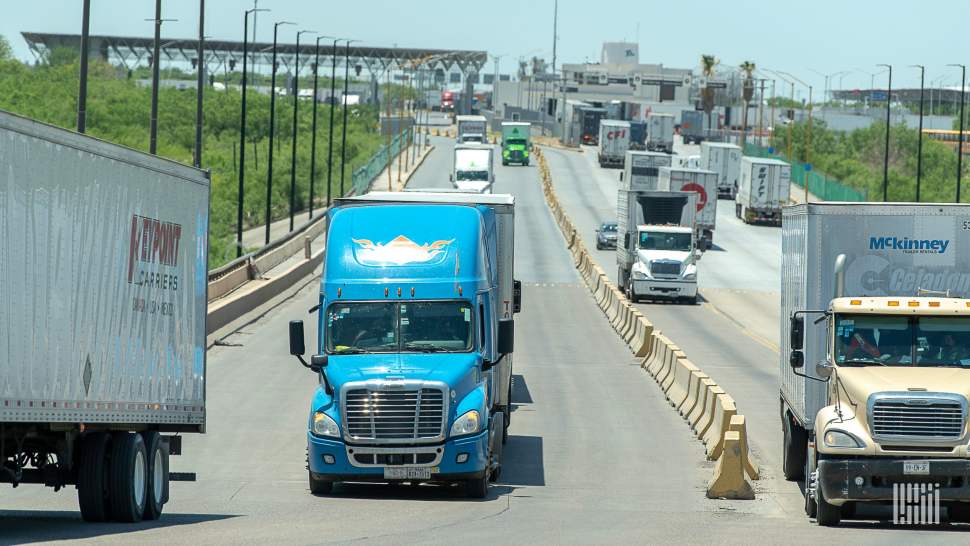
Borderlands Mexico is a weekly rundown of developments in the world of United States-Mexico cross-border trucking and trade. This week, Volatile trade, rising carrier costs reshape retail shipping strategies; Cainiao launches U.S.–Mexico cross-border logistics service; and Speedora launches white-glove logistics service in Arizona.
Volatile trade, rising carrier costs reshape retail shipping strategies
As tariffs fluctuate and shipping costs climb, retailers are increasingly turning to technology, multi-carrier strategies and greater price transparency to protect margins and customers, according to Josh Steinitz, chief strategy officer at ShipStation.
“Customer expectations are high and always getting higher, and that hasn’t changed despite all of the thrash in the shipping environment,” Steinitz said. “Speed, service and transparency are still key differentiators.”
Austin, Texas-based Shipstation, powered by Auctane, is a global company focused on providing e-commerce shipping and fulfillment solutions for businesses.
SMBs diversify carriers to manage risk
ShipStation, which works with hundreds of thousands of small- and medium-sized merchants (SMBs), is seeing customers move away from reliance on a single carrier or static rate card.
Instead, merchants are increasingly adopting diversified carrier mixes, regional providers and rate-shopping tools to regain control over shipping costs.
“Merchants are needing to take the wheel a little more of their own shipping destiny,” Steinitz said. “That means using automation and analytics to optimize their carrier mix and manage risk instead of relying on one provider.”
Cross-border complexity remains a major hurdle
International shipping remains one of the biggest challenges for smaller retailers, particularly as tariffs and customs rules change frequently. Steinitz said many SMBs lack the resources that large enterprises use to manage duties, taxes, currency conversion and customs brokerage.
“Historically, it’s been very hard for the average small or medium business to sell globally,” he said. “They don’t have massive software teams or the volumes needed to justify custom solutions.”
To address that, ShipStation has been investing in tools designed to simplify cross-border commerce, including delivery-duties-paid (DDP) capabilities that allow customers to see full landed costs at checkout. Steinitz said transparency is critical to driving conversion and reducing abandoned carts.
“If I don’t know what the total cost is to get the item to my front door, I’m just not going to buy it,” he said. “Surprise duties or fees kill conversion.”
Margin protection is about “best value,” not just lowest cost
While slower shipping is often cheaper, Steinitz cautioned that lowest cost isn’t always the best strategy. Instead, ShipStation is helping merchants focus on what he described as “best value” — balancing speed, cost and customer expectations to maximize overall efficiency.
“Sometimes offering a slightly faster, slightly more expensive service is actually better because it drives higher conversion,” he said. “It depends on the product and the situation.”
He compared the tradeoff to everyday consumer behavior: shoppers may pay a premium for urgent items but wait longer for nonessential purchases.
Adapting to a volatile trade environment
Steinitz acknowledged that policy shifts, including changes to de minimis rules and ongoing tariff disputes, have forced many carriers and retailers to rethink their networks. Some cross-border sellers, particularly those shipping from China to the U.S., have responded by investing in domestic fulfillment as regulations tighten.
“Tariffs aren’t a good thing for the world,” he said. “But what we can do is make the complexity easier for merchants to navigate.”
Take control, or fall behind
For retailers facing continued uncertainty in 2026, Steinitz said the biggest mistake is passivity.
“Don’t rely on a single carrier, a single rate card, or a single service,” he said. “Think of shipping as a portfolio and use software to constantly ensure you’re getting the best price, best service and best customer experience.”
As volatility becomes a permanent feature of global trade, retailers that invest in flexibility, transparency and automation are more likely to protect margins — and customer loyalty — in the year ahead.
Cainiao launches U.S.–Mexico cross-border logistics service
Cainiao, the logistics unit of Alibaba Group, has launched a cross-border supply chain service connecting the U.S. and Mexico, expanding its footprint in one of North America’s busiest e-commerce corridors.
The service, Cainiao’s first cross-border offering in the Americas, is designed to handle parcel flows between the two countries and is expected to reach 99% of Mexico, according to a news release.
Cainiao said the service will be priced at about 60% of the current market average, aiming to lower cross-border shipping costs for e-commerce platforms and merchants.
Cainiao plans to directly control key logistics nodes, including sorting, line-haul transportation and last-mile delivery, relying on self-operated local networks in both the U.S. and Mexico rather than outsourcing, the company said
Speedora launches white-glove logistics service in Arizona
Speedora has launched an asset-owned logistics service in Arizona, targeting the big-and-bulky white-glove delivery market, according to a news release.
The Phoenix-based company said it will operate its own fleet and employ a dedicated delivery workforce to provide greater control over final-mile performance for high-value shipments such as furniture and specialized equipment.
Speedora is launching operations across Phoenix and Southern California, with plans to expand into Northern California as it builds a West Coast delivery network.
Speedora founder and CEO Bob Smith said the goal is to improve accountability and customer experience in a last-mile sector often marked by inconsistent service.
Brokerage Compliance Symposium
The day before F3. Every compliance issue you face - fraud exposure, carrier liability, FMCSA rules, cargo theft, insurance gaps - navigated by attorneys and operators defining best practices in a changing industry.
F3 Awards Dinner
The night before F3. FreightTech100 companies honored. FreightTech 25 and Shipper of Choice winners revealed live. Cocktail reception into dinner and live music - 300 industry leaders in one purpose-built room.
F3: Future of Freight Festival
Industry-defining keynotes, rapid-fire technology demos, and industry leaders networking in experiences across Chattanooga - plus the inaugural F3 Awards Dinner featuring the FreightTech and Shipper of Choice reveals.
The day before F3. Every compliance issue you face - fraud exposure, carrier liability, FMCSA rules, cargo theft, insurance gaps - navigated by attorneys and operators defining best practices in a changing industry.
The Signal at Chattanooga Choo Choo • Chattanooga, TN Register NowThe night before F3. FreightTech100 companies honored. FreightTech 25 and Shipper of Choice winners revealed live. Cocktail reception into dinner and live music - 300 industry leaders in one purpose-built room.
The Signal at Chattanooga Choo Choo • Chattanooga, TN Register NowIndustry-defining keynotes, rapid-fire technology demos, and industry leaders networking in experiences across Chattanooga - plus the inaugural F3 Awards Dinner featuring the FreightTech and Shipper of Choice reveals.
The Signal at Chattanooga Choo Choo • Chattanooga, TN Register Now