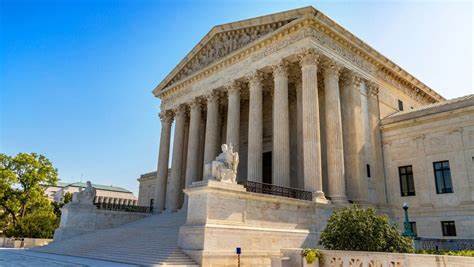
The so-called safety exception of the Federal Aviation Administration Authorization Act (F4A) includes the freight brokerage industry in its umbrella, the Supreme Court ruled Thursday in the closely-watched case of Montgomery vs. Caribe Transport II.
The decision of the court was unanimous.
Its immediate impact is that the Supreme Court decision clears up conflicting circuit court cases about whether a 3PL can be sued in state court for damages resulting from a crash involving a carrier the broker hired. With this decision, the circuit conflicts are essentially settled and the question has been answered: yes, they can.
At issue was the phrase “with respect to motor vehicles” in F4A. That wording in the safety exception allowed state action on issues of safety to proceed even where F4A otherwise barred state actions that might impact a “price, route or service.” Does “respect to motor vehicles” include the broker that hired the carrier driving that vehicle?
The 9-0 vote, stunning not necessarily in its outcome but in its unanimity, emphatically answers that brokers are subject to tort action in a state court for incidents involving carriers they hired.
The decision remands the Montgomery case back to the Seventh Circuit. It is that court, and a lower Illinois federal court before that, which had ruled that brokers were not covered by F4A and its “with respect to motor vehicles” decision, and therefore state action against a broker was blocked by the rest of the law.
With that action, presumably C.H. Robinson (NASDAQ: CHRW) will return to the case as a defendant. It was C.H. Robinson that booked Caribe Transport II and was one of the defendants in the original case filed by Shawn Montgomery, the truck driver who was on the side of the road when struck by a Caribe truck. His leg needed to be amputated and Montgomery suffered other injuries as well.
C.H. Robinson led the defense of the case before the Supreme Court in early March oral arguments. The timing of Thursday’s decision took some attorneys by surprise, as they had assumed the decision might not come down until late June.
In the opinion penned by Amy Comey Barrett, who some attorneys, based on her questioning during oral arguments, assumed might be a swing vote in the decision, the summation passage said “the preemption question thus boils down to whether negligent-hiring claims of the type Montgomery presses are claims ‘with respect to motor vehicles.’ We conclude that they are.”
Defining ‘with respect to’
After reviewing dictionary definitions of “with respect to,” Judge Barrett then notes that F4A says a motor vehicle is a “machine, tractor, trailer, or semitrailer propelled or drawn by mechanical power and used on a highway in transportation.”
“Putting the pieces together, a claim is ‘with respect to motor vehicles’ if it ‘concerns’ or ‘regards’ the vehicles used in transportation,” Justice Barrett writes.
“Applying that interpretation here is straightforward,” Justice Barrett adds. “Montgomery alleges that C.H. Robinson failed to exercise reasonable care when it hired Caribe Transport, which had a subpar safety rating from federal regulators, to transport goods via truck. Based on that safety rating, Montgomery claims that C.H. Robinson knew (or should have known) that choosing Caribe Transport to move goods was reasonably likely to cause an accident. Requiring C.H. Robinson to exercise ordinary care in selecting a carrier therefore ‘concerns’ motor vehicles—most obviously, the trucks that will transport the goods. So Montgomery’s negligent-hiring claim falls within the FAAAA’s safety exception, which saves it from preemption.”
Rebutting C.H. Robinson’s arguments
Justice Barrett’s decision tackled several of C.H. Robinson’s arguments.
She dismissed the brokerage’s claim that allowing the safety exception to bring in brokerages would by extension bring in other activity as well.
“The safety exception saves only a subset of preempted claims: those involving regulations concerning motor vehicle safety,” Justice Barrett wrote in response.
There were also C.H. Robinson arguments about language within F4A regarding intrastate versus interstate transportation. Justice Barrett conceded there was a lack of logical consistency in some section of F4A.
But she then wrote: “Better to live with the mystery than to rewrite the statute.”
In a separate opinion that concurs with the decision by Justice Barrett, Justice Brett Kavanaugh, joined by Justice Samuel Alito, said the two justices believed “this case is closer than the Court’s opinion might suggest.”
The justices say the answer to the question of broker liability “depends on how expansively to read the key statutory phrase ‘with respect to motor vehicles.’ That inquiry is complicated because the phrase “with respect to”—like similar statutory phrases such as “related to” or ‘relating to’—is a somewhat elastic phrase whose breadth is determined by context.”
Even in concurring with the decision, the two separate justices support the brokerage industry’s argument that minimum insurance coverage mandates “suggests to at least some extent that Congress did not anticipate state tort suites against brokers for negligent selection. Otherwise, Congress presumably would have mandated insurance coverage for brokers as well.”
The two justices also discuss the intrastate-interstate dichotomy also raised by Justice Barrett.
The points raised by Justices Alito and Kavanaugh “favor the brokers and point toward a narrower construction of ‘with respect to motor vehicles’ such that state tort suits against brokers would be preempted,” the concurring opinion says. “But other contextual points decisively tilt in the opposite direction and point toward a broader construction of ‘with respect to motor vehicles’ such that state tort suits against brokers would be permitted.”
Montgomery broker case before SCOTUS featured topic in Robinson’s earnings call
At TIA meeting, freight brokers brace for Supreme Court decision
Strange bedfellows as states say brokers not protected under ‘safety exception’
Brokerage Compliance Symposium
The day before F3. Every compliance issue you face - fraud exposure, carrier liability, FMCSA rules, cargo theft, insurance gaps - navigated by attorneys and operators defining best practices in a changing industry.
F3 Awards Dinner
The night before F3. FreightTech100 companies honored. FreightTech 25 and Shipper of Choice winners revealed live. Cocktail reception into dinner and live music - 300 industry leaders in one purpose-built room.
F3: Future of Freight Festival
Industry-defining keynotes, rapid-fire technology demos, and industry leaders networking in experiences across Chattanooga - plus the inaugural F3 Awards Dinner featuring the FreightTech and Shipper of Choice reveals.
The day before F3. Every compliance issue you face - fraud exposure, carrier liability, FMCSA rules, cargo theft, insurance gaps - navigated by attorneys and operators defining best practices in a changing industry.
The Signal at Chattanooga Choo Choo • Chattanooga, TN Register NowThe night before F3. FreightTech100 companies honored. FreightTech 25 and Shipper of Choice winners revealed live. Cocktail reception into dinner and live music - 300 industry leaders in one purpose-built room.
The Signal at Chattanooga Choo Choo • Chattanooga, TN Register NowIndustry-defining keynotes, rapid-fire technology demos, and industry leaders networking in experiences across Chattanooga - plus the inaugural F3 Awards Dinner featuring the FreightTech and Shipper of Choice reveals.
The Signal at Chattanooga Choo Choo • Chattanooga, TN Register Now