




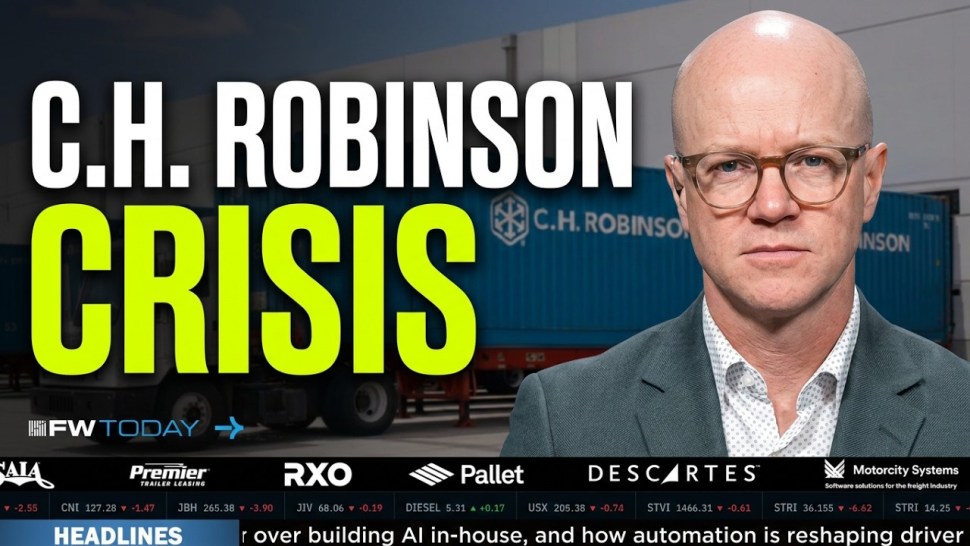
The C.H. Robinson earnings call was overshadowed by the massive $600M nuclear verdict. FreightWaves’ John Kingston and Max Fuller dive into the lawsuit’s implications, from rising insurance costs to the redefinition of independent contractor status. Is this an existential threat to the brokerage business model as we know it?
C.H. Robinson’s CEO Dave Bozeman addressed the Dallas County nuclear verdict directly on the company’s earnings call — defying expectations from some analysts that lawyers would keep him silent — confirming the broker will appeal and warning that the process “could take years.” The stock has fallen roughly 20% over the past five days, and Citibank characterized the $600 million award as an existential threat to brokers and their business model.
The verdict has not yet been formally affirmed by the presiding judge, and C.H. Robinson is waiting on that step before launching its appeal. Bozeman disclosed that settlement talks did occur but were rejected on the recommendation of the company’s insurers. FreightWaves Senior Editor John Kingston noted that rating agencies are a secondary concern: “I’ve been sort of checking every day… to see if Moody’s and/or S&P Global puts them on some credit watch,” he said, adding that a $600 million charge would need to be accounted for on the balance sheet if the verdict is affirmed.
Kingston pointed to Wabash National’s experience as a precedent. That company faced a St. Louis verdict exceeding $400 million, took a charge, and ultimately settled for still over $100 million. He also noted the Texas Supreme Court previously knocked a large Werner judgment down to zero, a fact C.H. Robinson’s legal team is almost certainly tracking.
“This was not some fly-by-night carrier. They had a satisfactory rating before the accident. Even after the accident, they had a satisfactory rating,” Kingston said. “The jury found that the driver was effectively an employee of C.H. Robinson. And their argument is, we’ve never employed a driver in our life.”
Those two findings — that a vetted, satisfactory-rated carrier was still grounds for broker liability, and that the driver could be deemed a C.H. Robinson employee despite receiving a W-2 from carrier Lupus Superior — may carry more long-term weight than the dollar figure itself, Kingston argued. The Transportation Intermediaries Association has already filed a formal rulemaking request with FMCSA seeking clarity on what constitutes appropriate broker behavior in carrier vetting. C.H. Robinson’s position is that it hired a carrier with approximately 200 power units and a satisfactory safety rating, leaving open the question of what more a broker could reasonably be expected to do.
The independent contractor classification issue extends the case’s potential reach well beyond brokerage. If Texas courts uphold the finding that a W-2 employee of a carrier can simultaneously be deemed an employee of the hiring broker, the implications could touch Amazon, FedEx, and any company relying on third-party trucking relationships, according to discussion on the broadcast. One panelist said he could not imagine the verdict surviving appeal, but noted that plaintiff attorneys will be drawn by the $600 million figure regardless.
Beyond the Robinson litigation, Kingston flagged consistent themes across the broader earnings cycle: insurance costs are expected to rise across the board, shippers will increasingly seek out high-quality carrier capacity, and multiple executives — including Covenant Logistics’ David Parker — described the current structural market shift as unlike anything in their careers. On a lighter note, Kingston highlighted TFI International’s strong truckload results, driven by its specialty flatbed segment built around the former Daseke unit, with CEO Alain Bedard eager to spotlight that business as LTL operations tied to the former UPS Freight network continue to lag.
- C.H. Robinson faces a $600 million unaffirmed Texas verdict it plans to appeal, with CEO Dave Bozeman warning the process could take years and settlement talks already rejected on insurer advice.
- Beyond the dollar figure, the jury’s findings that a satisfactory-rated carrier still triggered broker liability and that the driver was effectively a C.H. Robinson employee pose broad structural risks for the brokerage model.
- Insurance costs are rising industry-wide in the wake of nuclear verdicts, and the Transportation Intermediaries Association has filed a formal FMCSA rulemaking request to clarify broker vetting standards.
Speaker 1 [0:00] Welcome back to FreightWaves Today. John Kingston, all I gotta say is the word oil and you just show up in my monitor. How are you, sir?
Speaker 2 [0:06] You’re my boss. I show up no matter what word you say.
Speaker 1 [0:09] There is some truth there, but I also have magic words. John, you’ve been covering the earnings of all of these different players in logistics. Well, I wanna talk CH ’cause it’s— everyone’s been watching CH for obviously, you know, it’s been the most targeted, we’ll say, in terms of lawsuits. A lot of noise around the stock with the Supreme Court decision, as well as the lawsuit in Texas.
Speaker 3 [0:37] The—
Speaker 1 [0:39] what is the name of that?
Speaker 4 [0:40] Lupus. Thank you.
Speaker 1 [0:41] Lupus Superior. John, tell us about what you’re hearing.
Speaker 2 [0:45] Well, so the earnings call was interesting. First of all, I predicted on X, on Twitter last week, that Dave Bozeman, the CEO, would not be allowed to talk about it because the lawyers would tell him not to. I was totally 100% wrong on that, and he talked about the case quite a bit. The call was interesting because it started out— C.H. Rommerson is just laser-focused on this message about lean AI and all the impact it is having, which there is no doubt about it. Once again, their headcount was down, revenue and profits are up. Obviously, you can see where the impact of AI is in terms of per-employee performance. But I mean, I have to laugh because these are the same analysts who have heard the same message over and over again. I do not know. They are not— CH Ramas’ job is not to write news for me. Anyway, so it started by talking about that. The performance was solid. The financial performance was solid. But then, yes, they did get into the case, the Dallas County case. In it, they repeated that they are going to appeal. Remember, and they reiterated a couple of times that it’s been a week now, and the judge down there has not yet affirmed the verdict. So they’re waiting on that. If she does affirm the verdict, they will appeal. You know, at one point, Dave Bozeman said he expects that this process could take years. There were settlement talks. He would not go into what they were, but they rejected it basically on on the recommendation of their insurers. They rejected that. And you know what, you heard this on several calls, not just C.H. Robinson, but you heard that insurance costs are inevitably going to go up, number one, and everybody will be looking for high-quality capacity. So that is the message that really has come through in the wake of not just Montgomery, because this was the first earnings cycle since Montgomery came down, but also since the nuclear verdict. So there was quite a bit there. The other message that came, I know you said David Parker is going to be on. Their earnings call was yesterday. Our story on it is going to go out as soon as this is over. He just got on, and most of that call was handled by James Grant, who’s the CFO. But when Mr. Parker spoke, he just said, this is unique in my long history, the structural change in the market. Several people on several other calls said, The driver— I guess I was about to say driver shortage. You know, the market for drivers, the market for drivers is definitely tight, no doubt about it. They all had praise for the DOT and actions that the Trump administration has taken. So that was a kind of a, you know, consistent message through the calls that I’ve done.
Speaker 1 [3:26] John, it’s @JohnKingston if you want to send your hate mail about the driver shortage comments, not @FreightAlley, just in case the drivers have strong opinions about that. So John, by the way, Tripp Grant, James Grant, I think is the official name. I went to school with the kid. Zach Strickland, Tripp and I all were in the same class here in Chattanooga at McCauley. So we all went to school. It’s cool to see 2 of the non-truckers. I grew up in it. I didn’t have a choice but to be in this industry. But both Zach and Tripp are in this industry. When we hear about, we think about C.H. Robinson, did we learn anything new? I mean, obviously they’re talking about appeal.
Speaker 3 [4:06] It wasn’t a shock.
Speaker 1 [4:09] They’re talking about, you know, AI. You talked about how persistent this is. Wall Street sold off. We’re down 20% in the last 5 days. But what did we learn on that call, John?
Speaker 2 [4:21] I don’t know that you learned much. There really wasn’t much that they said that they hadn’t said in their statements after the verdict. I will say I’ve been sort of checking every day, and then my guess is this would not come until the judgment was affirmed, to see if Moody’s or Moody’s and/or S&P Global puts them on some credit watch. Because right now, they are going to essentially— if it is affirmed, they have got a $600 million charge that they have got to account for somewhere. Jason Seidel of TD Cowen mentioned that too in his post-earnings call report, that there very well may be a charge taken. Wabash National took a charge. They had that gigantic St. Louis verdict. over $400 million. They eventually— and they did take a charge. I don’t know if they took the full $400 million. And then they knocked that down on settlement. But that settlement was still over $100 million. They had to take a charge on that too. At a certain point, this does become real money. I think that now it just seems so far from when they’re going to have to write a check. You had a verdict last week, still hasn’t been affirmed. You start the appeals process. So, uh, you wonder how much that’s going to impact their bottom line. But someday, unless the whole thing is tossed out, uh, there will be a charge. Let’s remember, this is Texas. The Texas Supreme Court eventually got a hold of that big Werner judgment a couple of years ago and knocked that down to zero. So, uh, I can’t imagine that the C.H. Robinson lawyers aren’t looking at that.
Speaker 1 [5:48] Look, I, I think every defense attorney in the country and every compliance officer is thinking, God blessed Texas Supreme Court, hoping that this thing gets disputed. If you’re running a broker, you got to do it. I got to ask you, when you guys were public, when you were running a public company—
Speaker 3 [6:05] Right.
Speaker 1 [6:05] You have a big, massive lawsuit risk that’s there. Wall Street— I think maybe because these cases are so big, and the lawsuit is so big, that C.H. Robinson doesn’t have a choice but to talk about it. How did you guys handle that in terms of discussing Wall Street? Because you have the The plaintiff’s attorneys are— everything you can will be used against you.
Speaker 3 [6:28] You had to watch anything that you said because like you said, it would be used against you. It’s hard to defend yourself in the public eyes when the other attorneys are trying to find something that you said, one word that you might have said wrong, and they would use that one word to build a whole case around. The judges today are letting a lot of these people run.
Speaker 1 [6:53] You’re talking about plaintiffs?
Speaker 3 [6:55] Plaintiffs. But the judges are letting them run to find anything wrong. It doesn’t have to be anything that really affected the accident, but they’re letting them find something that’s wrong in maybe hiring or something that the company’s done or anything. to create a judgment against them. And it’s really sad. This industry is going to change and change a lot if tort reform doesn’t happen. And it’s got to happen pretty fast because if you look at almost every major trucking company out there, they’re dealing with this type of stuff, whether it’s higher insurance costs or whether it’s their own balance sheet being in jeopardy.
Speaker 1 [7:37] I think Citibank Citibank’s quote was that this lawsuit, the C.H. Robinson lawsuit, the award, that nuclear verdict is an existential threat to brokers and the business model, John.
Speaker 2 [7:54] 2 things. Everybody tends to get focused on the dollar number, understandably, but there are 2 other things in here that are probably even more scary for brokers. Number one, this was not some fly-by-night carrier. They had a satisfactory rating before the accident. Even after the accident, they had a satisfactory rating. The other thing is that the jury found, and this gets into the whole sort of independent contractor law, that the driver was effectively an employee of C.H. Robinson. And their argument is, we’ve never employed a driver in our life. And so this is not just a— the issues here are not just a lot of money. Those are two— those issues have legs. And so you kind of got to watch that too. in any kind of resolution. Let’s remember something, that a few weeks ago, the Transportation Intermediaries Association, the TIA, which is the brokerage trade group, put out, I guess, a formal request for a rulemaking from FMCSA on what constitutes appropriate behavior on the part of brokers. I mean, the C.H. Robinson point of view would be, we hired a guy who’s solid. I think he had 200 power units. And he had a satisfactory rating, and now we’re getting stuck with a $600 million verdict. What else were we supposed to do?
Speaker 1 [9:10] But I think it goes down, John, this idea that Matt Loeffler and I are going to get into this later today on Freight Expectations. And Matt is an attorney, transportation attorney, particularly transportation law, loves these Supreme Court decisions, these decisions that ultimately is going to get appealed. The whole thing, as far as he can tell is the definition of an employee. And in this particular decision, the jury decided for whatever reason that the driver that died— he passed away— was an employee of Sage Robinson. That seems like— and we’re going to get into this later today— but it seems like everything rides on that one issue. And if somehow that gets held up in the court system, if the courts and all the way to the Supreme Court— I imagine this would go all the way to the federal Supreme Court if this this plays out, which is why we’re talking many years. If somehow Texas upholds it, this puts all of the independent contractor services, including Amazon, FedEx, all of these different companies, puts the entire business at risk, John.
Speaker 2 [10:15] But let’s remember something, though, about this driver. He was a W-2 employee of Lupus Superior. So I think it’d be a little more complicated. if he was an independent owner-operator that got hired by Lupus Superior. And then maybe, you know, the whole question of independent contractor status, et cetera, might get a little more cloudy. But this guy got a paycheck from Lupus Superior. So that establishes that he’s an employee. He got a W-2 every year from Lupus Superior. How can you be an employee of somebody else when that’s happening?
Speaker 1 [10:49] I mean, this is in Texas. I can’t imagine, I mean, like my perspective, and again, I wanna get into it, Matt Leffler, we’re gonna get into it deeper. Stay tuned for that. I can’t imagine this holds up on appeal. Like, I think it’s going to get thrown out on appeal.
Speaker 4 [11:03] Yeah, but is the damage already done in their stock price?
Speaker 1 [11:05] Well, look, plaintiff’s attorneys read this, $600 million, it’s just going to attract them that much more. They’re like vultures. They smell it. They attack it. They want it. They taste it.
Speaker 4 [11:17] So, John, I could talk about this.
Speaker 1 [11:20] We have a lot to talk about, Ernie.
Speaker 4 [11:22] Yeah, I was going to say, last final question because we’re out of time. You know, Heartland, Werner, Schneider, lots of other earnings. Anything stand out in any of those to you?
Speaker 2 [11:30] Well, I didn’t do Heartland or Schneider. My colleague Todd Maiden did that. I did Werner. I guess the thing that stood out is like it was good. I probably, after all the talk of higher rates, I may have expected better. I thought one of the more interesting was TFI International. You know, we tend to think of them primarily as an LTL carrier. And the fact is more of their revenue comes from LTL primarily. A lot of it the old UPS Freight arm. Um, their, their truckload did really well, and a lot of what did really well is what they call the specialty group. And the core of that is the old Desky, uh, flatbed unit that they bought. They’re doing really well on that, a lot of AI-related work. Uh, so, you know, normally— I mean, I’ve been doing these calls for TFY for quite a while— the talk tends to focus in on their LTL operations because the ones in the US, the former UPS operations have been struggling. But this call was interesting because there was a lot more talk about truckload, and clearly Alain Bardard wanted to talk about that. And anytime he talks, it’s really entertaining.
Speaker 1 [12:32] Yeah, it’s interesting because people have asked, how do you get exposure to flatbed? There is— Daseke was the only pure-play flatbed public company. It is now part of TFI. And look, if I were If I were running the business, if I were running TFI, we’re talking about a flatbed all the time.
Speaker 4 [12:51] Oh gosh, especially in this market.
Speaker 1 [12:52] So much sexier.
Speaker 3 [12:52] That’s a big word.
Speaker 1 [12:53] The industrial economy is back. John Cason, we’ll have you back next week to talk more oil, energy, and earnings. This rock and roll continues on.
Brokerage Compliance Symposium
The day before F3. Every compliance issue you face - fraud exposure, carrier liability, FMCSA rules, cargo theft, insurance gaps - navigated by attorneys and operators defining best practices in a changing industry.
F3 Awards Dinner
The night before F3. FreightTech100 companies honored. FreightTech 25 and Shipper of Choice winners revealed live. Cocktail reception into dinner and live music - 300 industry leaders in one purpose-built room.
F3: Future of Freight Festival
Industry-defining keynotes, rapid-fire technology demos, and industry leaders networking in experiences across Chattanooga - plus the inaugural F3 Awards Dinner featuring the FreightTech and Shipper of Choice reveals.
The day before F3. Every compliance issue you face - fraud exposure, carrier liability, FMCSA rules, cargo theft, insurance gaps - navigated by attorneys and operators defining best practices in a changing industry.
The Signal at Chattanooga Choo Choo • Chattanooga, TN Register NowThe night before F3. FreightTech100 companies honored. FreightTech 25 and Shipper of Choice winners revealed live. Cocktail reception into dinner and live music - 300 industry leaders in one purpose-built room.
The Signal at Chattanooga Choo Choo • Chattanooga, TN Register NowIndustry-defining keynotes, rapid-fire technology demos, and industry leaders networking in experiences across Chattanooga - plus the inaugural F3 Awards Dinner featuring the FreightTech and Shipper of Choice reveals.
The Signal at Chattanooga Choo Choo • Chattanooga, TN Register Now