




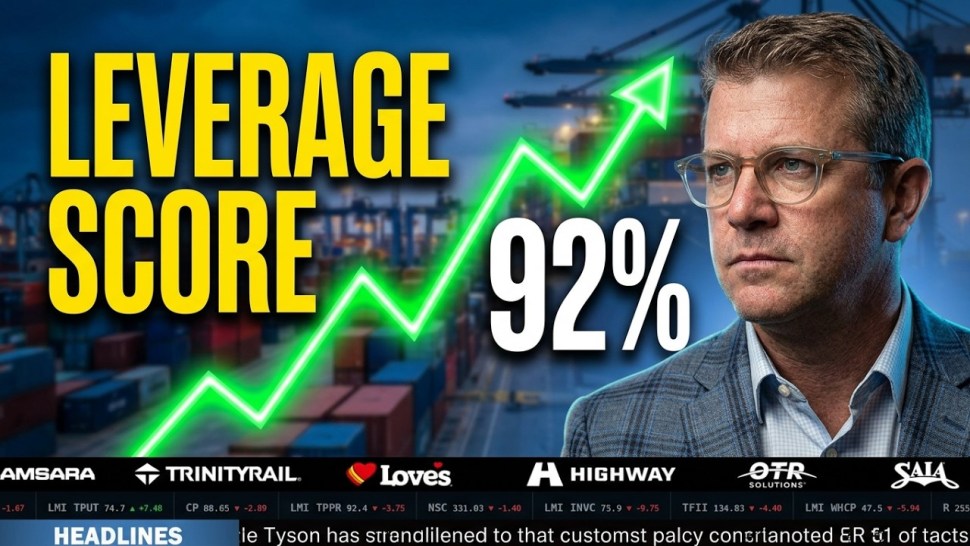
In today’s evolving freight market, gaining carrier loyalty means becoming a true “shipper of choice.” Covenant’s Tyson Wimberly shares actionable insights from the Univar Carrier Kickoff on what carriers look for in long-term partners. Discover strategies for visibility, operational alignment, and how to differentiate your business to secure capacity amidst fierce competition.
Carriers are entering a stronger negotiating position than they have held in years, but the industry still faces compounding cost pressures from insurance inflation and an underpaid driver workforce, according to Tyson Wimberly, Senior Vice President of Sales and Revenue Management at Covenant Transport. Wimberly spoke with FreightWaves at the Univar Carrier Kickoff event in Chattanooga, where Covenant joined peer carriers and shipper leadership to align on long-term capacity planning.
“We are in a much more favorable marketplace than we were the last four years — that’s a fact,” Wimberly said. The shift matters for shippers because carriers with leverage will increasingly direct capacity toward accounts that offer network visibility, freight predictability, and what Wimberly called “linear consistency” in weekly volumes.
“How are we collaborating with our shippers to take out this variability of saying, I really need steady business — linear consistency. And that’s really why we’re here today with Univar, is to understand how do we plug in and solve more solutions for them.”
On the regulatory front, Wimberly cited six or seven rules currently in full national enforcement, with another three to five on the docket — a pipeline he said is meaningfully tightening supply. Insurance costs are compounding the pressure. Wimberly referenced a $604 million judgment recently disclosed on the broadcast as evidence that brokers and asset carriers alike face escalating litigation exposure when subcontracting freight. He noted Covenant has maintained more than four consecutive years of improving safety records, yet has seen no corresponding relief on insurance premiums.
Driver compensation emerged as what Wimberly called the number one driver of attrition. He argued that professional drivers did not benefit from the inflation cycle during the freight recession period and that pay packages are now coming in with more demanding terms. The core problem, he said, is utilization variability — a solo driver whose weekly mileage swings from 1,600 to 2,200 miles sees a paycheck “moving like in a regular heartbeat,” which he described as unsustainable for retention.
Wimberly also highlighted Covenant’s sustainability push as a differentiator in shipper conversations. The carrier is running B100 fuel fleets on a handful of dedicated accounts and frames its approach as customer-led — willing to absorb the transition costs of alternative-fuel equipment when a shipper prioritizes emissions reduction. “If it’s something that’s important to you, it’s important to us,” he said.
Covenant is celebrating its 40th year in 2026, having been founded by David Parker in 1986. Wimberly noted the company spent its first 30 years as a one-dimensional over-the-road asset carrier before pivoting over the past decade toward a logistics model that integrates dedicated, brokerage, and warehousing services. Parker was scheduled to discuss Covenant’s recently released earnings on FreightWaves the following day.
- Covenant SVP says carriers are in their most favorable market position in four years, with capacity exits giving them leverage to prioritize shippers offering predictable, steady freight volumes.
- Six to seven active federal regulations and three to five more pending are constraining truck supply, while insurance costs continue to rise independent of individual carrier safety records.
- Driver pay correction is the top retention issue; Wimberly says mileage variability that causes weekly paycheck swings is the central problem carriers must solve with shipper collaboration.
Speaker 1 [0:00] Welcome back to FreightWaves Today, live at the Univar Carrier Kickoff event here in Chattanooga. It’s been a great event so far, and we have our last guest. We are joined with Tyson Wimberly, Senior Vice President of Sales and Revenue Management at Covenant. Tyson, thank you for coming and sitting in with us. Excited to hear you talk a little bit about what you thought of the event so far and really what it means to you as a carrier when shippers do these sorts of things.
Speaker 2 [0:28] Yeah, I mean, great event. I think Univar does a great job with really collaborating with not only their key decision makers that come in that really we support with transportation operations, also their procurement, their leadership. Anytime you can do that, it’s a great use of time for our organization. You know, it’s really also good to collaborate with our peer competitors who are here. There are plenty. And I would just say that, you know, we’re in a marketplace right now where our competition’s good, but our competition’s also getting a lot better.
Speaker 1 [0:55] Absolutely.
Speaker 2 [0:55] There’s some fierce competition out there. And when we can do that, we learn because I think, you know, iron sharpens iron and we’re able to have great conversations not only with our peer group but our customers.
Speaker 1 [1:05] Yeah. What is it in the market right now where carriers finally have a bit of leverage, right, as capacity has exited the market? What would you say that other— that shippers can do like Univar to be a shipper of choice who you all want to work with and who you would like to give your capacity to or your resources from your brokerage group?
Speaker 2 [1:25] Yeah, super good question. You know, we we are really really dived in deep on visibility to their networks. You know, every carrier, every service provider is slightly different. It’s their job to make sure why we’re uniquely different in a market where we can best serve them, not only from a service standpoint but a rating competitiveness standpoint, but just a whole value creation. So when we can get visibility to their networks, how they operate, where they operate, seasonality, ebbs and flows of freight, so we can properly plan not only for now but really long-term agreements that we’re trying to focus our strategy on at Covenant Transport.
Speaker 1 [2:00] Yeah.
Speaker 3 [2:01] You know, when it comes to it, there’s a lot to love right now at Covenant.
Speaker 2 [2:05] A lot to love.
Speaker 3 [2:07] Something that not a lot of people talk about, which I think is very, very cool. And again, it’s because I study this stuff. Let’s focus on sustainability. Like, people don’t necessarily talk about that. Why is that such a niche specifically for Covenant?
Speaker 2 [2:21] And what y’all been able to do.
Speaker 3 [2:22] Yeah.
Speaker 2 [2:23] You know, I mean, I think you guys probably had Matt McClellan on and Matt’s an ambassador of the industry.
Speaker 1 [2:28] He’s keynote speaker all over the country. He’s been on the show yet, actually.
Speaker 3 [2:30] He’s been on with the truck. Yeah, but it’s been a long time ago. I had a little bit more weight back then.
Speaker 2 [2:35] So a little plug for Matt. Matt and I are boys. We’re out. We’re friends outside of work. And I would just tell you that he brings an immense amount of credibility to our industry and our company that I work with. And by doing that, my customers are very curious right now. And some of the things that we’re doing are really aligned to long-term sustainable solutions with alternative fuels across the network. We’re doing B100 fleets in a couple, couple accounts that we have on our dedicated space now, because at the end of the day, that has to differentiate where we are making investments and where can we deploy our capital for a sustainable piece of business that we can operate successful. So we continue to be very focused on that in our strategy and learn more. You know, at the end of the day, we’re asking our customers, if it’s something that’s important to you, it’s important to us. We would be customer-led. We will go through this journey with you. But at the end of the day, there is some transitioning of cost of equipment versus alternative ways to do it. And it’s not the most costly way. I think at some point in time we’ll get there.
Speaker 3 [3:37] Yeah.
Speaker 2 [3:38] It’s just if and when we get to a point where we can start transitioning some of that, it will be customer-led.
Speaker 3 [3:45] I love that mentality, being customer-led, because you hear organizations, right, Julie, that say like, you know, the customer is first, the customer is always the priority, but it’s shown up and it’s shown up in ways that are public, obviously with earnings and things of that nature. Like it’s showing that this isn’t just coach speak. It’s actually a fabric of our DNA at the company. It shows up.
Speaker 2 [4:03] It is. It is. And, you know, it’s competitive and there’s a lot of headwinds still in the industry and maybe that’s a good transition, but I would just say that whatever headwind we have, we are in a much more favorable marketplace than we were the last 4 years.
Speaker 3 [4:19] Agreed.
Speaker 2 [4:19] That’s a fact.
Speaker 3 [4:20] Wholeheartedly.
Speaker 2 [4:20] So as we kind of think about our balance, our networks, how do we serve customers? How do we not overcommit? How do we do it in a manner where we’re strategically, strategically placing assets in our logistics brokerage support in areas where we can best serve them if and when a shipment comes in that that really is kind of out of network. Developing a yes culture is a little bit different, and Covenant does pride itself on finding solutions for every, every opportunity a customer has.
Speaker 1 [4:47] Yeah, but it can be yes, but that’s beyond my commitment at X rate. It is.
Speaker 2 [4:55] We’re stretched. I mean, and that— I think that’s okay to be stretched. Customers should stretch us. I think we should stretch our customers. really in a manner where we’re working together to solve the most amount of problems with hopefully the fewest amount of, of carriers. And that’s where our value really is on full display.
Speaker 1 [5:12] So I want to talk a little bit more about the freight market, which you alluded to. But first, I want to ask, like, what are you most proud of from your team at Covenant?
Speaker 2 [5:19] We’re pretty resilient.
Speaker 1 [5:22] And I don’t want to steal thunder. David Parker will be on tomorrow to talk about Covenant earnings, which were released today. So let’s not steal his thunder. But what you personally are most proud of?
Speaker 2 [5:30] I want to break it down and really, we’re celebrating our 40th year right now. 1986, David founded the company. Really unique story. You guys will get to hear that. He was on FreightWaves Conference F3 probably 2 years ago. Yeah, that was a great talk.
Speaker 1 [5:43] Great keynote speaker. Yeah.
Speaker 2 [5:44] And I would just say probably what’s most proud for a lot of our associates, including myself, is for the first 30 years of being a 40-year-old company, we were pretty one-dimensional, very one-dimensional. We were an over-the-road asset-based company. And now we’ve really shifted to we’re a logistics company that has a lot of assets and serving our customers differently with assets and our brokerage solutions through dedicated and our warehousing. That’s really our core competency of how we’ve, we’ve been very disciplined the last 10 years by getting deeper with customers to buy and really kind of align ourselves resources to how they, how they purchase transportation from providers.
Speaker 1 [6:22] All right. So let’s talk about the freight market. What are you guys seeing? What do you think’s in store for the rest of 2026 and into ’27?
Speaker 2 [6:29] Yeah, you know, pretty volatile right now. If you look at the stock market, you see, you follow the transportation providers, it’s kind of up and down and all around. And I would just say that it’s really—
Speaker 1 [6:38] The market is not reflecting the strength of the earnings that have— I don’t mean the freight market, I mean the stock market, the strength of the earnings that carriers and logistics providers have been reporting.
Speaker 2 [6:48] Yep. So I think there is a lot of regulation that we’re all well aware of, probably 6 or 7 that are in full deployment right now being enforced on a national level. And there’s probably 3 or 4 or 5 more that are on the docket that we believe is really driving a lot of the economy of what supply looks like to support the number of shipments. The demand is not necessarily massively increasing at a pace that we’re all feeling great about. I do think it comes. I do think it comes. But that’s part of really kind of just making sure that you’re following the regulatory environment because it’s real and it impacts everyone. And then it’s the risk side. So what are we doing with insurance? And I know you guys are talking a lot to providers and shippers and getting perspectives and takes on what does risk look like? What’s the cost of insurance? Is it an increase in inflation number? And the fact is it is. Absolutely.
Speaker 1 [7:39] Yes.
Speaker 2 [7:39] And it’s something we all need to be best positioned to to respond and make sure we understand if we, if we subcontract the shipment, we really do know who’s driving that. Do we have carrier history? Are we properly, you know, vetting those carriers on the front end? Not that it was just a, you know, a Robinson versus, you know, the lawsuit that just kind of went out there. Your best bet. The Montgomery case. We’ve been practicing really a safe environment for decades. We have 4+ years of history of being safer than we were 4 years prior, over and over and over and over and over. Does that mean we get benefit from insurance? Not necessarily. It doesn’t. No one’s immune to the cost of inflation in insurance alone.
Speaker 1 [8:24] So— No, I mean, especially with the most recent, you know, the $604 million judgment, I think you have to know that if you broker a shipment, like, you’re absolutely going to get pulled into that. And I’ve been talking about that a little bit on the show based on my background in that. having assets, having deeper pockets, having that, like, ultimately you’re a bigger target. And so that creates more pressure.
Speaker 2 [8:45] It does.
Speaker 1 [8:46] But I’m confident you guys are doing all of the right stuff and absolutely have a safe future.
Speaker 2 [8:51] We are. And I would say too, Julie, one other thing that, that is probably going to be talked about a whole lot more is the professional driver.
Speaker 3 [8:58] Yes.
Speaker 2 [8:59] Driver pay absolutely has to correct. We’ve been in an environment where professional drivers have not seen the benefit of inflation in that 4-year period where I kind of go back to freight recession, maybe. Yes, in a lot of cases we’ve had a lot of challenges, but the driver’s kind of been the one that’s not been taken care of. We’re seeing driver pay packages come in in a more demanding manner. A lot of it is in really understanding that the work those professional drivers will be doing, how many miles, how are you paying those if you’re not getting the utilization you need on assets? Parry off saying that with a W-2 that satisfies the driver’s income. And that is absolutely probably the number one criteria in attrition of drivers is driver pay. And then we have to make sure we are absolutely understanding what are they looking for with us? How often can they get home? What does it look like with time off? And we want to be good stewards of the professional drivers that we bring out.
Speaker 3 [9:55] So how do we keep this attractive for, I guess, The generation, I mean, you just said 40 years, right, of company, right? So ’86 to 2026, fantastic. To get to, what’s it going to be, 2066? The next 40.
Speaker 2 [10:10] That’s right.
Speaker 3 [10:11] All right. What does this need to look like? I mean, we can talk, take this multiple ways, but for drivers specifically, it’s again DNA of the fabric of company.
Speaker 2 [10:20] Yeah.
Speaker 3 [10:20] How do you keep this attractive for them in the words you said? Yeah.
Speaker 2 [10:25] I mean, it has to be predictable. I think that has to come out is there’s predictability in how they operate week in and week out. If they operate in a solo application and they’re handling 1,800 miles to 1,600 miles, back up to 2,200 miles to 20, right down to 2,000, this paycheck is now moving like in a regular heartbeat.
Speaker 3 [10:44] 100%.
Speaker 2 [10:44] And that’s not healthy.
Speaker 3 [10:45] No way.
Speaker 2 [10:45] So how are we collaborating with our shippers to take out this variability of saying, I really need steady business.
Speaker 3 [10:53] Linear consistency.
Speaker 2 [10:54] Linear consistency. And that’s really why we’re here today with Univar is, is to understand how do we plug in and solve more solutions for them because they’ve got a lot of attractive freight for our networks that we can best support.
Speaker 1 [11:06] I think that was the perfect way to bring it full circle and back to the conversation about this event. I could ask you a million more questions, but I don’t wanna steal the thunder of having David Parker on the show tomorrow to give us all the details on Covenant post the earnings release and I’m sure some great backstory. I’m really excited that I get to be a part of it tomorrow. I think Max is going to be on with Craig as well. So it’s going to be a really, really cool dynamic.
Speaker 2 [11:31] That is a full house.
Speaker 1 [11:32] Yeah, it is. Fuller house. So yeah, it’s going to be great. So again, thank you for joining us and talking a little bit about the event. My neighbor, friend, and industry colleague, Tyson Wimberly, SVP of Sales and Revenue at Covenant.
Brokerage Compliance Symposium
The day before F3. Every compliance issue you face - fraud exposure, carrier liability, FMCSA rules, cargo theft, insurance gaps - navigated by attorneys and operators defining best practices in a changing industry.
F3 Awards Dinner
The night before F3. FreightTech100 companies honored. FreightTech 25 and Shipper of Choice winners revealed live. Cocktail reception into dinner and live music - 300 industry leaders in one purpose-built room.
F3: Future of Freight Festival
Industry-defining keynotes, rapid-fire technology demos, and industry leaders networking in experiences across Chattanooga - plus the inaugural F3 Awards Dinner featuring the FreightTech and Shipper of Choice reveals.
The day before F3. Every compliance issue you face - fraud exposure, carrier liability, FMCSA rules, cargo theft, insurance gaps - navigated by attorneys and operators defining best practices in a changing industry.
The Signal at Chattanooga Choo Choo • Chattanooga, TN Register NowThe night before F3. FreightTech100 companies honored. FreightTech 25 and Shipper of Choice winners revealed live. Cocktail reception into dinner and live music - 300 industry leaders in one purpose-built room.
The Signal at Chattanooga Choo Choo • Chattanooga, TN Register NowIndustry-defining keynotes, rapid-fire technology demos, and industry leaders networking in experiences across Chattanooga - plus the inaugural F3 Awards Dinner featuring the FreightTech and Shipper of Choice reveals.
The Signal at Chattanooga Choo Choo • Chattanooga, TN Register Now