Border town boom is realigning the freight market
As companies are shifting their sourcing and logistics networks, it is changing the way transportation providers will have to manage their own businesses.


This month’s State of Freight webinar focused on robust volumes in July and rejection rates that aren’t budging.
Transportation providers are going to have to maintain an aggressive posture when competing for business during the upcoming bid season.
An unseasonable upward trend in truckload tender volumes is giving domestic transportation providers the potential inflection point they have waiting for.
Against significant odds, the Federal Reserve might realize its once-unlikely goal of a “soft landing” — that is, taming inflation without also triggering a recession.
Published on July 24 regarding the ongoing Yellow Corp. potential crisis, this report analyzes the current state of the freight market based on critical insights from our SONAR platform. All insights are provided by FreightWaves’ Craig Fuller, Founder and CEO, and Zach Strickland, Head of Freight Market Intelligence. The report’s key topics include:• Yellow Corp, […]
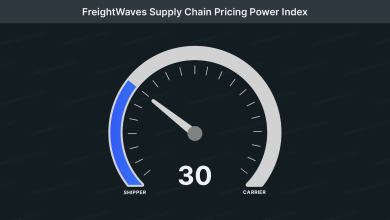
For the first time since freight sentiment index inception, shippers are the least positive group. Does that mean the market is balancing?
The less-than-truckload sector has been disrupted by a very public dispute between Yellow and the Teamsters. Rates have already seemingly responded and may continue to see support.
Ocean carriers are steadily losing pricing power on the trans-Pacific as China to U.S. demand peaks for the second half of 2023.
Freight volumes continue to trend sideways, which is a positive sign overall as the 15th of July traditionally marks a time for slowing demand in the freight market.
FreightWaves’ State of Freight for July focused on a potential Yellow shutdown and a looming strike at UPS.
In a market where capacity is abundant, it is difficult to identify underlying shifts in demand.
Demand from retail shippers is historically quiet in the period from now until August, after which retailers restock their shelves for the back-to-school season.
There are some positive signs that the freight market has cleared most of the post-pandemic rubble, but full recovery is still a ways off.
U.S. import demand is likely peaking and could soon begin a steady decline toward a “new” bottom in the back half of 2023.
Demand from retail shippers is historically quiet in the period from now until August, after which retailers restock their shelves for the back-to-school season.
If the spread between contract and spot rates narrows, capacity will become increasingly inconsistent in the second half of the year.
Maritime’s peak season — which typically ramps up in August and lasts throughout October — is expected by retailers and supply chain professionals to be weaker than it has been in previous years.
Softening demand in an excess of vessel capacity is putting tremendous downwards pressure on ocean container spot rates.
FreightWaves SONAR has launched the Index-Linked Contracts solution to help shippers and carriers get consistent service and volumes.