




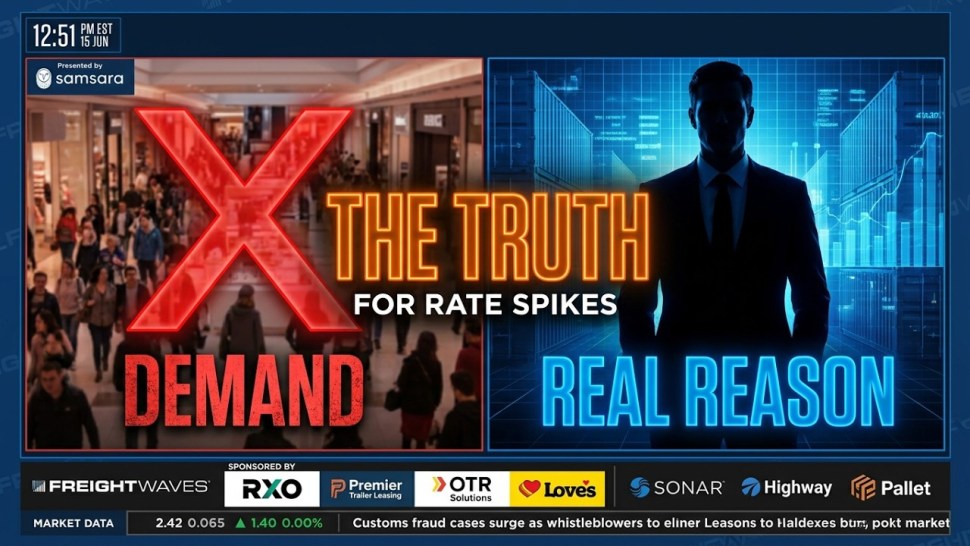
Container spot rates from China to the US West Coast have surged over 300% from March to June. FreightWaves' Craig Fuller breaks down why this isn't a demand-driven surge, but a reflection of concentrated power among international ocean carriers. Discover how foreign-owned shipping lines operate as a cartel, manipulating capacity and impacting US businesses. Plus, get insights on the domestic trucking market's holiday capacity crunch and how RXO provides crucial support.
Daily spot rates on the China-to-U.S. West Coast lane — the most important trade lane in international container shipping — have climbed from $1,800 in March to more than $6,100 today, a jump of roughly 239%, according to FreightWaves. The increase is not being driven by demand; in fact, import volumes remain well below year-ago levels following the collapse in Chinese shipments tied to Liberation Day tariff chaos that began in April, when imports out of China dropped roughly 50%.
"These high spot rates is not a reflection of higher demand," said the FreightWaves analyst on the broadcast. "In fact, demand is off quite sizably from where we were a year ago." The analyst attributed the pricing surge primarily to the structural market power held by the top ocean carriers, compounding the effect of elevated fuel costs.
"The top 10 ocean carriers have approximately 90% of the capacity in the global market. To put that in perspective, OPEC controlled about 35% of global oil supplies — and it's a cartel. No doubt that it has the power to manipulate fuel and oil prices. It's the same thing with the international ocean container business, except they have so much more power because they control 90% of it."
The analyst noted that carrier alliances — which allow ocean lines to legally coordinate schedules — effectively function as a capacity management tool. When spot rates soften, carriers pull capacity from the market, pushing prices back up. Fuel costs are a contributing factor: oil prices spiked to around $115 per barrel before retreating to approximately $70, but the drop has not translated into proportional rate relief for shippers.
Notably, none of the top 10 global container lines are U.S.-owned companies. The analyst pointed out that American shippers must go to roughly the 29th-ranked carrier before finding a U.S.-flagged operator, meaning rate increases benefit foreign entities — including carriers with ties to the Chinese government — rather than domestic businesses. "It's a tax that we pay," the analyst said.
With demand recovering modestly from post-Liberation Day lows but not surging, the analyst does not expect a flood of containers to back up at U.S. ports. However, shippers are being squeezed from multiple directions simultaneously: rising container rates, higher warehouse rents as fulfillment space fills up, climbing domestic trucking costs, and fuel surcharges — making budget management exceptionally difficult across both domestic and international freight.
On the domestic side, the Independence Day holiday week is expected to push tender rejections toward and potentially beyond the 17.5% level already recorded, with spot rates projected to move sharply higher Wednesday through Thursday as driver availability tightens and routing guides fail.
- China-to-U.S. West Coast container spot rates have surged from $1,800 in March to over $6,100 today, a roughly 239% increase unrelated to demand growth.
- The top 10 ocean carriers control approximately 90% of global container capacity, giving them far greater pricing power than OPEC holds over global oil supply.
- U.S. shippers face simultaneous cost pressure from container rates, warehouse rents, domestic trucking rates, and fuel surcharges, with no U.S.-owned carrier in the global top 10.
Speaker 1 [0:00] Back to FreightWaves today. It has been some great conversations, Craig.
Speaker 2 [0:04] Yeah, look, I thought Jenna was great. I'm really intrigued by this idea of a company with the scale of Trimble, all the systems that they have, all the data. They're sitting on a mountain of data. And they historically have had this massive amount of data. And getting it into customers' hands has beenu2014 it's been a big lift. We struggle with it. The great thing about AI is that that is exactly what AI can do, is it can create these Fantastic visual layers. And I'm curious where they take it.
Speaker 1 [0:33] I'm curious where they take it as well. Speaking of data, let's talk more about the data and all things when it comes to capacity. Now, let's get to it.
Speaker 2 [0:49] Porter, you're paying much higher spot rates for capacity to bring in a container from China to the United States. Spot rates have jump from $1,800 back in March to over $6,100 today. That is the daily spot rate from China to the US West Coast, the most, uh, important trade lane in international container movements. And it's a reflection of really the pricing power that the international container lines have. They took rates way, uh, up when there was the Iran conflict, largely under the guise of, of fuel. And also just anytime there's a conflict, the container lines are not shy about implementing higher surcharges. But one of the ironies of all of this is that the international container ships coming out of China to the United States were not being disrupted. It's not like they were going through the Middle East. They're going directly across the Pacific. So this is really a reflection of the pricing power that the international ship lines have over the US import market and ultimately over US consumers. Now, some of this is fuel related, no doubt. These big ships consume a lot, and I mean a lot of diesel. They burn a lot of it. So there is some element of it in just higher fuel prices is showing up. And those, while they have internationally cooled, we've seen the futures contracts in both Brent and WTI have come down significantly since the sort of maximum pressure on oil and global oil supplies. $115, now down to about $70 a barrel. It still is something that the market is working out. What I think is interesting is that this is notu2014 these high spot rates is not a reflection of higher demand. In fact, demand is off quite sizably from where we were a year ago. Now, in fairness, the reason that demand is off today versus where we were a year ago is largely related to the Liberation Day chaos that really started in April. And, you know, we had a collapse in imports into the United States due to that. Imports out of China dropped something like 50%. And then we saw this massive surge. And that's whatu2014 when we look at year-over-year comps, that's where we were a year ago. And we're off that number today. We are looking at more normal volumes, but it's not really something that should suggest that spot rates should be up 300%. And while fuel represents a significant portion of that increase, it doesn't explain everything. The bottom line that you need to know about international container marketsu2014 it's very different than truckingu2014 is just how concentrated the power is among the international ship lines. It's a cartel. There's no doubt about it. The top 10 ocean carriers have a approximately 90% of the capacity in the global market. To put that in perspective, OPEC prior to, you know, a couple of months ago when we had some OPEC members leave, OPEC controlled about 35% of global oil supplies. And it's a cartel. No doubt that it has the power, has traditionally had the power to manipulate fuel and oil prices. It's the same thing with the international ocean container business, except they have so much more power because they control 90% of it. So what they do when they see prices start to slow down is they pull capacity out of the market. They're also allowed to coordinate their schedules, which is kind of ridiculous because they can manipulate the market by schedule coordination. They say it's there to be more efficient, but the reality is these things called alliances allow them to basically manage capacity. And ultimately, if you want to control price, you take out the supply or take out capacity, and you're going to see much higher prices. And that's exactly what happens. Also, one thing to keep in mind is the international container linesu2014 none of the top 10 international container linesu2014 in fact, you have to go to like number 29 before you see a US container ship company. But none of the top 10 are US-owned companies. They're owned by foreign companies, foreign entities, some of them including, uh, Costco's owned by the Chinese government, connections to the, you know, our potentially our enemy, if you call it, or at least our rival. And it's just something that you keep in mind because ultimately U.S. consumers, U.S. importers are paying higher container rates, but these are not really helping U.S. businesses. Weu2014 it's a tax that we pay, and it's something that I've always had an issue with, that really we don't control our own international ocean capacity and therefore sort of subject to the whims and the decisions of our global competitors. Now, one of the things that I think is important is because we're not seeing a massive surge in demand, even though we're seeing recovery in the market from where we were just a couple of months ago, really coming out of Chinese New Year, we're not seeing a massive surge. It means that really the market is operating pretty rationally. There's no panic that's in the market, international container market, and therefore, it's not going to flood us full and have a backlog of containers that hit the shore and all of a sudden cause problems. It will probably create some level of inflation and transportation inflation. And really, shippers are getting hit from all angles. They're getting hit from the container prices that are accelerating. They're getting hit from warehouse rates that are going up. These REITs are increasing rates tou2014 as demand fills up, as warehouses fill up, and they're getting hit from trucking increases as well as fuel surcharges that are playing into that. So it's really a difficult market for anyone to maintain a budget due to all the pricing pressures that are happening in the freight market, domestic and internationally. Now, I want to talk a little bit about the domestic market. It's July 4th week. We've talked a lot about it on FreightWaves Today. The fact that this is a week where we should see significant increase in tender projections and a significant increase in spot rates. Now, yesterday we saw a little bit of cooling, not much. We're well into 17%, near 17.5%, cooled a little bit overnight, not much. But really, Monday's the softest day of the week. So you would expect that. And spot rates cooled a little bit by a couple of pennies. Again, very small softness. But as we head into the rest of the week, this is the time we will expect, especially as we get through Wednesday and into Thursday, spot rates are going to go absolutely hyperbolic and tender rejections are going to do the same. And the reason this is important is that RXO has set, set themselves up to be the on-demand call. So if your routing guide, if you're a shipper and your routing guide's falling apart or your normal carriers don't have capacity because their drivers are off, duty or taking home for the holidays and you've got those last-minute loads, RXO is there to help you. They want to be there. That's really what they've done is set up a hotline to assist you as you, as you see your routing guides fail. They're there to serve you. They're there to help you. That's why they've set up capacity now. And that's why they are supporting FreightWaves in this and sponsoring this to remind their shippers that they are there. If your routing guides fail, if your normal carriers fail, they have a lot of resources. Not only do they tap into the over-the-road for-hire market, but they actually tap into the private fleet market as well, which is a really unique feature of RXO's capacity, is they are looking at the private fleet capacity, which is approximately as big, uh, as the over-the-road for-hire market. And frankly, it doesn't have the regulatory concerns or issues that you typically see in for-hire because the shippers that offer private fleet capacity tend to be far more compliant. They're not hiring the non-domiciled CDL drivers and the companies and not hiring companies that are non-compliant. These are privately owned fleets and that's a big source of RXO's capacity. So if you get into trouble and you can't find a truck, RXO wants to remind you that they're there for you. And that's why they've set up a capacity hotline for you. And you can go to rxo.com to find out more. Well, look, I think it's fireworks week. It's Independence. It's July 4th.
Speaker 1 [9:17] This is theu2014 this is the raw fireworks. Perfect storm. Perfect storm.
Speaker 2 [9:20] It's going to be a lot of routing guide failures out there. And if you need help, if you need a truck, you need a 911 operator, that's what RXO wants to be.
Speaker 1 [9:28] 100%. Talk to me a little bit about, real quick, that private fleet aspect that you just had in the back half of Capacity Now. Why are they so important? Given the aspect that we're in right now?
Speaker 2 [9:38] Well, they don't. So private fleets are typically larger companies that have a fleet set aside to run their core operations. So they're not there to make money. They're there to make sureu2014 typically, the reason you have a private fleet is to ensure service. So you'll see it in the carpet mills down in Dalton, not too far from here. Like Shaw and Mohawk have private fleets. You see it in food service. PepsiCo, you see it in places like Walmart. So they, they use those private fleets, and what enables them to do is they don't hire the non-compliant drivers because these companies are huge. Like, they don'tu2014 they can't hire people that don't have work registrations and are properly vetted. So RXO have a core part of their capacity comes from the private fleet segment, which gives them an edge over brokers that aren't using those private fleets.
Speaker 1 [10:29] You gives them an edge for sure. All right, so we'll hear from them, of course, in a little bit. But coming up, a Dallas truck service team just punched their ticket to Sweden, and you're going to hear all about it. This story is next, only on FreightWaves Today.
Brokerage Compliance Symposium
The day before F3. Every compliance issue you face - fraud exposure, carrier liability, FMCSA rules, cargo theft, insurance gaps - navigated by attorneys and operators defining best practices in a changing industry.
F3 Awards Dinner
The night before F3. FreightTech100 companies honored. FreightTech 25 and Shipper of Choice winners revealed live. Cocktail reception into dinner and live music - 300 industry leaders in one purpose-built room.
F3: Future of Freight Festival
Industry-defining keynotes, rapid-fire technology demos, and industry leaders networking in experiences across Chattanooga - plus the inaugural F3 Awards Dinner featuring the FreightTech and Shipper of Choice reveals.
The day before F3. Every compliance issue you face - fraud exposure, carrier liability, FMCSA rules, cargo theft, insurance gaps - navigated by attorneys and operators defining best practices in a changing industry.
The Signal at Chattanooga Choo Choo • Chattanooga, TN Register NowThe night before F3. FreightTech100 companies honored. FreightTech 25 and Shipper of Choice winners revealed live. Cocktail reception into dinner and live music - 300 industry leaders in one purpose-built room.
The Signal at Chattanooga Choo Choo • Chattanooga, TN Register NowIndustry-defining keynotes, rapid-fire technology demos, and industry leaders networking in experiences across Chattanooga - plus the inaugural F3 Awards Dinner featuring the FreightTech and Shipper of Choice reveals.
The Signal at Chattanooga Choo Choo • Chattanooga, TN Register Now