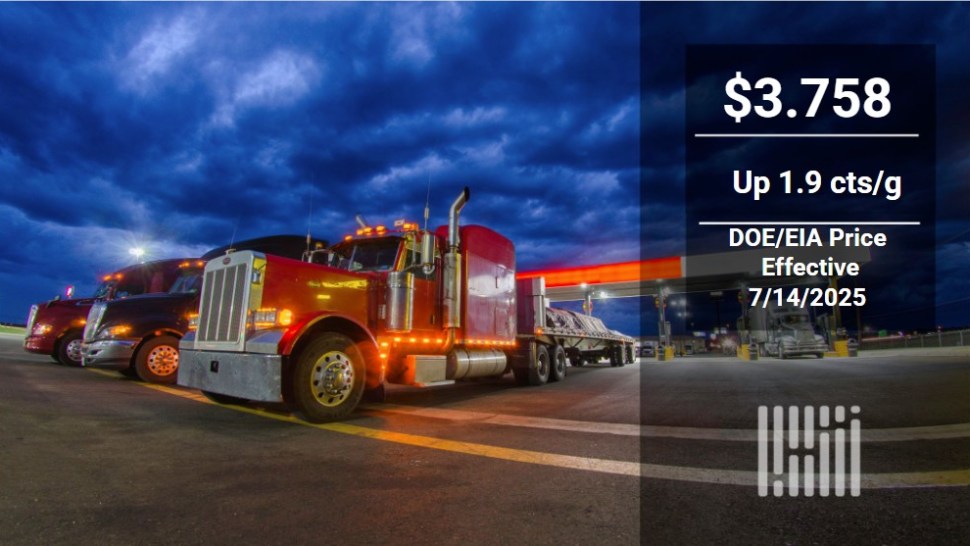
The benchmark diesel price used for most fuel surcharges rose Monday for the fifth time in six weeks, and it seems that market conditions for distillates–which includes diesel–are the only oil market fundamentals garnering attention these days.
The Department of Energy/Energy Information Administration average weekly retail price rose 1.9 cents/gallon to $3.758/g, effective Monday and published Tuesday. That stretch of five up, one down in the last six weeks has added 30.7 cts/g to the benchmark.
Most of the chatter on broad oil market moves has been looking to geopolitics as reasons for movement. But when it turns to fundamentals, it is the diesel market that has been the most important factor.
That the oil markets are being led by diesel can be seen in one basic comparison.
Since the start of last month, the price of Brent on the CME commodity exchange has risen 7%, to a settlement Monday of $69.21 from a starting point of $64.63/barrel on June 2.
During that same period, ultra low sulfur diesel on CME climbed to a settlement Monday of $2.3898/g from $2.0445/g, an increase of 16.9%.
The widening of diesel to crude continued Tuesday. At approximately 11 a.m., ULSD was up about 0.75% while Brent crude was down about 0.16%.
The broader market economics for crude still remains heavily weighted toward bearish. The OPEC+ group continues to add supply into the market, voting to approve higher output in August when it met earlier this month.
It has been setting that “more is better” policy for several months when it gathers for its remote meetings. The OPEC+ more than 2-million barrel/day cutback in production that dates back to 2023 is expected to be fully unwound by September, far earlier than expected.
The monthly production estimate from S&P Global Commodity Insights, which had not been showing large increases in OPEC+ output in recent months despite the changes in the group’s production policies, finally did so in its estimate of OPEC+ output in June. It was up about 600,000 b/d, a huge one-month increase.
And the monthly estimate of the International Energy Agency released late last week still showed an overall global petroleum market where new supply is outstripping new demand.
But that is the macro picture. In diesel and distillates, tight inventories are driving their price higher relative to crude.
A straight comparison of the price of ULSD versus the price of CME Brent, translated into cents per gallon, shows that ULSD was about 53 cts/g more than Brent on June 2. That number is now solidly above 70 cts/g.
In his weekly report, energy economist Philip Verleger, who has long focused on diesel markets as the underappreciated driver of oil prices, cited several factors that he said could be tightening diesel supply, leading to those dwindling stocks.
The OPEC cuts that are in place, as well as sanctions against Russia, are removing heavier barrels from the market that tend to have strong diesel yields when refined. Those supplies in many cases have been replaced with light crude from the U.S. which has a much lower diesel yield, Verleger wrote.
A tighter emissions rule for shipping in the Mediterranean that took effect in May also is a factor, Verleger said. That rule dropped the sulfur emission limit in that body of water to 0.1% from the broader worldwide limit of 0.5%. To get there, diesel or distillate molecules are often called upon to replace heavier and dirtier fuel sources.
The Iran-Israel conflict also has a role in the tighter diesel market, Verleger reported. Israel, as a defensive move, had cut supplies of its offshore natural gas production that had been used to power generators in Egypt, Verleger said. But with those cuts, Egypt has turned to diesel as a generating fuel, adding another source of demand that didn’t exist a few months ago.
The overall impact of these various factors can be seen in how tight ULSD inventories are in the U.S. for this time of year. The most recent weekly report on ULSD inventories was published Wednesday with data for the week ended July 4. It shows that current ULSD inventories are well below those of other reports for the first week of July.
Brokerage Compliance Symposium
The day before F3. Every compliance issue you face - fraud exposure, carrier liability, FMCSA rules, cargo theft, insurance gaps - navigated by attorneys and operators defining best practices in a changing industry.
F3 Awards Dinner
The night before F3. FreightTech100 companies honored. FreightTech 25 and Shipper of Choice winners revealed live. Cocktail reception into dinner and live music - 300 industry leaders in one purpose-built room.
F3: Future of Freight Festival
Industry-defining keynotes, rapid-fire technology demos, and industry leaders networking in experiences across Chattanooga - plus the inaugural F3 Awards Dinner featuring the FreightTech and Shipper of Choice reveals.
The day before F3. Every compliance issue you face - fraud exposure, carrier liability, FMCSA rules, cargo theft, insurance gaps - navigated by attorneys and operators defining best practices in a changing industry.
The Signal at Chattanooga Choo Choo • Chattanooga, TN Register NowThe night before F3. FreightTech100 companies honored. FreightTech 25 and Shipper of Choice winners revealed live. Cocktail reception into dinner and live music - 300 industry leaders in one purpose-built room.
The Signal at Chattanooga Choo Choo • Chattanooga, TN Register NowIndustry-defining keynotes, rapid-fire technology demos, and industry leaders networking in experiences across Chattanooga - plus the inaugural F3 Awards Dinner featuring the FreightTech and Shipper of Choice reveals.
The Signal at Chattanooga Choo Choo • Chattanooga, TN Register Now