




The Department of Transportation has little understanding of air cargo infrastructure challenges because officials, focused on other modes, don’t engage with industry officials and rely on incomplete and unreliable freight data, the Government Accountability Office said in a report released Wednesday.
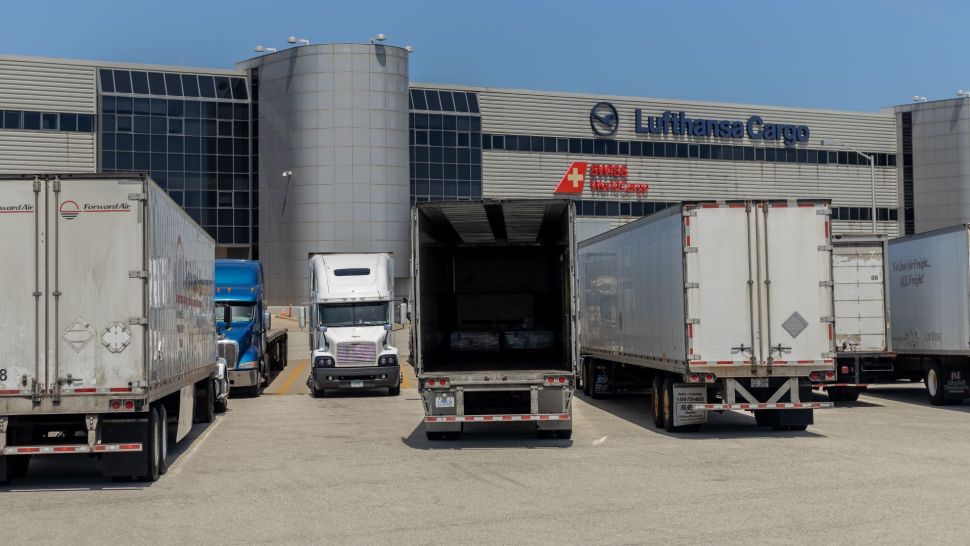
The report catalogued a familiar list of complaints made by logistics providers, airlines and ground support companies about operational bottlenecks caused by insufficient truck parking, poorly configured roadways, crowded cargo aprons and outdated warehouses at airports.
The Airforwarders Association, which pushed for the study in the FAA Reauthorization Act of 2024, is expected to use the results as the launch pad for requesting dedicated federal funding for enhancing cargo area infrastructure.
The organization, which represents logistics companies that arrange and manage the transport of goods for producers and retailers, has long argued that federal funding formulas for airports typically support passenger operations, making it difficult for the cargo community to modernize infrastructure and reduce truck queues. It says cargo delays add costs across the air logistics sector and impede the timely delivery of goods, a prime example of which happened during the Covid crisis when it could take days for forwarders to retrieve shipments.
“For years, we have highlighted the critical need for investment in our ground-based air cargo infrastructure. This report provides the irrefutable, government-backed evidence we need to drive real change and secure essential federal funding,” said AfA Executive Director Brandon Fried in a statement.
The GAO recommended that the assistant secretary for multimodal freight infrastructure and policy routinely communicate with air cargo stakeholders, identify challenges to the efficient movement of air cargo and determine whether the agency needs to take steps to address the constraints. It also called on the Bureau of Transportation Statistics to assess the reliability of air cargo data it compiles and to communicate the data’s limitations.
The GAO said the department’s Multimodal Freight Office, which was established in 2023, has not tried to identify where air cargo congestion occurs and how to eliminate it, either through studying available data and state freight plans or routinely engaging with the air cargo community. It also doesn’t discuss air cargo issues or concerns with the department’s modal administrations, such as the Federal Aviation Administration or the Federal Highway Administration. And the FAA, for its part, doesn’t engage with the air cargo industry or passenger airlines about air cargo infrastructure needs, despite routinely communicating with airports and airlines regarding other matters.
Data Limitations
The Bureau of Transportation Statistics’s Freight Analysis Framework (FAF) and National Transportation Atlas Database (NTAD) on airport warehouses were not sufficient to describe changes in air cargo value, commodities or infrastructure, the government auditors said.
The Department of Transportation, states, localities and companies use FAF data to assess the condition of freight infrastructure, plan projects and help allocate state and federal freight funding. While FAF data for other freight modes may use dozens of different datasets, the FAF air cargo data are based on two sources, one of which has known sampling error, the GAO said. Users are in the dark about these limitations because the Bureau of Transportation Statistics hasn’t provided clear explanations of the data’s limitations.
The NTDA database describes the estimated location, number, size and operators of U.S. warehouses on airport property. The agency uses NTAD data to identify transportation vulnerability and resilience, and to support the Transportation Department’s response to critical incidents. Last year, for example, it used NTAD to assess freight disruptions between distribution centers and the Baltimore-Washington International Airport after the Francis Scott Key Bridge collapsed in Baltimore harbor.
The GAO determined NTAD air cargo data is not complete, timely, or accurate, with many warehouses not included. Bureau officials said it is difficult to accurately capture information on air cargo warehouses because warehouses change frequently, and air cargo stakeholders do not report warehouse data to DOT. They are now exploring methods to improve the quality of the NTAD data.
“Having information on air cargo challenges is critical for the Department of Transportation as it sets federal goals that will inform future investments and priorities for freight infrastructure in the U.S.,” the auditors said.
Click here for more FreightWaves/American Shipper stories by Eric Kulisch.
Write to Eric Kulisch at ekulisch@freightwaves.com.
RELATED STORIES:
Saudi Arabia-based leasing company to buy 10 Airbus A350 freighters
Airbus postpones rollout of A350 freighter until late 2027
China Airlines finalizes deal for 4 Boeing 777-8 cargo aircraft
Brokerage Compliance Symposium
The day before F3. Every compliance issue you face - fraud exposure, carrier liability, FMCSA rules, cargo theft, insurance gaps - navigated by attorneys and operators defining best practices in a changing industry.
F3 Awards Dinner
The night before F3. FreightTech100 companies honored. FreightTech 25 and Shipper of Choice winners revealed live. Cocktail reception into dinner and live music - 300 industry leaders in one purpose-built room.
F3: Future of Freight Festival
Industry-defining keynotes, rapid-fire technology demos, and industry leaders networking in experiences across Chattanooga - plus the inaugural F3 Awards Dinner featuring the FreightTech and Shipper of Choice reveals.
The day before F3. Every compliance issue you face - fraud exposure, carrier liability, FMCSA rules, cargo theft, insurance gaps - navigated by attorneys and operators defining best practices in a changing industry.
The Signal at Chattanooga Choo Choo • Chattanooga, TN Register NowThe night before F3. FreightTech100 companies honored. FreightTech 25 and Shipper of Choice winners revealed live. Cocktail reception into dinner and live music - 300 industry leaders in one purpose-built room.
The Signal at Chattanooga Choo Choo • Chattanooga, TN Register NowIndustry-defining keynotes, rapid-fire technology demos, and industry leaders networking in experiences across Chattanooga - plus the inaugural F3 Awards Dinner featuring the FreightTech and Shipper of Choice reveals.
The Signal at Chattanooga Choo Choo • Chattanooga, TN Register Now