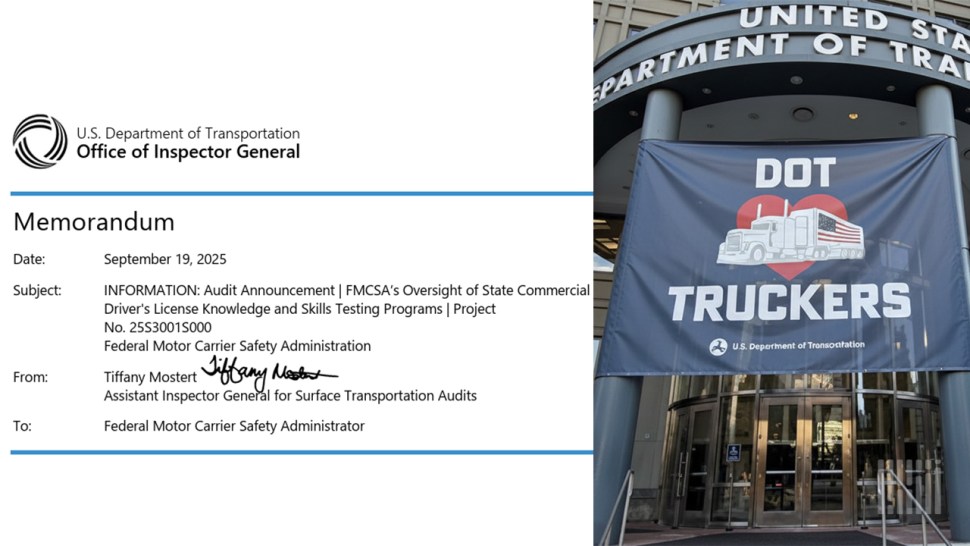
The Department of Transportation’s Office of Inspector General has announced yet another audit into the Federal Motor Carrier Safety Administration’s oversight of Commercial Driver’s License programs.
The September 19 announcement targets FMCSA’s monitoring of state CDL knowledge and skills testing programs, with auditors planning to examine everything from third-party testing oversight to enforcement of English proficiency. This isn’t the first time federal watchdogs have taken a close look at CDL program compliance, and the timing couldn’t be more contentious.
Based on the inspector general’s announcement, in 2024, 4,909 people died in crashes involving large trucks and buses. That statistic sits front and center in the OIG’s audit announcement, underscoring why federal officials continue to focus on CDL program integrity and licensing standards.
A similar audit of FMCSA’s testing oversight conducted in 2002 found that federal standards and state controls, “are not sufficient to defend against the alarming threat posed by individuals who seek to fraudulently obtain CDLs.” That audit was conducted over two decades ago, but the issues are still front and center in the industry today.
The 2002 audit concluded that, “FMCSA has recognized the need to strengthen standards for State testing and licensing of commercial drivers and has increased the depth and frequency of its oversight reviews of State CDL programs. However, more can be done to broaden the scope of the reviews and improve the basis for the States’ annual certifications that their programs comply with Federal standards.”
This audit announcement comes at a heated moment in trucking policy. Just last month, Transportation Secretary Sean Duffy threatened to withhold federal funding from California, Washington, and New Mexico unless they adopt and enforce English Language Proficiency requirements for commercial motor vehicle drivers.
The enforcement push stems from the fatal crash on a South Florida turnpike involving truck driver Harjinder Singh, who was issued a CDL by both Washington state in 2023 and California in 2024. After the crash, Singh failed English proficiency tests, providing correct responses to just 2 of 12 verbal questions and only accurately identifying 1 of 4 highway traffic signs.
The DOT found that from June 25 to August 21, California conducted approximately 34,000 inspections, resulting in at least one reported violation. However, only one inspection involved an ELP violation, which resulted in a driver being placed out of service.
The Small Business in Transportation Coalition, which represents owner-operators and small trucking companies, petitioned the OIG in 2022 for an audit of FMCSA’s CDL testing oversight due to what it perceived as inconsistencies in regulations regarding English proficiency. The watchdog declined to proceed.
The timing of the audit suggests federal officials are finally ready to address what many in the industry have been saying for years: state-by-state variations in CDL testing and enforcement create dangerous gaps in highway safety.
For fleet managers and owner-operators, this audit represents something bigger than bureaucratic housekeeping. It’s about the fundamental question of whether we have a national CDL program or 50 different state programs that happen to use the same plastic card.
CDL testing is performed by either a State Driver’s Licensing Agency or State-approved third-party testers and examiners, and FMCSA is responsible for verifying SDLAs’ compliance with regulations regarding knowledge and skills testing.
The audit will examine whether the FMCSA is effectively fulfilling its role in ensuring states meet federal standards. Given what was seen with the enforcement of English proficiency, or lack thereof, in California, Washington, and New Mexico, there’s reason to question how effectively federal oversight is working.
The audit will be conducted at FMCSA Headquarters in Washington, DC, as well as FMCSA Division Offices and State locations, as necessary. This suggests that auditors plan to examine both federal oversight mechanisms and state implementation on the ground.
For trucking companies, particularly those operating across multiple states, the audit could lead to more standardized enforcement of CDL requirements. That might mean stricter oversight in some states with lax regulations, but it could also mean more consistent expectations nationwide.
The Florida Turnpike crash was a catalyst that exposed serious gaps in how states issue and oversee commercial driver’s licenses.
Of the 3.5 million employed truck drivers in the United States, about 18% are immigrants, according to the U.S. Bureau of Labor Statistics. This audit is happening against a backdrop of intense political debate about immigration and English proficiency requirements, making it as much about policy as safety.
For trucking companies, you should expect more federal scrutiny of CDL programs and more standardized enforcement. Companies that operate across state lines should prepare for tighter oversight and more consistent application of federal CDL standards.
The audit results won’t be available for months. Still, the investigation itself signals that federal officials are finally ready to tackle the patchwork of state CDL oversight that has persisted for decades. Whether that leads to meaningful improvements or just more paperwork remains to be seen.
One thing’s certain, with nearly 5,000 fatalities involving large trucks and buses last year, the pressure for meaningful CDL program reform isn’t going away anytime soon. This audit is the first step toward the standardized, rigorous oversight that the trucking industry and highway safety demand.
Brokerage Compliance Symposium
The day before F3. Every compliance issue you face - fraud exposure, carrier liability, FMCSA rules, cargo theft, insurance gaps - navigated by attorneys and operators defining best practices in a changing industry.
F3 Awards Dinner
The night before F3. FreightTech100 companies honored. FreightTech 25 and Shipper of Choice winners revealed live. Cocktail reception into dinner and live music - 300 industry leaders in one purpose-built room.
F3: Future of Freight Festival
Industry-defining keynotes, rapid-fire technology demos, and industry leaders networking in experiences across Chattanooga - plus the inaugural F3 Awards Dinner featuring the FreightTech and Shipper of Choice reveals.
The day before F3. Every compliance issue you face - fraud exposure, carrier liability, FMCSA rules, cargo theft, insurance gaps - navigated by attorneys and operators defining best practices in a changing industry.
The Signal at Chattanooga Choo Choo • Chattanooga, TN Register NowThe night before F3. FreightTech100 companies honored. FreightTech 25 and Shipper of Choice winners revealed live. Cocktail reception into dinner and live music - 300 industry leaders in one purpose-built room.
The Signal at Chattanooga Choo Choo • Chattanooga, TN Register NowIndustry-defining keynotes, rapid-fire technology demos, and industry leaders networking in experiences across Chattanooga - plus the inaugural F3 Awards Dinner featuring the FreightTech and Shipper of Choice reveals.
The Signal at Chattanooga Choo Choo • Chattanooga, TN Register Now