FedEx Corp. posted fiscal 2023 second-quarter results late Tuesday that demonstrated its ability to quickly slash costs but also confirmed the damage a slowdown in demand is inflicting on its top line.
FedEx (NYSE: FDX) reported adjusted diluted earnings per share of $3.18, coming in above consensus estimates of $2.77. However, revenue came in about $700 million below the lower end of the company’s target range at $22.8 billion. It was als below the $23.5 billion revenue level in its fiscal 2022 second quarter.
Adjusted operating income came in at $1.21 billion, down from $1.68 billion in the year-earlier quarter. Operating margin fell markedly to 5.3% from 7.1%. Net income dropped to $815 million from $1.3 billion.
FedEx said it identified an additional $1 billion in cost savings following a September announcement that it would shave $2.7 billion in expenses in the current fiscal year. As a result, the company expects to cut $3.7 billion in costs for the fiscal year. It also said it would cut capital spending for the fiscal year by $400 million to $5.9 billion.
In early trading after markets closed, shares were up 3%. Shares traded down Tuesday by 2.62%. FedEx shares are down more than 33% over the past 12 months.
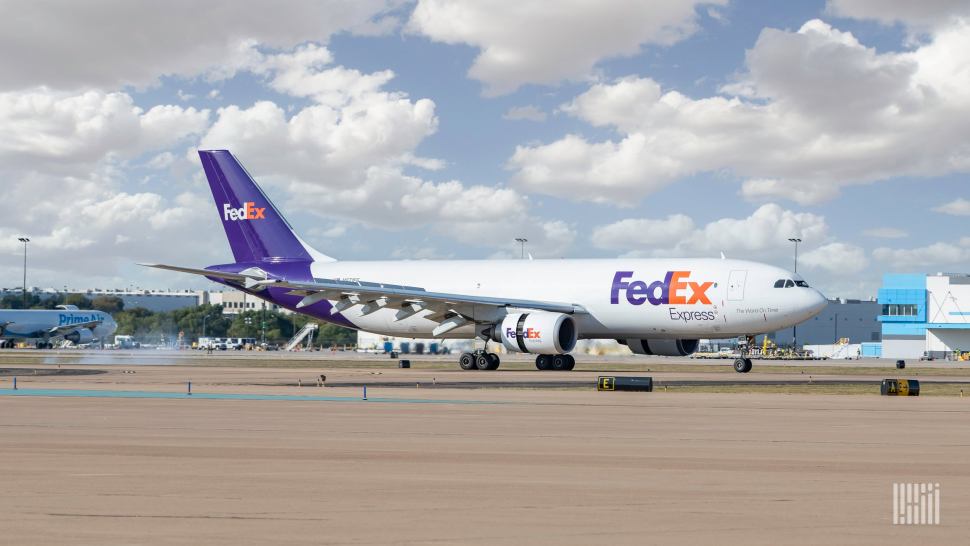
As expected, most of the revenue weakness came from FedEx Express, the company’s air and international unit. Operating income at the unit dropped 64% year over year (y/y) due to lower global volumes. Yield per-package rose 8% y/y.
FedEx telegraphed pronounced weakness in international airfreight activity, especially out of Asia, when it shocked investors and the transportation community in mid-September by pre-announcing substantially weaker-than-expected fiscal first-quarter results and withdrawing financial guidance for the rest of the fiscal year.
FedEx Express’ operating income plummeted to $186 million from $660 million in the fiscal 2022 first quarter. Company executives said at the time they don’t expect much of a rebound for the balance of the fiscal year.
In the second quarter, FedEx Ground, FedEx’s U.S. ground-delivery unit, posted a 24% year-on-year gain in operating income, primarily due to a 13% increase in package yields and cost-reduction actions. These factors were partially offset by increased purchased transportation rates, lower package volume and other higher operating expenses.
FedEx Freight, the company’s less-than-truckload unit, posted a 32% year-on-year gain in operating income due largely to an 18% increase in shipment yields. The gains were partially offset by wage increases and a decline in shipments.
FedEx Freight has temporarily furloughed an undetermined number of drivers until early March to bring capacity and costs in line with lower demand.
Brokerage Compliance Symposium
The day before F3. Every compliance issue you face - fraud exposure, carrier liability, FMCSA rules, cargo theft, insurance gaps - navigated by attorneys and operators defining best practices in a changing industry.
F3 Awards Dinner
The night before F3. FreightTech100 companies honored. FreightTech 25 and Shipper of Choice winners revealed live. Cocktail reception into dinner and live music - 300 industry leaders in one purpose-built room.
F3: Future of Freight Festival
Industry-defining keynotes, rapid-fire technology demos, and industry leaders networking in experiences across Chattanooga - plus the inaugural F3 Awards Dinner featuring the FreightTech and Shipper of Choice reveals.
The day before F3. Every compliance issue you face - fraud exposure, carrier liability, FMCSA rules, cargo theft, insurance gaps - navigated by attorneys and operators defining best practices in a changing industry.
The Signal at Chattanooga Choo Choo • Chattanooga, TN Register NowThe night before F3. FreightTech100 companies honored. FreightTech 25 and Shipper of Choice winners revealed live. Cocktail reception into dinner and live music - 300 industry leaders in one purpose-built room.
The Signal at Chattanooga Choo Choo • Chattanooga, TN Register NowIndustry-defining keynotes, rapid-fire technology demos, and industry leaders networking in experiences across Chattanooga - plus the inaugural F3 Awards Dinner featuring the FreightTech and Shipper of Choice reveals.
The Signal at Chattanooga Choo Choo • Chattanooga, TN Register Now