




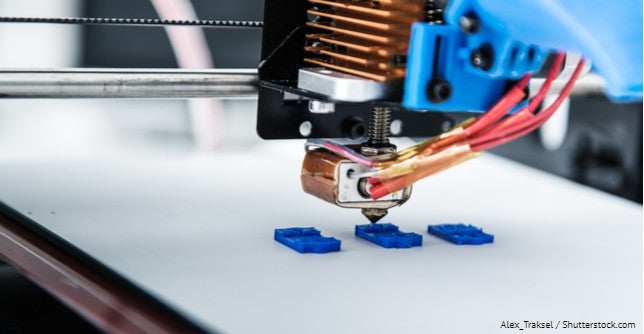
A new report by Fitch Ratings says 3D printing (3DP), sometimes called additive manufacturing, may “negatively affect the transportation industry’s revenue by reducing net goods transportation because it requires less labor than traditional manufacturing and, therefore, could reduce reliance on lower-wage countries for product assembly.”
“In addition, as mass production via 3D printing becomes more economically feasible, supply chains could be shortened with more manufacturing done near company headquarters,” the bond rating agency said.
3D printing allows parts to be built up by adding small particles of material such as plastic resin, metal or ceramic instead of taking blocks of materials and milling them or molding or casting parts. GE, for example, is manufacturing turbine blades for jet engines using 3D printing.
Fitch said it expects the nascent technology to grow significantly over the next 20 years, potentially reaching an industry value as high as about $600 billion, or about 3% of total global manufacturing, “with a materially higher share for products that are well suited for 3DP.”
Fitch, however, said that the “disruption risk is limited in the short to medium term.” It added that if and when disruption happens, “ports may be may be the most affected.
“A significant portion of U.S. imports from China are products that, in our view and based on recent technological advancements, are well suited for 3DP, including machinery and electronic equipment such as computers and mobile phones,” it said.
Fitch expects that 20% to 50% of these goods can be produced domestically, which it said could result in a reduction of 10% to 25% in U.S. imports from China.
“We also expect trade relationships between countries in other regions such as Europe, the Middle East and Africa, Asia and Latin America to be affected,” Fitch said.
Fitch said increased protectionism also could be a catalyst for more businesses to adopt 3D printing as a manufacturing process.
Brokerage Compliance Symposium
The day before F3. Every compliance issue you face - fraud exposure, carrier liability, FMCSA rules, cargo theft, insurance gaps - navigated by attorneys and operators defining best practices in a changing industry.
F3 Awards Dinner
The night before F3. FreightTech100 companies honored. FreightTech 25 and Shipper of Choice winners revealed live. Cocktail reception into dinner and live music - 300 industry leaders in one purpose-built room.
F3: Future of Freight Festival
Industry-defining keynotes, rapid-fire technology demos, and industry leaders networking in experiences across Chattanooga - plus the inaugural F3 Awards Dinner featuring the FreightTech and Shipper of Choice reveals.
The day before F3. Every compliance issue you face - fraud exposure, carrier liability, FMCSA rules, cargo theft, insurance gaps - navigated by attorneys and operators defining best practices in a changing industry.
The Signal at Chattanooga Choo Choo • Chattanooga, TN Register NowThe night before F3. FreightTech100 companies honored. FreightTech 25 and Shipper of Choice winners revealed live. Cocktail reception into dinner and live music - 300 industry leaders in one purpose-built room.
The Signal at Chattanooga Choo Choo • Chattanooga, TN Register NowIndustry-defining keynotes, rapid-fire technology demos, and industry leaders networking in experiences across Chattanooga - plus the inaugural F3 Awards Dinner featuring the FreightTech and Shipper of Choice reveals.
The Signal at Chattanooga Choo Choo • Chattanooga, TN Register Now