




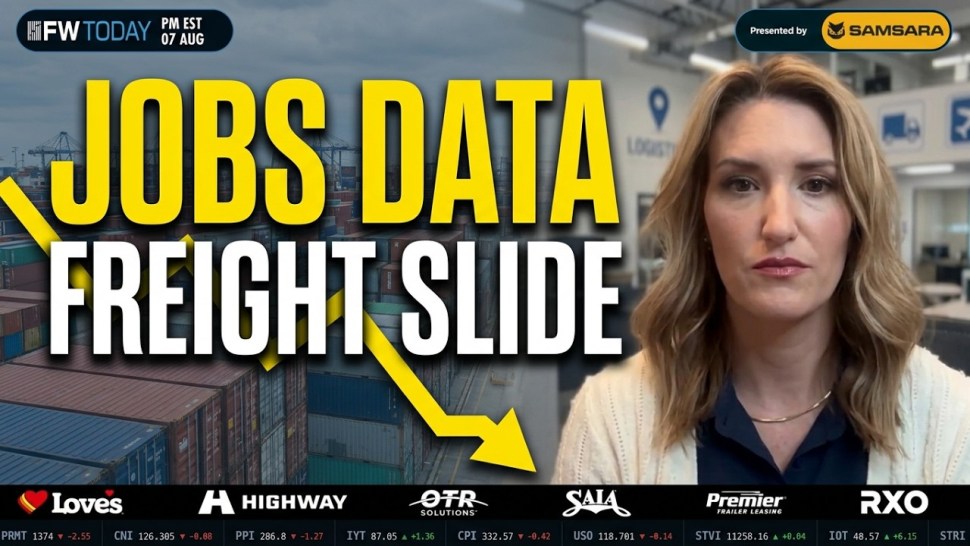
The July jobs report delivered a surprise: a decline of 23,000 non-farm payrolls, directly impacting the freight market. While unemployment dipped, it was largely due to people leaving the workforce, not finding new jobs. We break down how this, alongside declining Sonar Truckload Rejection and Volume Indexes, signals soft demand. However, contract rates are still rising, and manufacturing is accelerating. Dive into the complex interplay of these economic indicators and what they mean for capacity, pricing power, and the future of freight.
The U.S. economy shed 23,000 nonfarm payrolls in July, far below consensus expectations of 83,000 to 95,000 job gains, according to the Bureau of Labor Statistics report released Friday, Aug. 7. The miss was compounded by downward revisions to May and June that together showed 103,000 fewer jobs than originally reported. While the unemployment rate ticked down to 4.1%, the decline was driven by labor force participation falling to 61.4% — a five-year low — meaning workers left the workforce rather than found jobs.
For the freight market, the most relevant losses were in retail trade, down 19,000 jobs, and warehousing clubs and general merchandise, down 21,000. “Those are shippers generating truckload freight,” said the FreightWaves analyst presenting the SONAR update. Transportation and warehousing employment was flat — neither declining nor adding workers — mirroring what real-time SONAR data are showing on volumes and capacity.
The SONAR Truckload Rejection Index stood at 13.6% as of the update, down from a peak of 17.9% in early June. The SONAR Truckload Volume Index also retreated from its mid-July peak to roughly 11,258. The analyst cautioned against reading the rejection slide as a fundamental shift in market power, noting that the current cycle is driven by a lack of capacity, not weakening demand.
“I wouldn’t overread the rejection slide as a market flip to shippers by any means. The PPI still clearly says that carriers have the leverage. It’s just softened a bit off of that really high recent number from early June.”
The SONAR Freight Pricing Power Index, ticker FWPI, came in at 72 for the week, down from a mid-July peak of 79 but still firmly in carrier-favorable territory. Contract rates continued to rise near their recent highs even as spot rates dipped slightly versus the 30-day average, narrowing the spot-to-contract spread. Rail volumes remained near the top of their five-year range, providing additional support for the carrier-favorable reading.
Manufacturing data offer a counterweight to the soft freight and labor numbers. The ISM Purchasing Managers Index hit 55.6 in July, its highest reading since May 2022 and the seventh consecutive month of expansion. New orders and backlogs both accelerated, and manufacturing added jobs for the first time in 33 months. The analyst said industrial activity should eventually pull freight demand higher, unless shippers are still burning through existing inventory rather than placing fresh orders.
Geopolitical risk adds further uncertainty. DOE diesel prices rose 16.8% month over month amid renewed conflict in the Middle East, raising questions about whether carriers can continue passing higher fuel costs through to all-in spot rates given the capacity environment. Regionally, capacity loosened most quickly in Atlanta and El Paso, while tender rejections remained elevated and actually increased over the prior few days across parts of the Midwest, with Green Bay standing out. The analyst summarized the setup as three economic forces — a weakening labor market, accelerating manufacturing, and stubborn inflation — pulling in different directions, with the Pricing Power Index sitting at their intersection.
- U.S. payrolls fell 23,000 in July, missing consensus forecasts of 83,000–95,000 gains, with prior months revised 103,000 jobs lower combined.
- SONAR’s Truckload Rejection Index slipped to 13.6% from a June peak of 17.9%, but the Freight Pricing Power Index remains at 72, firmly in carrier-favorable territory.
- ISM Manufacturing PMI reached 55.6 in July — highest since May 2022 — signaling potential freight demand acceleration even as current volumes soften.
Speaker 1 [0:07] For today’s Sonar Update, Friday, August 7th, I want to talk a little bit about the overall freight economy and, well, Sonar Freight data, and then the economy as a whole is a little bit of an economic update. There’s not a lot moving in the freight data week over week, so I wanted to zoom out a little bit and look at it a little bit more holistically. And when you do that, this is one of the more interesting weeks we’ve had all summer because freight, manufacturing, and the labor market are all telling us a little bit of a different story. So this is one of the reasons why having real-time data is so important so that you can really watch these things as they develop and rapidly change. The Bureau of Labor and Statistics released the July jobs report this morning showing a decline in 23,000 nonfarm payrolls. So that was a bit unexpected. The consensus was that we’d be adding between 83,000 and 95,000 jobs. And instead, it was reported that we were down 23,000. Unemployment did tick down to 4.1%, but it wasn’t driven by labor force increasing or by people finding jobs. It was driven by labor force participation falling to 61.4%, which is a 5-year low. So people are leaving the workforce rather than finding jobs. to bring that unemployment number down to 4.1%. Also, the May and June numbers were revised. And between those 2, when you combine those revisions, those prior 2 months are 103,000 jobs weaker than were first reported. The losses in jobs month over month were relatively concentrated in a couple of areas. Local government and education was down 50,000, but that’s mostly seasonal noise and really not that relevant to the freight market. However, retail trade As well as warehousing clubs and general merchandise were also both down 19,000 and 21,000 respectively. And the retail number matters because those are shippers generating truckload freight. Then to round it out, transportation warehousing employment was flat, not declining, not hiring either. So kind of what we’re seeing in our current sonar numbers. So let’s talk about that, what sonar is showing on the freight side. So our STRI, Sonar Truckload Rejection Index, is at 13.6%, which is down from that high peak in early June of 17.9%. So we have seen a little bit of a 3-week slide. But again, I feel like this is relatively seasonally normal. STVI, the Sonar Truckload Volume Index, is also declining alongside it. It’s down from mid-July peak. To about 11,258 currently. So it’s relatively normal for those numbers to move in tandem. And as we’ve said all along, this is not a demand-driven tight freight cycle. It is a lack of capacity freight cycle. So capacity did loosen a bit. But again, I feel relatively normal for July and August numbers. We just saw that really high peak early in June that brought the baseline up. Spot rates are down slightly versus the 30-day average, but contract rates continue to rise. They’re near their high. And as you can see in the spot-to-contract spread graphic, They are— that spread is getting smaller. So while spot rates have come down a bit over the last 3 weeks, contract rates are continuing to rise. So that is happening as new mini bids have come out and been put in place and new contracts are being put in place with contract rates rising. If we look at the country regionally, we are seeing capacity loosen in the Southeast, the Atlanta area, and in El Paso the most quickly. But we are also seeing some parts of the country remaining elevated. Green Bay stands out. So across the Midwest, tender rejections are remaining elevated and have actually gone up the past few days. So the bottom line is the The freight data and the jobs data are sort of pointing in the same direction to soft demand, but I think it is relatively normal summer seasonality. And I want to put that a little bit in context with the Sonar Pricing Power Index. So that ticker is FWPI. We also each week produce a detailed article on what is happening with that pricing power index, which gauges really who is holding sort of the balance of power and has the leverage in negotiating capacity, demand, and pricing. And we boil it down into a single weekly score on who has the leverage between shippers and those providers or carriers. So it’s a great article to read each week. It can be found in the FreightWaves Market Monitor. Or it can be found inside Sonar platform under research. So the current reading for the PPI this week is 72. It’s down from a mid-July peak of 79, but it’s still firmly in carrier favorably territory. So it’s easing a bit, but it’s not flipping. Capacity has loosened modestly and the spot-to-contract spread has narrowed. And so that’s the STRI decline we were talking about. But that’s being offset by contractual pricing continuing to remain resilient and begin to rise, as well as rail volumes sitting near the top of their 5-year range. So as we talked about earlier, some of the rejections and volume numbers, I wouldn’t overread the rejection slide as a market flip to shippers by any means. The PPI still clearly says that carriers have the leverage. It’s just softened a bit off of that really high recent number from early June. The other thing that’s pointing to what I believe will lead to some increased demand and a continued tight freight market is the ISM manufacturing data. So the ISM PMI hit 55.6 in July, which is the highest since May 2022 and the 7th straight month of expansion. So new orders and backlogs both accelerated and manufacturing added jobs for the first time in 33 months. So all of this should really create continued acceleration in the industrial activity happening at the exact same time that truckload demand is softening. So while freight demand feels like it has been weak, I believe freight demand is going to have to catch up with what the manufacturers are signaling, or shippers are really still burning through inventory rather than ordering fresh capacity, which isn’t creating that demand yet. Services PMI. Was it 51, 54.1? But services employment fell back into contraction. So that’s another kind of cross-current number that doesn’t necessarily align. But I think services versus the actual industrial manufacturing is less important of a number. And then the last thing that’s sort of throwing a wrinkle into this and that we’re all, we’re all watching is the conflict in Iran escalating and de-escalating and re-escalating. DOE diesel is up 16.8% month over month. So the conflict has flared back up. So we will see what happens there and what that continues to do regarding, you know, spot rates and if carriers continue to have the ability to recoup those fuel costs based on a lack of capacity and really push those rising fuel costs through in their all-in spot rates. So to really close this out, the week’s freight numbers look boring on the surface. Normal seasonally, normal seasonal July and August softening. But underneath, there are really 3 parts of the economy that are pulling in 3 different directions. The labor market is weakening, manufacturing is accelerating, and inflation is, is really refusing to cooperate and is sort of an unknown at the moment because of the war. So freight and the PPI specifically sits right at the intersection of all 3, which is really why it’s worth watching that Pricing Power Index number and taking in all of the context of what is happening in the market and available leverage for carriers versus shippers when negotiating contracts and rates.
Speaker 2 [8:48] So, Julie, obviously a little softness, or we’ll call it cooling, in the month of July and August. But I think as we’ve heard for public earnings, no one is bearish. I think that’s the headline, right? Do we worry about the housing— I mean, the employment market cooling? I think a lot of that is actually encouraging if you’re worried about interest rates, right?
Speaker 1 [9:08] I think the employment is cooling, but it’s not cooling in transportation and warehousing. There’s a little bit of pullback in some retail, but it’s not anything that should affect Transportation specifically. I think other parts can be cooling while transportation is hot and demand is still leaving the market. And there’s been nothing that’s allowing— I’m sorry, capacity is still leaving the market, and there’s been nothing that’s allowed capacity or anything indicating capacity is entering or will be.
Speaker 2 [9:34] Well, I think we’ve talked about that. John Kingston talked about that earlier, is the fact that the employment number hasn’t shifted at all really since February. And then transportation employment, which I find encouraging. I think the fact that the overall employment number is cooling just a bit, tiny bit, not a big number. It’s not anything they should be worried about. It’s actually good from an inflation standpoint, because it will cool a lot of the threatened inflation that everyone’s worried about.
Speaker 1 [9:56] Yeah, I don’t know what is going to happen with that inflation and the Fed with oil and diesel prices and energy prices, employment. It’s kind of a mess.
Speaker 2 [10:07] It’s interesting how the energy market, everyone thought it was going to crater the consumer. It’s not happening. In fact, John Kingston had something he tweeted earlier today about just the number of miles driven, the amount of gasoline being consumed by AAA. They’re not showing any sign that consumers are changing their consumption habits. We talked about that. Consumers spend as much as $400 a month on food between grocery and food delivery. They’re really stretched on higher oil prices or gasoline prices by 60% to 70%. Uh, dollars a month per household, they would stop having their burritos delivered at $28. They’re not doing that.
Speaker 1 [10:44] Is it bad that I think that $400 number feels low?
Speaker 2 [10:46] I mean, it’s all perspective, right? But if you’re gonna—
Speaker 1 [10:51] if you had a choice, I think it depends on how many people are in the household and all of that.
Speaker 2 [10:54] But say gasoline prices are really impacting you, wouldn’t you just stop getting your burritos delivered? $28 for a burrito delivery is a lot of money.
Speaker 1 [11:03] Yes, some people— or I would eat at home. I don’t know if Will would stop getting his food delivered.
Speaker 2 [11:08] He does?
Speaker 1 [11:10] He’s really big on it.
Speaker 2 [11:11] That’s a family discussion.
Speaker 1 [11:12] But I, yes, I would.
Speaker 2 [11:14] You and he need to talk about it.
Speaker 1 [11:15] Because I don’t care that much about what I eat. I just would find something in the pantry.
Speaker 2 [11:17] Yeah, I kind of like getting my food delivered. So. Although not all the time. I kind of prefer it. I just feel like I want to have chain of custody of my food. I want to know what’s been—
Speaker 1 [11:29] They seal it up. The DoorDash food, they seal it up.
Speaker 2 [11:31] Still, chain of custody is important. We know. I don’t want a double broker. I don’t want a double broker.
Brokerage Compliance Symposium
The day before F3. Every compliance issue you face - fraud exposure, carrier liability, FMCSA rules, cargo theft, insurance gaps - navigated by attorneys and operators defining best practices in a changing industry.
F3 Awards Dinner
The night before F3. FreightTech100 companies honored. FreightTech 25 and Shipper of Choice winners revealed live. Cocktail reception into dinner and live music - 300 industry leaders in one purpose-built room.
F3: Future of Freight Festival
Industry-defining keynotes, rapid-fire technology demos, and industry leaders networking in experiences across Chattanooga - plus the inaugural F3 Awards Dinner featuring the FreightTech and Shipper of Choice reveals.
The day before F3. Every compliance issue you face - fraud exposure, carrier liability, FMCSA rules, cargo theft, insurance gaps - navigated by attorneys and operators defining best practices in a changing industry.
The Signal at Chattanooga Choo Choo • Chattanooga, TN Register NowThe night before F3. FreightTech100 companies honored. FreightTech 25 and Shipper of Choice winners revealed live. Cocktail reception into dinner and live music - 300 industry leaders in one purpose-built room.
The Signal at Chattanooga Choo Choo • Chattanooga, TN Register NowIndustry-defining keynotes, rapid-fire technology demos, and industry leaders networking in experiences across Chattanooga - plus the inaugural F3 Awards Dinner featuring the FreightTech and Shipper of Choice reveals.
The Signal at Chattanooga Choo Choo • Chattanooga, TN Register Now