
Gartner’s inaugural 2025 Magic Quadrant for Fourth-Party Logistics (4PL) marks a formal turning point for a segment long discussed but rarely defined, as supply chains face persistent disruption from tariffs, geopolitics and technology fragmentation
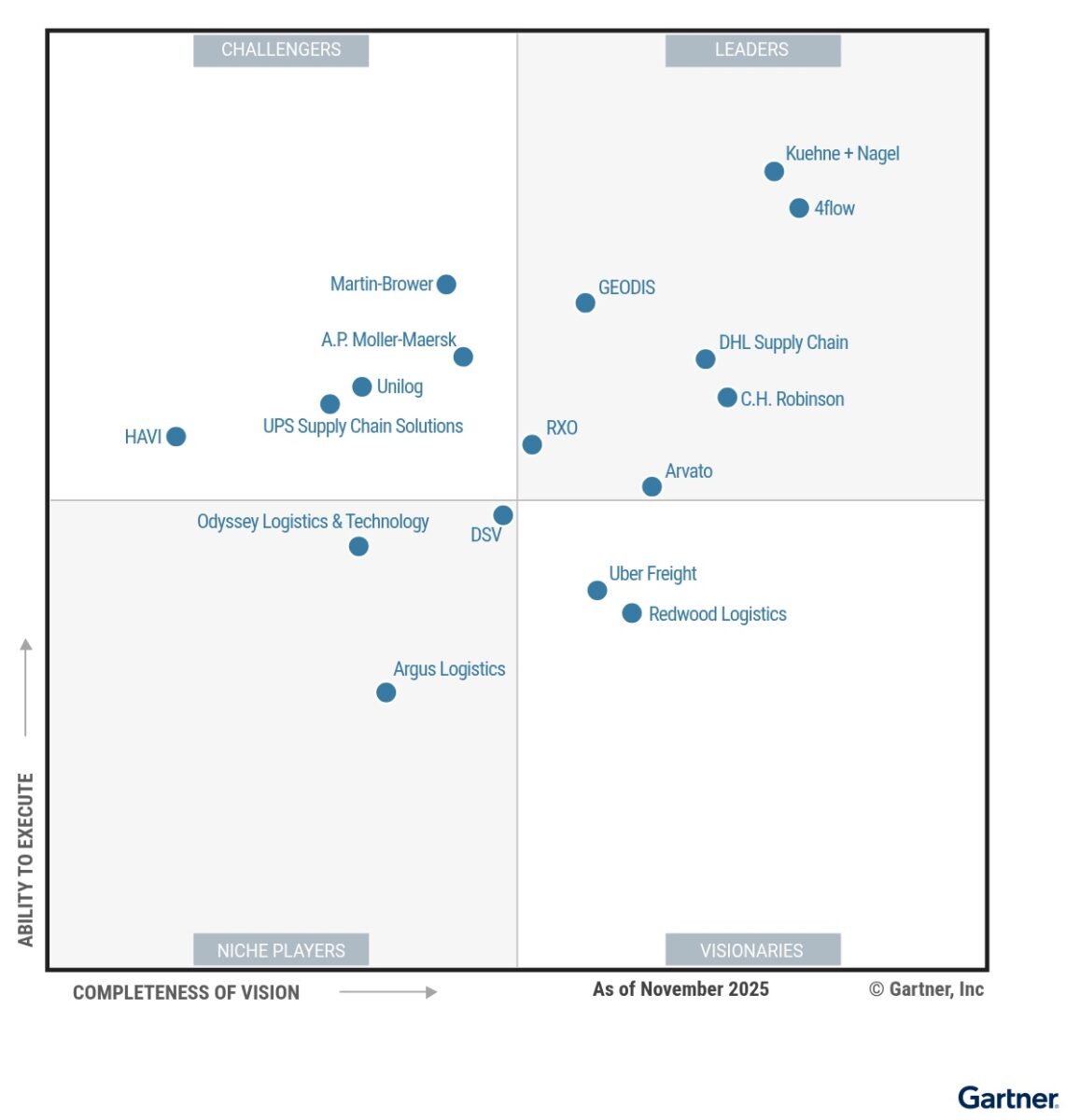
The report evaluates global 4PL providers based on ability to execute and completeness of vision, positioning companies such as C.H. Robinson, RXO, GEODIS, Arvato, Kuehne+Nagel, 4flow and DHL Supply Chain among leaders while identifying a growing tier of challengers and visionaries seeking to redefine how complex logistics networks are managed.
“Being recognized as a Leader in Gartner’s Magic Quadrant reflects the strength of our global team and the trust our customers place in us,” said Stefan Paul, CEO of Kuehne+Nagel. “As we continue to execute on our Roadmap 2026, we remain focused on driving innovation, advancing sustainable logistics solutions, and delivering meaningful value across increasingly complex global supply chains.”
Unlike traditional third-party logistics providers, Gartner defines a 4PL as an orchestrator — responsible for end-to-end visibility, governance and optimization across internal teams, carriers, brokers and technology platforms rather than discrete transportation or warehousing tasks.
That distinction is increasingly relevant as volatility becomes a permanent feature of global trade.
Unilog: tariffs and disruption are no longer temporary shocks
Global supply chain design and execution provider Unilog was named a Challenger in the inaugural Magic Quadrant, a placement executives say reflects rising demand for accountability amid persistent trade disruption rather than simple visibility tools.
Unilog CEO Osi Tagger said the company’s Challenger placement reflects both customer validation and its focus on disruption management rather than asset ownership. While Gartner does not disclose the precise weighting behind its rankings, Tagger pointed to Unilog’s 100% score in disruption management — a distinction she described as rare — along with its nearly asset-free operating model as key differentiators.
“If you look at the quadrant, we are among, maybe, maybe three or maybe four companies who are pure 4PL, assets-free companies, those that have the ability to fully orchestrate a global supply chain, which put us, in the Challengers [quadrant],” Tagger told Freightwaves.
Tagger pushed back on the idea that global supply chains are retreating in favor of localized models, despite rising tariffs and political risk.
“Global supply chains are here to stay,” Taggar said. “What’s changing is the level of complexity and disruption. Tariffs are no longer a shock—they’re a permanent design constraint.”
Instead, Taggar said Unilog focuses on building resilience through visibility, adaptability and control — especially when disruptions range from port closures and customs delays to sudden regulatory changes.
“A control tower tells you there’s a problem,” Tagger said. “A 4PL owns the problem.”
Along with Unilog, other Challengers in Gartner’s Magic Quadrant for 4PLs include Martin-Brower, UPS, HAVI, and A.P. Moller-Maersk.
Unilog COO Vered Rubin added that the company’s asset-light model allows it to dynamically reconfigure supply chains without being tied to specific carriers, warehouses or regions.
“We’re not obligated to any service provider,” Rubin said. “We can choose the best fit every day, because reality keeps moving.”
Eran Tamir, whose firm International Cargo Logistics is Unilog’s parent company, said months-long engineering and planning work differentiates true 4PLs from forwarders or software-only platforms by embedding contingency plans before freight ever moves.
Redwood: open ecosystems and deep integrations define the next phase
Redwood Logistics was named a Visionary in the Magic Quadrant, with Gartner citing the company’s technology-led approach and emphasis on integrating physical and digital supply chains through a unified orchestration layer.
Chief Innovation Officer Eric Rempel said the recognition validates a strategy Redwood has quietly built for years — evolving from brokerage into managed transportation, systems integration and full-scale orchestration.
“A 4PL sits one level higher,” Rempel told FreightWaves. “It orchestrates the entire ecosystem — the 3PLs, the technology, the data — and helps shippers make better decisions across all of it.”
Other Visionaries in Gartner’s Magic Quadrant for 4PLs include Uber Freight. Niche players identified in the Magic Quadrant for 2025 include DSV, Argus Logistics and Odyssey Logistics and Technology.
Unlike legacy 4PL models that impose fixed technology stacks or preferred vendor networks, Redwood’s approach emphasizes optionality, allowing shippers, carriers and brokers to keep their existing tools while connecting them through its integration platform, RedwoodConnect.
For trucking companies and brokers, Rempel said integration depth is becoming a competitive dividing line as freight markets swing between oversupply and tight capacity.
“Everyone has multiple systems — TMS, ELDs, visibility tools, pricing engines,” he said. “The problem isn’t that those systems exist. It’s that they don’t talk to each other in real time.”
Shallow integrations, he added, often break first when volatility hits, driving up cost-to-serve and limiting the usefulness of automation and emerging technologies such as agentic AI.
A market moving beyond control towers
Across both Challenger and Visionary categories, Gartner’s first 4PL Magic Quadrant underscores a broader industry shift away from isolated control-tower visibility toward true orchestration with ownership of outcomes.
As tariffs, regionalization pressures and geopolitical risk remain elevated heading into 2026, executives across the 4PL spectrum argue that resilience — not localization — will determine which supply chains remain competitive.
“The market is finally aligning on what modern logistics actually needs,” Rempel said. “Open ecosystems, deep integrations and orchestration aren’t nice-to-haves anymore. They’re becoming table stakes.”
Brokerage Compliance Symposium
The day before F3. Every compliance issue you face - fraud exposure, carrier liability, FMCSA rules, cargo theft, insurance gaps - navigated by attorneys and operators defining best practices in a changing industry.
F3 Awards Dinner
The night before F3. FreightTech100 companies honored. FreightTech 25 and Shipper of Choice winners revealed live. Cocktail reception into dinner and live music - 300 industry leaders in one purpose-built room.
F3: Future of Freight Festival
Industry-defining keynotes, rapid-fire technology demos, and industry leaders networking in experiences across Chattanooga - plus the inaugural F3 Awards Dinner featuring the FreightTech and Shipper of Choice reveals.
The day before F3. Every compliance issue you face - fraud exposure, carrier liability, FMCSA rules, cargo theft, insurance gaps - navigated by attorneys and operators defining best practices in a changing industry.
The Signal at Chattanooga Choo Choo • Chattanooga, TN Register NowThe night before F3. FreightTech100 companies honored. FreightTech 25 and Shipper of Choice winners revealed live. Cocktail reception into dinner and live music - 300 industry leaders in one purpose-built room.
The Signal at Chattanooga Choo Choo • Chattanooga, TN Register NowIndustry-defining keynotes, rapid-fire technology demos, and industry leaders networking in experiences across Chattanooga - plus the inaugural F3 Awards Dinner featuring the FreightTech and Shipper of Choice reveals.
The Signal at Chattanooga Choo Choo • Chattanooga, TN Register Now