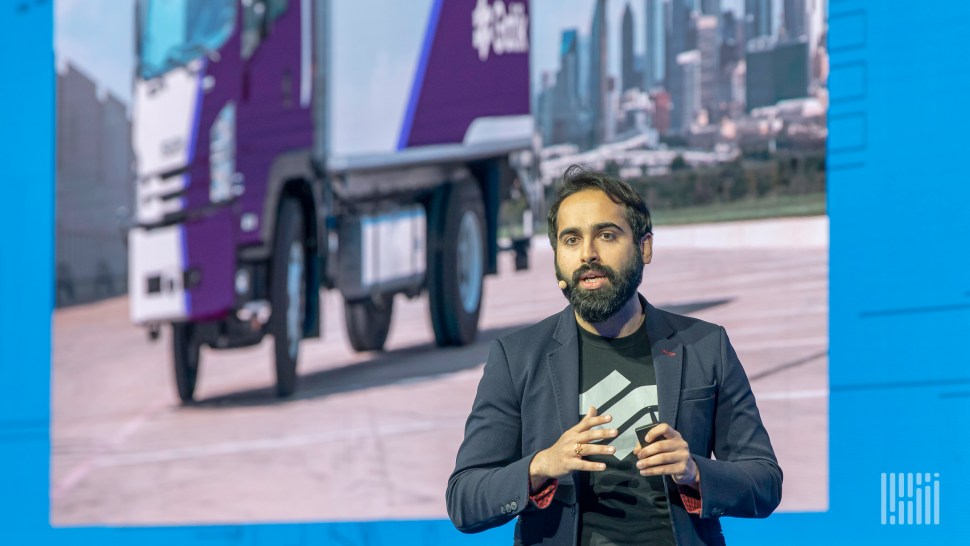
Gatik announced Wednesday its next-generation simulation platform called Gatik Arena. The platform is designed to help the autonomous truck technology maker accelerate the development and validation of its autonomous vehicle systems.
The platform is built in-house and produces photorealistic, structured synthetic data to address the limitations of traditional real-world testing methods.
“As the AV industry pushes toward scaled deployments, the bottleneck isn’t just better algorithms—it’s better, smarter data,” said Gautam Narang, Gatik’s CEO and co-founder, in a press release. “Arena allows us to simulate the edge cases, rare events, and high-risk scenarios that matter most, with photorealism and fidelity that match the complexities of the real world.”
The platform integrates with Nvidia Cosmos, a world foundation model that expands Arena’s capabilities by enabling data synthesis across diverse environments. This integration allows Gatik to transform limited real-world data into millions of testing miles with variations in weather, location, and agent behavior.
“One of the things that the industry has struggled with for a while is that there have been novel approaches that came about a few years ago that allowed re-creation or more photorealistic synthesis of data or synthesis of sensors,” said Apeksha Kumavat, co-founder and chief engineer at Gatik, in an interview with FreightWaves. “However, the grounding in physics or the physics-inspired way of doing these things was lacking, which caused skepticism in terms of using this for real safety validations.”

Traditional simulation methods relied on game engine physics that produced unrealistic sensor data, limiting their usefulness to small segments of the autonomous vehicle stack. Arena overcomes these limitations by providing end-to-end stack simulation with physically accurate sensor data.
The integration with Nvidia’s Cosmos world foundation model significantly expands Arena’s capabilities. While Gatik’s proprietary tools handle 3D reconstruction and scenario generation, Cosmos enables the translation of scenarios to different environments. One example is creating an environment in Europe compared to the U.S. Other possibilities include regional variations, like types of buildings, infrastructure and intersections.
This technology allows Gatik to test trucks in conditions they might rarely encounter physically, such as snow in Texas. Other examples include adverse weather conditions, unpredictable road users, and complex urban interactions.
“What Cosmos essentially provides is a physics-grounded, more generative AI style that allows large-scale simulation volumes,” Kumavat said. “As we collect the data, we collect a few miles on those networks, and as we plug that into the pipeline of Arena, we are able to turn those few miles to a few thousand and millions of miles.”
In the past, these were situations that would be too expensive, time-consuming, or unsafe to test in the real world.
For autonomous vehicle companies, the addition of these virtual environments is critical, as it would take years and millions of miles before some of the edge cases would be found using traditional testing.
Brokerage Compliance Symposium
The day before F3. Every compliance issue you face - fraud exposure, carrier liability, FMCSA rules, cargo theft, insurance gaps - navigated by attorneys and operators defining best practices in a changing industry.
F3 Awards Dinner
The night before F3. FreightTech100 companies honored. FreightTech 25 and Shipper of Choice winners revealed live. Cocktail reception into dinner and live music - 300 industry leaders in one purpose-built room.
F3: Future of Freight Festival
Industry-defining keynotes, rapid-fire technology demos, and industry leaders networking in experiences across Chattanooga - plus the inaugural F3 Awards Dinner featuring the FreightTech and Shipper of Choice reveals.
The day before F3. Every compliance issue you face - fraud exposure, carrier liability, FMCSA rules, cargo theft, insurance gaps - navigated by attorneys and operators defining best practices in a changing industry.
The Signal at Chattanooga Choo Choo • Chattanooga, TN Register NowThe night before F3. FreightTech100 companies honored. FreightTech 25 and Shipper of Choice winners revealed live. Cocktail reception into dinner and live music - 300 industry leaders in one purpose-built room.
The Signal at Chattanooga Choo Choo • Chattanooga, TN Register NowIndustry-defining keynotes, rapid-fire technology demos, and industry leaders networking in experiences across Chattanooga - plus the inaugural F3 Awards Dinner featuring the FreightTech and Shipper of Choice reveals.
The Signal at Chattanooga Choo Choo • Chattanooga, TN Register Now