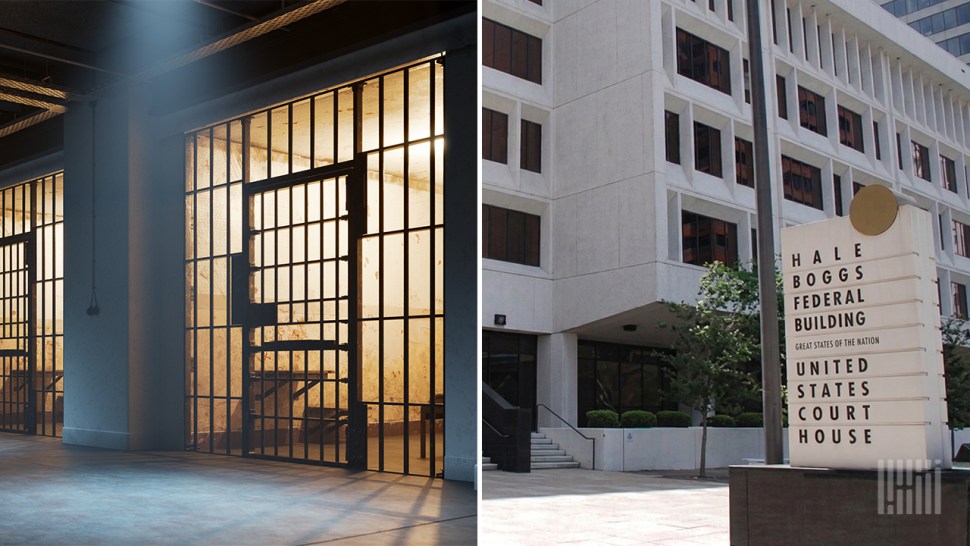
With the first major trial wrapped up in the federal investigation known as Operation Sideswipe, the biggest question now is how long two convicted attorneys will be imprisoned.
Attorneys Vanessa Motta and Jason Giles were convicted Friday in the U.S. District Court for the Eastern District of Louisiana on a variety of mail fraud, wire fraud and witness tampering charges connected to the scheme where a car full of passengers would slam into a truck in an effort to reap insurance payouts.
In its prepared statement announcing the verdicts, the U.S. Attorney’s office said the charges that Motta and Giles were convicted of–a mix of mail fraud, wire fraud and witness tampering –carried terms of as much as 20 years. Mail fraud and wire fraud were the charges levied against 63 people charged in the staged accidents. Most of them pleaded guilty; sentences so far have been as light as probation to more than four years.
A third defendant, non-attorney Daiminike Stalbert, was acquitted of some of the charges that snagged Motta and Giiles. However, he was convicted of making false statements to federal investigators.
Giles’ employer, the King Law Firm, also was convicted in the trial.
The Motta/Giles case was the first in Operation Sideswipe to go to trial. Motta will be sentenced July 7, Giles and The King Firm a week later and Stalbert a week after that.
Will be lots of jail time, not certain how much
Two New Orleans-based attorneys who followed the trial closely had different views on how stiff a sentence the two convicted attorneys face.
Neither Joseph Raspanti nor Edward McAuliffe III thinks the sentences will be short. But they have different forecasts of the potential length.
“People have done some math,” Raspanti said in an interview with FreightWaves after the verdict. He has commented on the Operation Sideswipe trial for local media in New Orleans throughout the trial.
Part of the calculation will be the loss suffered by insurance companies and others because of the staged accidents, Raspanti said. The “implied loss,” he said, could exceed a billion dollars.
And that sort of loss, Raspanti said, is likely to result in a jail term of at least eight years and possibly as much as 11.
Throwing the book at them
McAuliffe, an attorney with the New Orleans firm of Wilson Elser who followed the Motta/Giles case closely, said in a “normal fraud case, you wouldn’t expect the judge to throw the book at people.”
But McAuliffe looked to the comments of Judge Wendy Vitter after the convictions but before she had Motta and Giles remanded to federal custody as a sign that the judge’s outlook on this case is far from normal.
Given that the charges carry maximum terms of 20 years, when combined with the judge’s comments made after the convictions but before remanding the defendants to federal custody, McAuliffe had a shocking prediction for the sentences: Motta and Giles could get the 20-year maximum.
The witness tampering charge is a big factor in that view, McAuliffe said. Testimony showed Motta attempted to persuade one potential witness to take a pile of cash and fly off to the Caribbean, while another recording played by the defense had the unintended consequence of showing Motta speaking to a potential witness after she was indicted “and under orders from the court not to contact anyone involved,” McAuliffe said.
Judge thinks Motta knew
Judge Vitter also expressed skepticism that Motta did not know of the possible involvement of her fiance, Sean Alfortish, in the killing of Cornelius Garrison, a “slammer” who drove cars into trucks. Garrison was shot in his home in 2021 after he pleaded guilty and agreed to cooperate. Alfortis goes on trial with one other defendant for that crime in August.
“Considering all of that together, Judge Vitter has to see that there are some risks here, which she essentially alluded to when she decided to remand both of these attorneys pending their sentencing,” McAuliffe said.
He also noted that in a “normal” fraud trial, the defendants would be expected to stay free on bond after the conviction but before the sentencing. That did not occur with Motta and Giles.
Lots of crashes
One of the more notable pieces of information that emerged from the testimony in the trial was that the incidents spelled out in the various indictments of mostly “spotters,” “slammers” and people who rode along in the cars that collided with targeted trucks were but a small fraction of the total number of incidents.
“Prosecutors were not going to put, whatever they alleged, 60 to 80 to 100 incidents all in the indictment,” Raspanti said. “So they gave a representative act, and then they went with that. But in the course of the trial, the witnesses that were called certainly indicated that there were dozens and dozens of these types of cases.”
Either through direct testimony by attorney Danny Keating, who had pleaded guilty in the case five years ago, or by people connected to Motta, the earnings from Operation Sideswipe appear to have been in the seven-figure range per lawyer, far more than what could have been gleaned from just the specific collisions spelled out in the indictments.
Adding up the victims from Operation Sideswipe would ultimately need a lot more than the crashes spelled out in the indictments. One of the largest that was described, and with one of the biggest carriers, involved a $4.5 million payout in a case involving carrier C.R. England.
What’s the tab on the crashes?
But an accurate sum would also need the payouts for the staged accidents that weren’t in any specific indictments. And potentially more importantly, what did personal and commercial drivers in Louisiana pay in additional insurance premiums as a direct result of the state’s accident rate climbing for however many years the staged accident scam was ongoing?
The pile of accidents that resulted from Operation Sideswipe were generally thought to have led to Louisiana tort reform.
Renee Amar, the executive director of the Louisiana Motor Transport Association, said the tort reform that has taken place in Louisiana in recent years was driven in part by reaction to the crashes whose numbers were elevated by Operation Sideswipe. But that wasn’t the only reason, she added.
Amar told FreightWaves that Louisiana would have been fertile territory for something like the staged accident scam against trucks in Louisiana because “we are the big ticket target items which is the whole reason why they staged these accidents against us.”
“They didn’t do it against cars,” she said.
But the amount of tort reform in Louisiana has not been adequate, according to Amar. Reforms in Louisiana auto and commercial liability in Louisiana, Amar said, is “like a sinking ship and you’ve got 100 holes in it, and we plugged five of the holes at this point. We still have lots of holes they need to plug.”
Amar said there have been civil racketeering suits filed against some law firms that sued over medical procedures that some of the indictments said were not necessary, undertaken simply to increase the possible payout from an insurance company.
But there have been no criminal charges against any medical providers in Operation Sideswipe. Raspanti said such an action is difficult.
“It’s a hard case to prove beyond a reasonable doubt,” he said. “There has been no mention of physicians being pursued by the federal government.”
Next up in court will be the sentencing next month of Keating and Damian Labeaud, a leading “slammer” who along with Keating pleaded guilty and agreed to cooperate. Keating pleaded guilty in 2021, Labeaud a year earlier. Both testified at the Motta/Giles trial.
Their sentencings have been postponed numerous times. They are now scheduled for April 2 for Labeaud and April 9 for Keating.
More articles by John Kingston
Five takeaways from State of Freight: Already strong market gets a wartime jolt
Ohio jury awards $22.5 million in TQL pregnancy case
Dalilah’s Law that tightens CDL issuance gets House committee OK
Brokerage Compliance Symposium
The day before F3. Every compliance issue you face - fraud exposure, carrier liability, FMCSA rules, cargo theft, insurance gaps - navigated by attorneys and operators defining best practices in a changing industry.
F3 Awards Dinner
The night before F3. FreightTech100 companies honored. FreightTech 25 and Shipper of Choice winners revealed live. Cocktail reception into dinner and live music - 300 industry leaders in one purpose-built room.
F3: Future of Freight Festival
Industry-defining keynotes, rapid-fire technology demos, and industry leaders networking in experiences across Chattanooga - plus the inaugural F3 Awards Dinner featuring the FreightTech and Shipper of Choice reveals.
The day before F3. Every compliance issue you face - fraud exposure, carrier liability, FMCSA rules, cargo theft, insurance gaps - navigated by attorneys and operators defining best practices in a changing industry.
The Signal at Chattanooga Choo Choo • Chattanooga, TN Register NowThe night before F3. FreightTech100 companies honored. FreightTech 25 and Shipper of Choice winners revealed live. Cocktail reception into dinner and live music - 300 industry leaders in one purpose-built room.
The Signal at Chattanooga Choo Choo • Chattanooga, TN Register NowIndustry-defining keynotes, rapid-fire technology demos, and industry leaders networking in experiences across Chattanooga - plus the inaugural F3 Awards Dinner featuring the FreightTech and Shipper of Choice reveals.
The Signal at Chattanooga Choo Choo • Chattanooga, TN Register Now