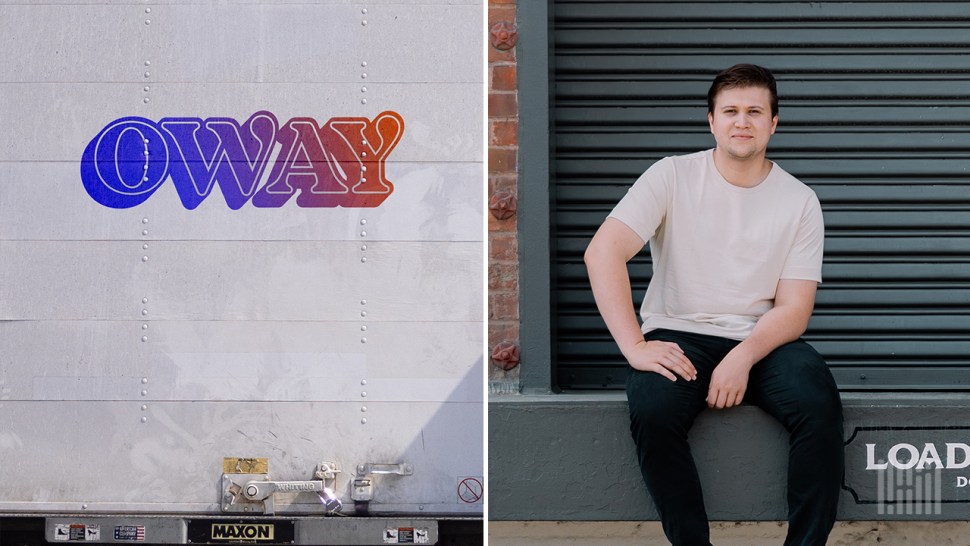
There’s a dirty secret in trucking: Not all truckloads are full. Some are only partially filled. Oway, a Y Combinator- and General Catalyst-backed Silicon Valley startup, is looking to change that. The startup, which recently raised a $4 million seed round, is creating an AI-powered platform that connects partial shipments with available capacity on full truckload carriers.
The logistics industry has long struggled with inefficiencies in the LTL market, where carriers are hesitant to accept partial loads due to perceived low rates. In an interview with FreightWaves, Phillip Nadjafov, founder of Oway, found an opportunity. The first challenge was to overcome the stigma that LTL only offers cheap rates.
“The biggest stigma we have with trying to make it so that full truckload carriers in general have the ability to accept partials is that they by default expect the rates to be very low,” Nadjafov said. “But in reality, if you can try to bring the LTL side of the marketplace over to full truckload, LTL by default has a lot of premiums in the cost for people who ship on LTL.”
Nadjafov described how premiums exist because LTL shippers effectively pay for the entire hub-and-spoke network required to move small pallet quantities. Oway’s innovation lies in bypassing this network entirely by utilizing existing truckload capacity. In doing so, Oway’s system enables carriers to increase annual revenue by up to 30% while providing shippers with cost reductions of up to 50% compared to traditional LTL services.
Oway’s platform uses machine learning and telematics data from electronic logging devices (ELDs) to identify optimal opportunities for carriers to pick up partial loads along routes they’re already traveling.
“We use AI and machine learning to say, ‘Can we use ELDs and specifically build a system where we can provide carriers with quick detours picking up batches of pallets for compensation that they believe are fair and actually good to market?’” explained Nadjafov.
To make the connection, the system connects through an encrypted military-grade ELD authentication protocol, connecting with most major ELD providers in North America. Encryption is key to maintaining security while only accessing approximated location data when necessary.
The platform then monitors their movements and automatically alerts dispatch teams when a nearby pickup opportunity aligns with a truck’s destination. All documentation, including bills of lading, is prepared automatically, creating a seamless experience for carriers who can accept or decline opportunities based on their capacity and schedule.
For carriers using the platform, Nadjafov said they are already seeing results from the added revenue. “If you’re on a popular lane on Oway and you’re doing daily hauls for it, that vehicle that specifically is driving on it will increase its net revenues by 30% annually,” Nadjafov noted.
“We’re already running thousands of shipments and are already partnered with major enterprise carriers that I can’t necessarily disclose right now,” Nadjafov said. “We’re proving out the model right now all over the West Coast and going out all the way to Texas and we’re quickly opening up new geographies across the country at all major hubs.”
Beyond cost savings, there are additional benefits including faster delivery times, reduced damage rates and simplified pricing. “Compared to LTL, Oway’s delivery times are now at least a day shorter but significantly shorter for long-distance hauls,” Nadjafov said, adding, “We don’t classify freight and we don’t do back charges as just a company principle.”
Looking ahead, Oway hopes to monetize its service through transaction fees while maintaining an API-first approach that allows for integration with various transportation management systems. Rather than competing with brokerages, Oway looks to position itself as infrastructure for the logistics industry rather than a direct competitor.
“I think overall it’s just a huge boon to be able to have something like this for the logistics industry over the next 10 years because, you know, we know that regardless of where the market is, it’s always difficult to be a carrier in the market and so any additional revenue is always going to be very, very helpful,” said Nadjafov.
Brokerage Compliance Symposium
The day before F3. Every compliance issue you face - fraud exposure, carrier liability, FMCSA rules, cargo theft, insurance gaps - navigated by attorneys and operators defining best practices in a changing industry.
F3 Awards Dinner
The night before F3. FreightTech100 companies honored. FreightTech 25 and Shipper of Choice winners revealed live. Cocktail reception into dinner and live music - 300 industry leaders in one purpose-built room.
F3: Future of Freight Festival
Industry-defining keynotes, rapid-fire technology demos, and industry leaders networking in experiences across Chattanooga - plus the inaugural F3 Awards Dinner featuring the FreightTech and Shipper of Choice reveals.
The day before F3. Every compliance issue you face - fraud exposure, carrier liability, FMCSA rules, cargo theft, insurance gaps - navigated by attorneys and operators defining best practices in a changing industry.
The Signal at Chattanooga Choo Choo • Chattanooga, TN Register NowThe night before F3. FreightTech100 companies honored. FreightTech 25 and Shipper of Choice winners revealed live. Cocktail reception into dinner and live music - 300 industry leaders in one purpose-built room.
The Signal at Chattanooga Choo Choo • Chattanooga, TN Register NowIndustry-defining keynotes, rapid-fire technology demos, and industry leaders networking in experiences across Chattanooga - plus the inaugural F3 Awards Dinner featuring the FreightTech and Shipper of Choice reveals.
The Signal at Chattanooga Choo Choo • Chattanooga, TN Register Now