




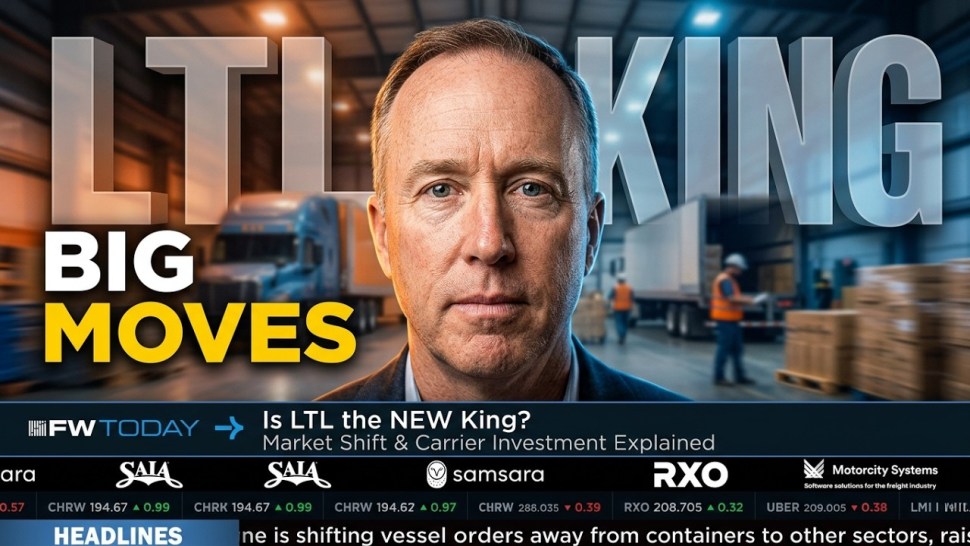
The freight market is seeing a major shift as rising truckload prices push shippers towards LTL solutions. Brad Hadley, VP of National Accounts at Saia, joins FreightWaves Today to discuss this trend, Saia’s record Q2 tonnage, and their strategic investments in terminals and talent programs. Discover how carriers are adapting and what it means for the future of freight.
Saia recorded its best quarter ever for tonnage in Q2, according to Brad Hadley, the carrier’s vice president of national accounts, who spoke with FreightWaves at the Univar Solutions Carrier Kickoff event in Chattanooga, Tennessee. Hadley said the milestone reflects a broader mode shift that began around the start of Q2, as tightening truckload capacity and rising truckload rates pushed shippers to move half-load freight back onto LTL networks.
“Capacity’s tightened, truckload prices have increased,” Hadley said. “Shipments that might have been half loads that were cheaper for customers to move via truckload have now shifted back to the LTL side.” Average shipment weights at Saia have climbed alongside the volume gains, he added.
Hadley framed the surge as the payoff for an aggressive infrastructure build. Over the past two years, Saia has deployed $1.6 billion in capital expenditures — a significant share of revenue for a company generating more than $3 billion annually. That spending has funded 70 new terminal openings over seven years, plus the relocation or expansion of an additional 26 terminals.
“We’ve basically been in a 4-year freight recession. And what we’ve seen happen in Q2, we think is going to continue. And as I mentioned before, it’s kind of what we’ve been building towards.”
On pricing, Hadley said LTL carriers are moving to recapture rates after years of margin pressure. He noted that equipment costs alone have climbed sharply, with a single tractor now running $140,000 to $160,000, while insurance costs have also risen materially. He said Saia intends to ensure it is “paid fairly” by customers who may have taken advantage of the soft market, while continuing to honor long-standing partnerships such as its roughly 15-year relationship with Univar Solutions.
To protect profitability as volumes grow, Hadley said Saia is being selective about the freight it pursues. The carrier is targeting shippers that engage across multiple service lines, including a white-glove final-mile logistics division called Saia Logistics that operates in Florida. He also noted that Saia recently opened a Saia Logistics international office in Chattanooga — two blocks from the Westin where the Univar event was held.
On the driver supply side, Hadley highlighted an internal program called dock-to-driver, in which high-performing dock workers are sponsored through CDL training at Saia break terminals at the company’s expense. He said the program reduces turnover and ensures the carrier knows the background of the drivers it places on the road. Hadley, who has been with Saia for 19 years, said culture and continued investment are what keep him at the company. Saia also received Univar’s Superior Excellence in Service and Partnership award at the event.
- Saia reported a record Q2 tonnage quarter, driven by shippers shifting half-load freight from truckload to LTL as capacity tightens.
- The carrier has invested $1.6 billion in CapEx over the past two years, opening 70 new terminals in seven years to prepare for volume growth.
- Saia’s dock-to-driver program sponsors internal dock workers through CDL training to fill driver needs and reduce turnover.
Speaker 1 [0:00] Welcome back everybody to FreightWaves Today. Of course, we are at the Univar Solutions Carrier Kickoff event here at the Westin in the heart of Chattanooga, Tennessee. Of course, Malcolm Harris as well as Julie Vandekamp. We are now joined by Brad Hadley from Sire. He is the VP of National Accounts. Brad, hello. It’s good to see you.
Speaker 2 [0:19] Is this an incredible event or what?
Speaker 3 [0:21] It’s very cool. Yeah, we’re thrilled to be here.
Speaker 1 [0:23] This is great.
Speaker 2 [0:24] I wish more customers would do something like this. It really, It brings the carrier and the customer together and it’s more educational as well as on our pick-it lots. So good stuff.
Speaker 3 [0:33] Yeah, that’s a great place to start. Talk a little bit more about what it means to you and how this positions Univar as a shipper of choice for you guys.
Speaker 2 [0:40] So we’ve been doing business with Univar for a long time, probably close to 15 years, but it really was like the last 5 years when we saw the relationship grow because of events like this. So we got to know more of their people that are from the different regional transportation people. And get a better idea of kind of the direction they were looking to go. So for us, this, it’s been a great kind of kickoff to the next season with them going into the bid.
Speaker 3 [1:06] Very cool.
Speaker 1 [1:07] Brad, just because I’m a dork, I want to put this in perspective for myself.
Speaker 2 [1:11] Okay.
Speaker 1 [1:12] Why has there been such a transition from a lot of full truckload to now LTL? Why are we seeing this trend across the board?
Speaker 2 [1:19] Well, I think a lot of it has to do with money. Right. So the root of all evil. So basically what we’ve seen is capacity’s tightened, truckload prices have increased, of course. And then they look for shipments that might have been half loads that were cheaper for customers to move via truckload have now shifted back to the LTL side. So that’s kind of what we’re seeing really started probably in the beginning of Q2.
Speaker 3 [1:46] So truckload rates rise, it creates more opportunity.
Speaker 2 [1:50] And customers kind of shift modes over to LTL for some of those half loads or, you know, moves like that.
Speaker 3 [1:57] And is that resulting in more LTL volume that you all are seeing?
Speaker 2 [2:01] Absolutely. Yeah. When you look at it, we’ve definitely seen the weights increase in our average shipment. I mean, you look at our Q2 results, which we released today, it was a record quarter for us for tonnage. So we’ve seen that transition.
Speaker 3 [2:19] Great. I know I didn’t get a lot of time to dig into it because it was— the release came out today after we were already here. Any headlines you want to share?
Speaker 2 [2:26] I’ll leave that to Fritz, our CEO. But you brought it up or I wouldn’t have. Yeah, I understand. But now we’re, you know, we’re pleased with the direction our company’s going. You know, we’re poised for, for what we think going to happen within the industry going forward with what we’ve invested into our company to this point.
Speaker 3 [2:48] Good.
Speaker 1 [2:49] So when it comes down to this, what you just discussed, is this temporary given the current aspect? Or you think this is going to be more so a permanent shift as we continue through this market cycle?
Speaker 2 [3:01] If I had that answer right, I would be a very rich man. But yeah, I think the way we’re looking at it, Is the trend is definitely heading that way. I mean, we’ve basically been in a 4-year freight recession. All right. And what we’ve seen happen in Q2, you know, we think is going to continue. And as I mentioned before, it’s kind of what we’ve been building towards. I mean, you look at Cy as a company in the last 2 years, we put $1.6 billion into CapEx. You know, we’re a $3+ billion a year company. That’s a significant percentage of our revenue going back into CapEx. preparing for this type of expansion. I mean, we opened— we’ve opened 70 new terminals in 7 years. We’ve 26 terminals, not including those 70, another 26 terminals we’ve relocated or expanded. So we’re poised for what we think is coming now.
Speaker 3 [3:55] So with a tight truckload capacity creating more opportunity for LTL, what are you seeing happening in pricing? I read earlier this week, I think it was ARK Invest, maybe, I don’t know, somebody pulled their GRI up 6 weeks sooner than normal. So what are you seeing regarding that and how pricing in the LTL world is reacting to this market?
Speaker 2 [4:17] Yeah, I think, you know, we know that we need to get paid for the services that we’re providing and we’re providing quality service to our customers. We’ve tried to be consistent even through the downside with our you know, with our partner customers like Univar that we’ve been doing business with for a long time. But, you know, I think we’ve seen there’s probably other customers that maybe have taken advantage of the marketplace. And I think what you’re going to see industry-wide, or I should just speak more for Sayes, is just knowing that we need to get paid fairly from those customers.
Speaker 3 [4:50] We say it all the time that for carriers to be compliant, and safe and have safe equipment and have quality drivers, they have to be profitable. And when rates are paying below their costs, it’s really hard to do that. So it’s not that I want, like, that I, like, love, like, sticking it to shippers and want it to be a carrier’s market because I do have a carrier background. It’s because there does need to be balance and that we do need safe roadways. We do need carriers to be able to cover their costs and be safe and compliant with quality drivers.
Speaker 2 [5:23] Absolutely.
Speaker 3 [5:24] And everyone wants drivers to make money. Like, they have the hardest jobs.
Speaker 2 [5:28] Absolutely. There’s nothing better when we do our quarterly meetings and we get out in front of all of our drivers and dock workers. To me, that’s the favorite part of my job. That’s what, that’s what really makes the work happen. But you’re right on the cost side of it. I mean, look at the LTL industry and we talked about earlier our insurance costs, right? And how much that’s gone up and how You know, you drive down the road and you see some more billboards about, you know, looking for trucking companies and stuff with lawsuits. So I think our costs have definitely risen significantly. You look at an average tractor nowadays, it’s up to $140,000 to $160,000 for one tractor.
Speaker 3 [6:10] So yeah, trailers are significantly more expensive. I mean, all of it is. Yeah.
Speaker 2 [6:14] Right. So yeah, I I think to cover that cost, you have to be profitable to provide quality service to your customers.
Speaker 3 [6:22] Right. So in this current market, as we’re seeing some more demand and volume shift to LTL, how do you balance that with choosing the right freight for your organization, being profitable, and then still providing the service you promised?
Speaker 2 [6:34] So I think, I think part of it is trying to partner with customers that are looking to work with you. And just as an example, right? So It’s not just doing LTL. You want to look for those customers that will do more than just the basic LTL with you, and that’s how you stay profitable. So we’ve got a Scia Logistics division now where, where we provide white glove final mile service into the state of Florida. Right. So it’s looking for those customers that will partner into different areas like that in other areas as well, whether it’s, you know, warehousing, final mile. And then maybe also looking at certain segments of the industry that are maybe pay a little higher revenue per bill than others. And also maybe focusing on some of those areas. For a shipper right now, they’re trying to make the decision.
Speaker 1 [7:22] All right, we talked about it earlier. It’s like, hey, like money drives everything, right? This might make more sense into the LTL space. But from your seat, how do you and how would you rather educate a shipper to make that decision On truckload versus less than truckload?
Speaker 2 [7:40] So what we like is the customers that are consistent, whether it’s on the truckload to LTL side, is keeping it consistent. So we know from the customer what we can expect, that we can control costs with their account. So whether it’s that truckload shipments moving to LTL or even certain times customers that might once a year switch the lanes of an LTL carrier with scanning between their, between their different carriers to maybe save a couple of pennies. But what you’re doing is you’re costing more for your traffic, right? Because now you’re going from handling these states to these states and now you’ve got to adjust your system operationally, whether it’s driver headcount, linehaul, that type of thing.
Speaker 1 [8:24] You know, Julie, when I was a young gun in the brokerage space, I used to use SIA quite a bit for my LTL needs as a broker.
Speaker 2 [8:31] And the one thing—
Speaker 3 [8:32] You’re a young guy.
Speaker 2 [8:33] A young guy.
Speaker 1 [8:34] Yeah, I’m saying a 21-year-old young guy. The one thing that was always good was reliability. How has that level of— and we’ve asked this question, but the level of service, but just the autonomy, visibility aspect, like I didn’t have to worry if SIA was the carrier associated with it. How has that always been the case from 2017 to now going into 2027?
Speaker 2 [8:56] And it’s funny you say that. We’re taking that philosophy that we’ve always had and expanding on it. So we just had a recent release of something we call REV, right?
Speaker 1 [9:06] Yeah.
Speaker 2 [9:07] Basically, that is, you know, when some carriers might be struggling, we’re looking to expand what we do with our customers in all those areas that you mentioned. So part of one of those areas is we give the offer now to our customers as we’re rolling out. As far as what I think is going to happen or not, I don’t know. I mean, I think You know, we do some business with Amazon. They’re obviously a great company. They’ve got the financial backing to do whatever they want to do. Right. But at the end of the day, we’re just going to focus on what we do and make sure we’re doing a better job for our customers each day.
Speaker 1 [9:43] Now, I think that’s a great answer for Warren. For sure. It just puts in perspective just how this evolution of transportation in this space and LTL is changing, man. I think it’s providing service at a high level and it’s gonna make everybody play up to this level. And a follow-up question to that is, you know, we talk news articles often. There’s a bunch of articles coming out. I’ve been, of course, listening to CDL news, the drivers and different things kind of entering the space. Is this having any impact on the level of service that you’re still, you know, 10 years ago to now?
Speaker 2 [10:18] Yeah.
Speaker 1 [10:19] providing on a daily basis?
Speaker 2 [10:20] Yeah, I mean, we’re fortunate that, that SIA, it, it, it is in for us. We’ve got a really strong, we call it dock-to-driver program.
Speaker 1 [10:30] Okay.
Speaker 2 [10:31] And that’s how we field into or fill our driver needs for terminal level. So dock-to-driver, so the dock worker is doing a really good job for us, good attendance, right? Good freight handling. And they want to become a CDL driver.
Speaker 3 [10:45] Right?
Speaker 2 [10:45] The terminal manager will put them into the dock-to-driver co-brand, and we pay for everything. You send them to one of our break terminals where we provide them the training, the course. They get their CDL license. They come back to their terminal, right? We don’t just put them right out on the road. Now they kind of do a little bit of dock and driving, and that way we’re filling the need from the driver’s side. But we know we’re filling it internally with with.
Speaker 3 [11:11] I imagine that has a positive impact on turnover as well.
Speaker 2 [11:15] Oh, absolutely. Yeah, absolutely.
Speaker 1 [11:17] And it—
Speaker 2 [11:18] you always want to try to promote from within anyways, and that really helps build our culture.
Speaker 3 [11:23] But you know who you’re putting in your trucks versus the first 30 days is when you lose so many new drivers. So that sounds like an amazing program and a really, really smart move. All right, so I’ve got to ask, where do you live?
Speaker 2 [11:37] You know, there’s certain words I try to stay away from, right? Like car and water and words like that because it just gives away that accent. So yeah, I’m, I’m from Rhode Island.
Speaker 3 [11:47] Okay. I mean, I, I knew it was, yes, Northeastern.
Speaker 1 [11:49] I was gonna guess Massachusetts.
Speaker 2 [11:50] Close.
Speaker 1 [11:50] I was.
Speaker 3 [11:51] So I asked that because I’ve got asked, what do you think of Chattanooga? What do you think of the event being here? Have you got any time to enjoy it?
Speaker 2 [11:58] Uh, yep. So I got in yesterday, so I was able to, uh, to check out the city a little bit and went for a little jog this morning around the city as well. Very impressed. You can see that the city is developing. And in fact, it was interesting that they moved it here this year. 2 blocks away, we just opened up a SCIA Logistics International office. So 2 blocks away. So yeah, so it worked out well. I was able to visit with the team yesterday while I was in town and really like the city. I think it’s definitely up and coming.
Speaker 3 [12:28] There’s just so much transportation and supply chain talent here. Makes sense that you’d open an office here. It’s why we call it Freight Alley. Everywhere I go here, I’ve met, you know, people I’ve worked with over the years, colleagues. It’s great to just go out. And with logistics being so close to my heart, everywhere you look in Chattanooga, it feels like it has a footprint.
Speaker 2 [12:48] Yeah, I hope they keep it here.
Speaker 1 [12:51] It was—
Speaker 2 [12:51] there was a good change.
Speaker 1 [12:52] So it’s a great change. I’m enjoying the sights and sounds so far. And, you know, anything for us that you want to leave with our listeners? for, for Saya, for the organization? I mean, you guys are doing incredible work in the LTL space. I mean, really in the general logistics space.
Speaker 2 [13:08] Yeah, for sure.
Speaker 1 [13:08] I can tell you really, you care about it. And what would you like to leave us with?
Speaker 2 [13:13] So, you know, I’ve been with Saya for 19 years.
Speaker 3 [13:16] Wow.
Speaker 2 [13:16] So, and it’s because of the culture that’s here and what I see the company growing and the people that are here. To me, the most impressive thing with our company is what we’ve invested back into the company for our customers. I mean, I talked about it, you know, 70 terminals in 7 years. I mean, that’s unheard of. And plus the expansion of the other terminals, you know, investing that type of CapEx in the expansion. I mean, we’re betting on the future of our company because of our people for our customers. So to me, I’m excited for what’s going to come in the next couple of years. We are positioned so well for what we see coming with the increase. Now you hear bits and pieces about some carriers recently that may, might be maybe struggling with some increased volumes that have come off from truck roads and stuff. Whether that’s true or not, again, we don’t talk about our competition, but as far as Saya goes, we were in a position to handle whatever that need is. We have the terminals, the tractors, the drivers available to, to handle whatever the need is. So Again, we’re excited for what’s to come. It’s a beautiful thing, right?
Speaker 3 [14:29] All right, final question. Any takeaways so far from the event?
Speaker 2 [14:34] Well, besides the award that we won, which was pretty exciting, right? That’s still up there. We’re pretty excited. The Superior Excellence Award.
Speaker 3 [14:42] So Superior Excellence in Service and Partnership, right? Exactly. Great. Congratulations.
Speaker 2 [14:47] Thank you. But I think that really speaks more to us, but more to Univar because You know, whether it’s, you know, the different people there, Kyle or Dean or whoever that we’re working with, they let us know where the need is. We let them know what we can do, but we’ll also communicate openly if there’s, if there’s certain issues we might be having or, or other opportunities that we might see. And just sharing that is refreshing on the customer level. They really don’t— Univar doesn’t, doesn’t see carriers as a commodity. They really don’t. They see them as partners that help them be successful in the veneer industry. And that’s great for us. So we enjoy, really enjoy working with customers like that.
Speaker 3 [15:30] Great. Well, I think that’s sort of the perfect way to end it. That’s how you be a shipper or how to be a shipper of choice, right?
Speaker 2 [15:38] Absolutely.
Speaker 3 [15:38] If you want to be someone carriers want to work with. Thank you so much for joining us. It’s been a great conversation. I hope you enjoy the rest of the event and your time in Chattanooga.
Speaker 2 [15:46] I enjoyed it as well.
Speaker 1 [15:47] We’re gonna get you down here from Rhode Island more often.
Brokerage Compliance Symposium
The day before F3. Every compliance issue you face - fraud exposure, carrier liability, FMCSA rules, cargo theft, insurance gaps - navigated by attorneys and operators defining best practices in a changing industry.
F3 Awards Dinner
The night before F3. FreightTech100 companies honored. FreightTech 25 and Shipper of Choice winners revealed live. Cocktail reception into dinner and live music - 300 industry leaders in one purpose-built room.
F3: Future of Freight Festival
Industry-defining keynotes, rapid-fire technology demos, and industry leaders networking in experiences across Chattanooga - plus the inaugural F3 Awards Dinner featuring the FreightTech and Shipper of Choice reveals.
The day before F3. Every compliance issue you face - fraud exposure, carrier liability, FMCSA rules, cargo theft, insurance gaps - navigated by attorneys and operators defining best practices in a changing industry.
The Signal at Chattanooga Choo Choo • Chattanooga, TN Register NowThe night before F3. FreightTech100 companies honored. FreightTech 25 and Shipper of Choice winners revealed live. Cocktail reception into dinner and live music - 300 industry leaders in one purpose-built room.
The Signal at Chattanooga Choo Choo • Chattanooga, TN Register NowIndustry-defining keynotes, rapid-fire technology demos, and industry leaders networking in experiences across Chattanooga - plus the inaugural F3 Awards Dinner featuring the FreightTech and Shipper of Choice reveals.
The Signal at Chattanooga Choo Choo • Chattanooga, TN Register Now