




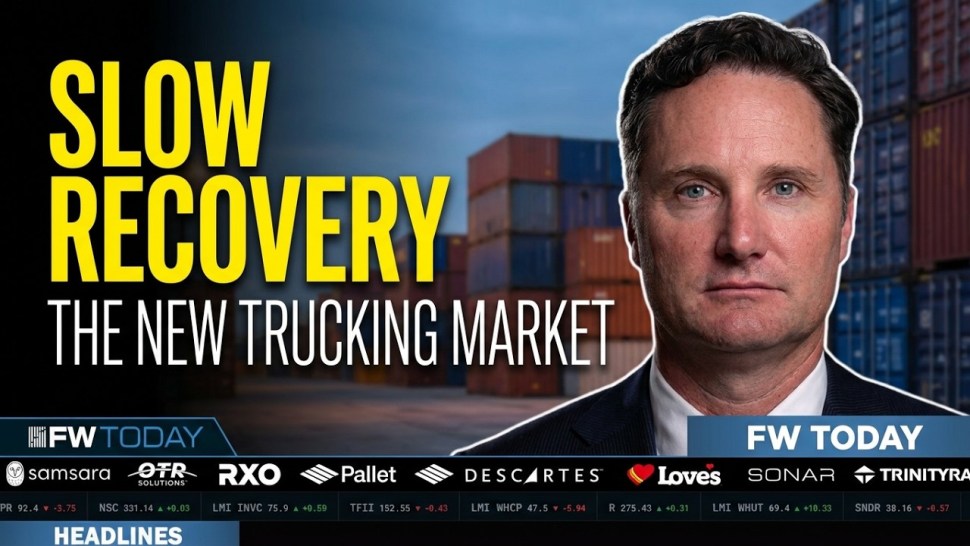
Aaron Graft, CEO of Triumph Financial, dives deep into why this freight market cycle is structurally different. He explains that increased litigation, regulation, and legislation act as barriers to entry, preventing the surge of new capacity seen in previous upturns. This fundamental shift suggests the current tight market conditions might persist longer than anticipated, impacting profitability and driver availability.
Triumph CEO and founder Aaron Graf said the current trucking upcycle is more structural than cyclical, pointing to litigation risk, regulatory pressure, and a tight driver market as barriers that will prevent capacity from returning the way it did in 2021. Graf made the comments during a video interview after reporting what he described as a standout quarter, with Triumph’s revenue up 49%.
“In the last cycle it was he who had the cheapest capacity would win. They would put unqualified, undocumented, unverified people into trucks,” Graf said, contrasting that environment with today’s. “Now it’s so different. You’re getting paid $2,000 to move freight, but you might be still staring at a $30 million verdict on the back end of it.”
“It feels more structural. We know it’s a cyclical business. And who’s to say when it would end, but it feels like it has more legs perhaps than what we’ve seen in the past.” — Aaron Graf, CEO and founder, Triumph
Graf pointed to data from Triumph’s factoring business — which he said represents 15% or more of the entire market — to illustrate tightening conditions. The average invoice size in that business rose 26% quarter over quarter, while Triumph’s customer count actually grew 4%. Graf noted fewer loads were tendered to owner-operators in the 1-to-4 truck segment, suggesting that cohort exited the market and drove the supply tightening rather than any meaningful increase in demand.
On brokerage margins, Graf said Q1 saw compression as contracts broke down, but by Q2 the gross dollars brokers earned per load increased because load sizes grew faster than margins fell. Broker margins compressed to between 10% and 12% for brokers Triumph tracks, but the actual dollar revenue per load still rose. Graf used a straightforward example: a 15% margin on a $1,500 load yields $225, while a 10% margin on a $3,000 load yields $300.
Graf said Triumph has eliminated more than $30 million in internal inefficiencies, improvements he credited to the prolonged soft market forcing the company to look inward. On the payments side, he said Triumph now touches 65% of all brokered freight and is running at approximately $54 billion in annualized payments. He also noted the total addressable market for brokered freight has been resized from $110 billion to $135 billion due to inflation. Triumph’s LoadPay product, which Graf described as starting as “the idea of Venmo for trucking,” has expanded into a digital business companion for carriers, offering a virtual wallet with 24/7 instantaneous funding through partners including C.H. Robinson.
Looking ahead, Graf said the market is “more brittle” than many realize, meaning any uptick in demand could push rates higher still given the lack of available, properly verified capacity. He added that even at current revenue levels, small carriers are not generating significant profits once diesel costs and equipment input costs are inflation-adjusted, leaving little incentive for aggressive re-entry into the market.
- Triumph’s average invoice size in its factoring business — covering 15%+ of the market — rose 26% quarter over quarter, while customer count grew 4%
- Broker margins compressed to 10–12%, but gross dollars earned per load increased as load sizes outpaced margin compression
- Graf cited $30 million-plus in eliminated internal inefficiencies and 49% revenue growth as Triumph scales its payments platform to $54 billion annualized
F3: Future of Freight Festival
Industry-defining keynotes, rapid-fire technology demos, and industry leaders networking in experiences across Chattanooga - plus the inaugural F3 Awards Dinner featuring the FreightTech and Shipper of Choice reveals.
Industry-defining keynotes, rapid-fire technology demos, and industry leaders networking in experiences across Chattanooga - plus the inaugural F3 Awards Dinner featuring the FreightTech and Shipper of Choice reveals.
The Signal at Chattanooga Choo Choo • Chattanooga, TN Register Now