




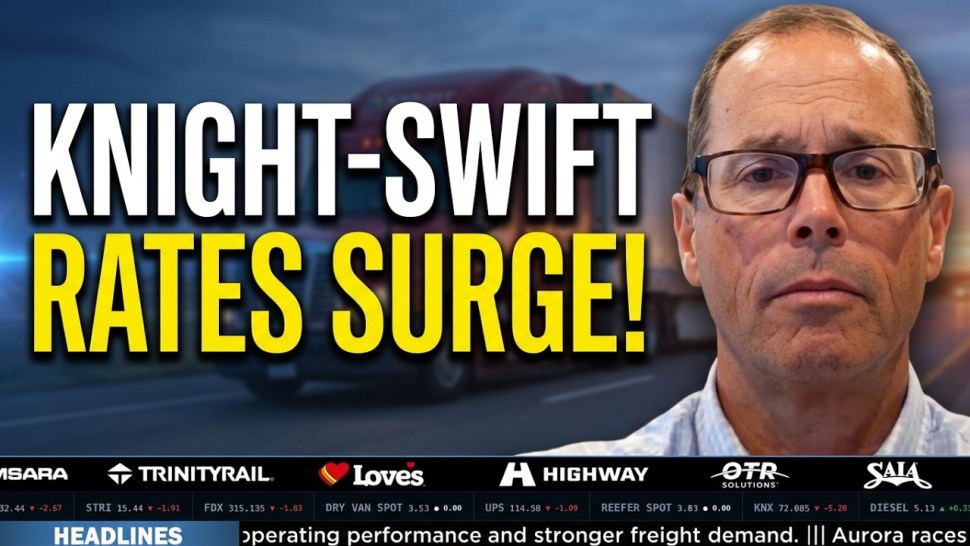
Knight-Swift’s Q2 earnings blew past expectations, driven by an impressive surge in truckload rates. Our Finance Editor, Todd Maiden, breaks down how this signals a major inflection point in the freight market. With aggressive rate reviews and strategic adjustments, Knight-Swift is poised for significant profit growth that hasn’t even hit the books yet.
Knight-Swift Transportation posted a second-quarter earnings beat of 23% above expectations, with FreightWaves reporter Todd Maiden calling the result — combined with forward guidance — confirmation that the truckload freight cycle has definitively turned. The carrier’s Q2 actual result beat its own prior guidance by 34%, and its third-quarter earnings guidance of $0.71 to $0.77 per share came in roughly 4% above the Wall Street consensus estimate.
The clearest signal of tightening capacity came from Knight-Swift’s tender rejection rate, which ran at twice the market average — a figure that one host pegged at roughly 30%. That level of selectivity means a large portion of the carrier’s contracted book was inked in January and February, when market conditions looked far softer, leaving meaningful rate upside still unrealized. “The bulk of what was implemented in the quarter was inked in January, February, when the supply side didn’t look anything like this,” Maiden said.
“Right now they’re getting double-digit contract rate increases across the board. And their spot market exposure has gapped up another 5%. It’s up to 15% now. So they have that optionality to play the market through the rest of the year.”
Truckload drove virtually all of the outperformance. Tender rejections, spot rates, and contract rates all moved higher from April through June, and Knight-Swift is accelerating off-cycle rate reviews on contracts not scheduled to roll until later in 2024, bringing them to market sooner than annual bid negotiations would allow. Maiden noted there is no material cost offset to those incremental rate gains — driver wage increases are being addressed through better utilization and loaded-mile growth rather than broad pay hikes, which preserves the flow-through to the bottom line. The carrier’s spot exposure climbing to 15% of the fleet adds further earnings leverage if seasonal demand holds.
Results were more mixed outside of truckload. In less-than-truckload, tonnage rose 4% but shipment count fell 4%, with the gap explained by an 8% increase in weight per shipment. Knight-Swift imposed temporary embargoes at certain facilities to protect service levels. Maiden characterized the segment’s trajectory as “stable to firming,” noting the carrier is still in early innings of an LTL buildout that has added roughly 180 terminals through acquisitions — including purchases from Yellow Corp’s defunct estate — over the past five years. Individual terminals typically require six to twelve months to reach breakeven and one to three additional years to match network margin averages.
The brokerage and logistics segment reported 350 basis points of gross margin compression, broadly in line with the rest of the market. Load count was down, though revenue per load increased. Maiden suggested Knight-Swift’s asset-based trucks may be absorbing higher-paying spot loads sourced through its own logistics desk, a common practice among large carriers running hybrid asset-brokerage models that becomes especially valuable when tender rejection rates are elevated.
Intermodal remained a minor contributor — Maiden estimated roughly 5% of revenue — and drew less analytical focus than truckload or LTL, where the carrier is allocating the bulk of its capital and management attention. The host noted that Knight-Swift’s heavy over-the-road exposure makes it a more representative barometer of the broader freight market than more intermodal-centric peers. With more than 600 trucks unseatd due to driver availability constraints, management’s commentary pointed to a tight driver market persisting, supporting the view that meaningful capacity additions remain unlikely in the near term.
- Knight-Swift’s Q2 earnings beat consensus by 23%, with Q3 guidance coming in roughly 4% above Wall Street estimates and no major cost offsets expected against rising rates.
- Tender rejection rates ran at twice the market average, with double-digit contract rate increases now flowing through and spot market exposure rising to 15% of the fleet.
- LTL tonnage rose 4% but shipments fell 4% as weight per shipment climbed 8%; Knight-Swift’s 180-terminal LTL network remains in early-stage ramp-up with 6–12 months needed per terminal to reach breakeven.
Speaker 1 [0:00] So, Julie, I think bottom line is markets are tight. Capacity is not going to be added quickly due to driver availability. And to talk about the Knight-Swift earnings, we have Todd Maiden, FreightWaves reporter, who covered Knight-Swift’s earnings report. Todd, tell us what is your general takeaway from this earnings report for KNX?
Speaker 2 [0:22] You know, really nice beat, 23% earnings better than expected. But, you know, it’s really confirmation to JB Hunt’s results last week that the cycle has indeed inflected. JB Hunt had some idiosyncratic things going on, taking market share, cost cleanup, that I think some investors were kind of speculative of, can we extrapolate that across all carriers and across the market in general? And Knight certainly delivered last night. And the best part, their commentary was even better and the outlook for the rest of the year. You know, momentum built throughout the quarter. Tender rejections, spot rates, contract rates, all up and to the right April to June. Uh, their tender rejection rate was twice the market average, uh, which speaks to the strength of a large, well-capitalized carrier. Uh, and then it— all of the strength came in truckload. Uh, you know, you look at across less than truckload logistics, intermodal, mixed results there, but truckload drove it all. And the best part is the reason that more is on the come, you know, as far as earnings are concerned, it was achieved through rate. You’re talking about better utilization and cost takeouts, you know, and just starting to see contractual bids that were inked earlier in the year bleed through to results. So as that continues to gain momentum and more of the book is repriced and actually implemented, You know, all that’s gonna drop to the bottom line. There’s not a cost offset to it. So really positive. And I think more so than the result is the forward-looking guidance.
Speaker 1 [2:05] Todd, I think my takeaway, if they’re at 30-plus percent rejection rates in their route, you know, what freight is being tendered, we study the market, obviously Sonar is the place where people are, you know, tender rejection data or OTRI and STRI indexes are the benchmarks of the industry. The obvious answer to a 30% rejection rate is that rate— there’s a lot of rate momentum that is yet to come, because it means that they’re likely underpricing or have these old contract rates that are underpriced to market conditions. If they’re able to achieve those rejection rates, that means a lot of rate increase is coming. That’s clearly the takeaway here.
Speaker 3 [2:47] Well, and they spoke to that a bit. I can’t remember the quote exactly, but I remember hearing saying that they finally saw contract rate momentum starting to really pick up in some of those new bid awards at the increased rates, uh, the back half of June, and are already seeing it in July, I believe, as well.
Speaker 2 [3:03] Yeah, so, and, and they received some pushback from analysts on the call. You know, rate per loaded mile only came in 6% higher year over year, but there, there’s a lot of nuance to that. One, uh, you know, they said the bulk of what was implemented in the quarter was inked in January, February, when the supply side didn’t look anything like this. They’re conducting— they’re seeing a ton of mini bids. They’re also conducting a bunch of rate reviews on contracts that aren’t scheduled to roll until later in the year, and they’re going to bring those up to snuff, to closer to market level sooner than the, the, the annual, uh, bid negotiation. But then you also had, uh, you know, 28% of their fleet’s dedicated, so you have some of that’s just tied to regular, you know, producer price index escalators. So that, you know, that was a little bit of a drag. But right now they’re getting double-digit contract rate increases across the board. And their spot market exposure, if you’re an investor, their spot market exposure has gapped up another 5%. It’s up to 15% now. So they have that optionality to play the market through the rest of the year.
Speaker 3 [4:13] Well, I think one of the things that you see closely managing tender acceptance on their contracts, right?
Speaker 1 [4:17] Clearly, if you’re, if you’re rejecting 30%, and you’re managing, as Julie says, the tender acceptance numbers, you’re at 30% rejections, you can easily take freight from the spot market, which I think is probably, Todd, the takeaway that I— another takeaway is that they are shifting some of the capacity perhaps from the US Express operation, where it wasn’t as tightly managed as the core Knight-Swift business was prior to their ownership in it. And therefore, they’re able to benefit from some of the spot market inflection when there’s such a wide delta between spot and contract.
Speaker 3 [4:53] And then I also wonder— and I don’t know how the interplay is now. I don’t know how it’s changed.
Speaker 1 [4:57] But in terms of disclosure, just to be fair, you ran US Express’s dedicated operations, or you were a part of different operations inside of US Express. Of course, our family office still owns some equity in US Express itself. But in terms of operations, you were saying?
Speaker 3 [5:15] Yeah. And so I don’t know how much of this they do at this point. But my intuition and what I would infer from the numbers is that a lot of that higher paying spot freight that they’re able to pull onto the asset-based trucks is coming from logistics because their logistics load count was down. Revenue per load was up, but their load count was down and they still had a relatively compressed margin in that brokerage group. So I wonder if some of the high paying freight that the broker, that their logistics group books goes on some of the assets to continue.
Speaker 1 [5:43] So that spot market, last minute spot market.
Speaker 3 [5:45] Yeah, to continue to drive that rate per mile up with some of that spot freight.
Speaker 2 [5:49] Yeah, I mean, they don’t, they don’t talk about it specifically, but you’re right, there’s some cherry-picking there. Uh, I mean, I know it occurs on the larger, the asset-based carriers that also have brokerage models. Absolutely. Uh, in a market like this, and like you said, 30% tender rejection rate, they’re— those loads that come across their broker board there and they’ve already transitioned equipment into spot, they’re absolutely jumping on those. Uh, yeah, and I, I think Uh, you know, on the brokerage side, 350 bps of gross margin compression, but that was really in line with, with the rest of the market. And they’ve also had the added headwind. I don’t think they were as far along as like a JB Hunt in their carrier vetting protocols, even though they’re still within the group of brokers that’s considered industry leading and, and kind of at the forefront of, you know, getting out the bad actors over the last year plus. So I think they had a little bit of work to do, and that’s why that load count was off a little bit.
Speaker 3 [6:47] So we talked a lot about— we talked a little bit just now about brokerage, talked a lot about their truckload. Um, what about LTL? We saw shipments down. Um, tell it— tell us, tell us more about their LTL report.
Speaker 2 [6:59] Yeah, tonnage was down, uh, you know, or I’m sorry, tonnage was up 4%, but shipments were down, uh, 4%. So the, the delta all came on an 8% increase in weight per shipment. So some headwinds there. They’re being more selective on their freight mix, which is positive for price, positive for margin. And they also enacted some temporary embargoes at certain facilities, and that was to maintain service levels. So the activity’s out there and they, you know, as that freight, that heavier stuff that was lost to truckload through the downturn to a depressed truckload spot market, that’s starting to bleed back into LTL networks. So I don’t think we can take a ton out of their volume trends. But what I will say is when you look at the other public carriers, your ODs, XPO, SIA, ArcBest, and you kind of aggregate their tonnage trends on a 2-year stack comparison, which, you know, takes out the volatility of what their prior year comps were, they all inflected positively in May and should have done further so in, in June. And we’ll get June results next week when they all report. Um, so LTL for Knight-Swift’s a little bit more state uh, stable. They’re still in the, the early innings of their LTL journey. Um, I mean, you’re talking basically 180 terminals added through acquisition and, you know, organic additions, buying from Yellow Corp’s defunct estate over the past, you know, 5 years, but really a lot of activity in the last 2 years. And it takes 6 to 12 months to get a terminal to break even and another, you know, 1 to 3 years to get it to where it’s actually comping to what the rest of your network looks like on a margin comparison. So their story is a little bit of an outlier, but I think the trends are firming. So stable to firming is kind of how I quantify their LTL trends. But the broader industry is doing better, and we’re talking multiple quarters. Nothing speaks to the health of the industry more than multiple quarters of mid-single-digit contractual rate increases year over year. So high moats, high defensibility in LTL, and nothing’s changed.
Speaker 1 [9:18] So Todd, the intermodal business for Knight-Swift certainly is not as bullish, at least the read on that is not as strong as what we got with JB Hunt and even the intermodal volume. Is there Is there some takeaway that you have on some of the intermodal? I mean, look, there’s been some improvements, but certainly not what we saw with some of the other, you know, JB Hunt blew out their earnings largely because of intermodal. What is it? What is really Knight-Swiss’s challenges with their intermodal business?
Speaker 2 [9:50] So yeah, some of that was comp-driven, you know, between TL and the onboarding of LTL. I think it’s more of a complementary service. It’s not that not that big, not that impactful. I mean, you’re talking about maybe a 5% revenue contributor or something that’s been a drag on earnings. So, you know, as far as, uh, focus intensity, you know, what requires CapEx dollars and attention, it’s all going to TL and LTL. So I, I think it’s, you know, whereas JB Hunt, I mean, you know, as you know, I mean, they’re leading intermodal first, dedicated first. Uh, there’s kind of a race there for JB Hunt between which one will end up being bigger for them, dedicated or intermodal. But so I, I think it’s just, you know, their, their focus. It’s a complementary service. Uh, they, they have some tailwinds. They control most of their dray capacity. They control most of the drivers. Uh, so there are some tailwinds. And, you know, as, as freight continues to convert, uh, to, to rail, they’re certainly going to be able to to, to participate in that, but they’re just not, you know, one of the, one of the top players at this point to where, uh, it’s gonna jump out off the page and, and drive numbers.
Speaker 3 [11:09] Yeah, and while it was very barely profitable, right, I mean, they did see the volume grow in that segment, um, and it was huge improvement in their OR over prior quarters for that segment.
Speaker 1 [11:21] So yeah, I mean, look, I, I, it’s interesting because We’ve talked about this before, is that logistics businesses inside of an asset-based business— JB Hunt’s logistics business is not remarkable. I mean, it’s sort of average. It certainly isn’t as good as some of the pure-play logistics operations. You could argue that for Knight-Swift, it’s the same thing, kind of an average operator in logistics. Logistics is secondary to the truck. I think at the end of the day, if you’ve studied asset-based models, And I think in JB Hunt’s— what Josh said is that he works ultimately for intermodal. That’s what pays his paycheck, not the trucking business. The trucking business for Knight-Swift is certainly the flagship. The trucking business for JB Hunt is sort of the derivative of really empowering global companies.
Speaker 3 [12:15] To have that service to be able to provide all of those things to your customers.
Speaker 1 [12:17] And I think that’s what my read is, is that ultimately Knight-Swift has the highest exposure, highest set of solutions in the over-the-road trucking business, and is a better barometer for the overall market than JB Hunt is, because JB Hunt is so well positioned for their business. That’s why it’s the best operator to own if you’re going to own one, simply because it has such great exposure from all cycles. Now, Swift is a much better signal to the overall freight market. And it tells us— my read on this, Todd, is that we’re early. And I think that is what I would take away, is that this cycle is going to continue. 600-plus trucks that are, you know, down in terms of seated trucks. They’re talking about how tight the driver market is, which does tell us that we’re going to be here for a while.
Speaker 3 [13:03] All right, Todd, final question. What has been, uh, the market reaction to their release last night so far?
Speaker 1 [13:08] I haven’t been able to look much at it.
Speaker 2 [13:11] Investors, uh, maybe entering price for perfection. So I don’t think everybody got the 3rd quarter guide. There was also a little bit of pushback on why is it taking so long for your rate per mile to inflect, which we talked about earlier. But, but here’s the thing I would look at.
Speaker 1 [13:29] All right.
Speaker 2 [13:30] So the guide came in $0.71 in the 3rd quarter or I’m sorry, $0.71 to $0.77, so 4% higher than the consensus estimate. And that’s on numbers that continue to gap higher through the period. So I think there’s a lot of conservatism in the, in the guidance they provide. Their Q2 actual result beat their guidance by 34%. So I’m not saying there’s 34% upside to the number they provided last night, but I think there certainly is some. And the thing is, everything like you’ve talked about is in front of them on the rate side. And I think the most important thing to take away from that that drops through to the bottom line. There’s no cost offset. They don’t even— they’re not even at the point yet in this driver market where they need to raise, uh, wages across the board. They’ll do it in select markets, but they’re going to use better utilization to get more driving time and more loaded miles for their drivers, which will raise their pay. So there’s really no cost offset. They, they have quarters here ahead of them where if we stay kind of where we are get that seasonal improvement in the back half, numbers are really going to inflect nicely. So I think everybody was a little concerned that the guide wasn’t stronger for next quarter.
Speaker 1 [14:46] I think, like you said, everyone’s expecting perfection. And I think if you’ve been around this industry, we can’t have nice things. It’s why everyone’s very conservative. I also think there’s been some softness and softening in July. We’ve been talking about it all last couple of weeks, just the overall market. We’re not seeing the momentum continue. And that’s probably, you know, made management a little bit more conservative just to make sure that the momentum holds. Does tell you have a lot of hope over the next couple of quarters. Well, appreciate it, Todd. Great report. Always great to hear your thoughts. Todd worked on Wall Street. He did the opposite of Rachel Premack, Seth, and JP. He went from Wall Street to FreightWaves, but he’s always a great someone to have on air. We’ll be right back. We have Paul Tonsager to talk about— he’s the CEO and founder of Integrated Multimodal Solutions. We’re going to hear all about multimodal here shortly.
F3: Future of Freight Festival
Industry-defining keynotes, rapid-fire technology demos, and industry leaders networking in experiences across Chattanooga - plus the inaugural F3 Awards Dinner featuring the FreightTech and Shipper of Choice reveals.
Industry-defining keynotes, rapid-fire technology demos, and industry leaders networking in experiences across Chattanooga - plus the inaugural F3 Awards Dinner featuring the FreightTech and Shipper of Choice reveals.
The Signal at Chattanooga Choo Choo • Chattanooga, TN Register Now