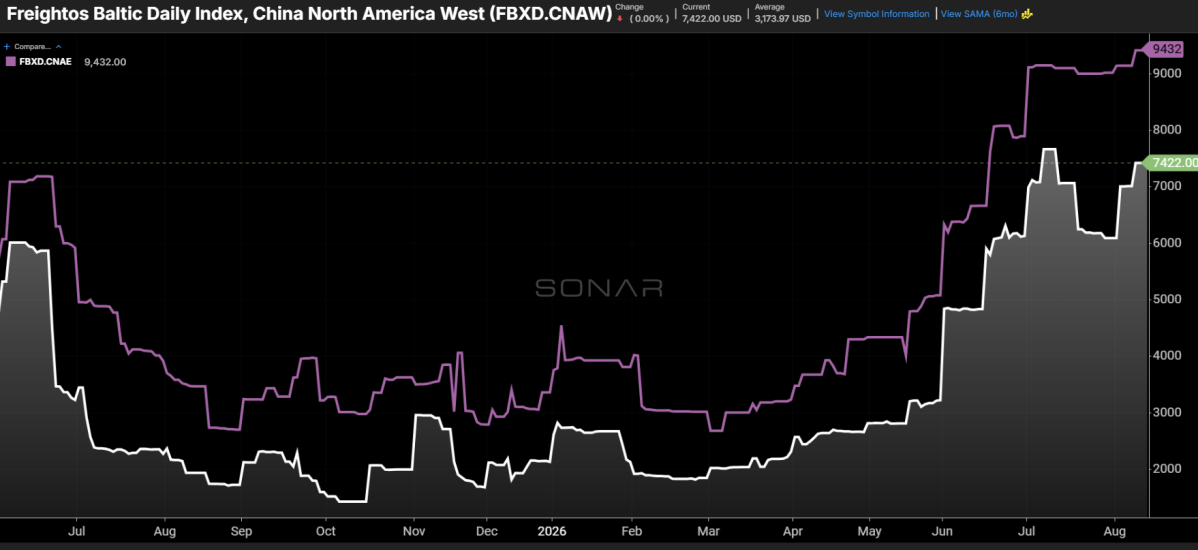
Chart of the Week: FreightosBaltic Daily Index – China to North America West and East Coasts SONAR: FBXD.CNAW, FBXD.CNAE
Spot rates for shipping forty-foot containers from China to North America’s East (CNAE) and West (CNAW) Coasts have started to climb once again after declining through most of July. The East Coast lane, which is most directly influenced by the ongoing conflict with Iran, has increased roughly $413 since the end of July, while freight to the West Coast is up $1,328, according to Freightos, as of August 13. Looking at the data, the rate volatility appears to be more supply side narrative-driven than a product of demand fluctuations.
Demand is not the primary driver
Bookings of twenty-foot equivalent units (TEUs) from China to the U.S. were actually down 4% Y/Y through the first two weeks of August, while spot rates from China to the North American West Coast were nearly triple what they were at this point last year. This suggests the increase — and continued elevation — in rates is being driven by supply rather than demand.
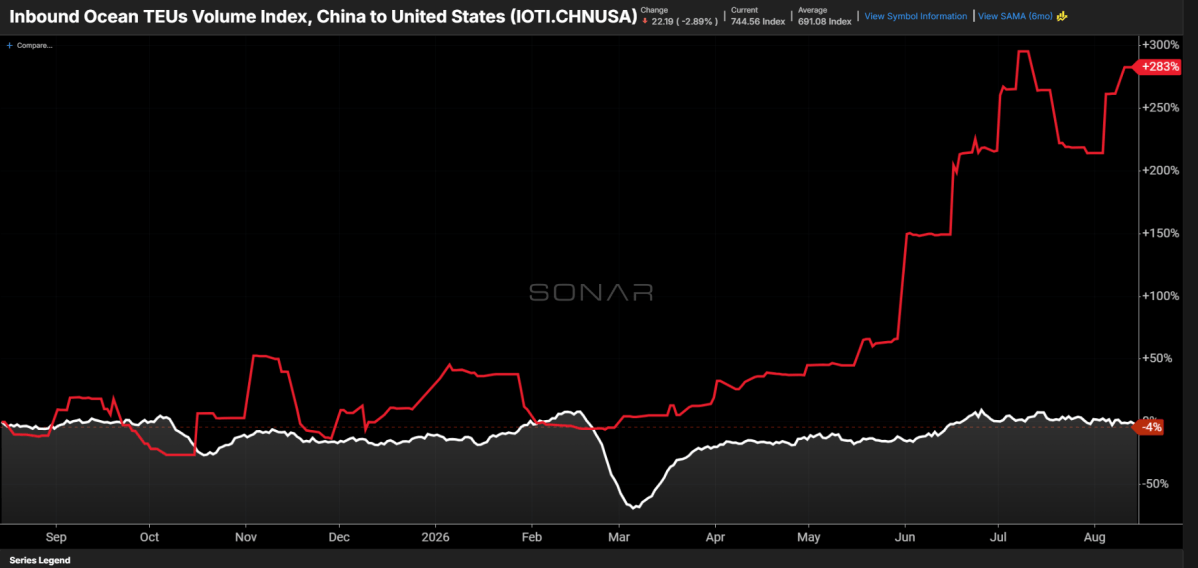
While spot rates have been increasing since the war with Iran began in late February, they rose the most in early and mid-June on expectations of a strong peak season. Soaring fuel costs have also been cited as a reason, but those costs have declined since May.
Maritime carriers typically institute general rate increases (GRIs) around the first and fifteenth of certain months, when conditions are expected to change or have already changed. Not all of these increases succeed, as shippers pull back on their ordering when rates rise — an effect that can be observed after the July 1 increase.
Super El Nino strikes the Pacific
Weather has also been cited as a factor disrupting port activity in southern China since July. The eastern Pacific is currently in a strong, or “super,” El Niño cycle, which typically leads to a more active tropical storm season in the western Pacific. So far this year there have been 16 named storms, making it the most active season by this point since 1971. Typhoons Noul and Dolphin both made landfall in mainland China over the past month, with the ports of Shanghai, Ningbo, and Shenzhen all reporting congestion as carriers skipped calls.
Dolphin was the third tropical storm to hit China’s east coast in a five-week period, leading to 2.4 million TEUs being stranded and further exacerbating port congestion.
El Niño is a recurring weather pattern characterized by substantial warming of the eastern Pacific, which can lead to more frequent and increasingly intense tropical weather.
An additional effect of this year’s El Niño is cooler Atlantic Ocean temperatures on the other side of the globe. This typically means less tropical activity, but also less rainfall throughout the Caribbean and Central America. That, in turn, is affecting the Panama Canal, which is once again experiencing drought-like conditions. The Panama Canal Authority just issued draft restrictions for cargo vessels effective into September, limiting how deep — and therefore how heavily loaded — vessels can be when transiting the canal.
This does not appear to be driving rates higher at this point, but it’s worth watching. The National Retail Federation recently revised its outlook, now expecting import demand to stay elevated through September rather than dropping off sharply after an early July peak, citing continued strength in orders and relatively low inventory levels among its members.
Elongated peak or just a plateau?
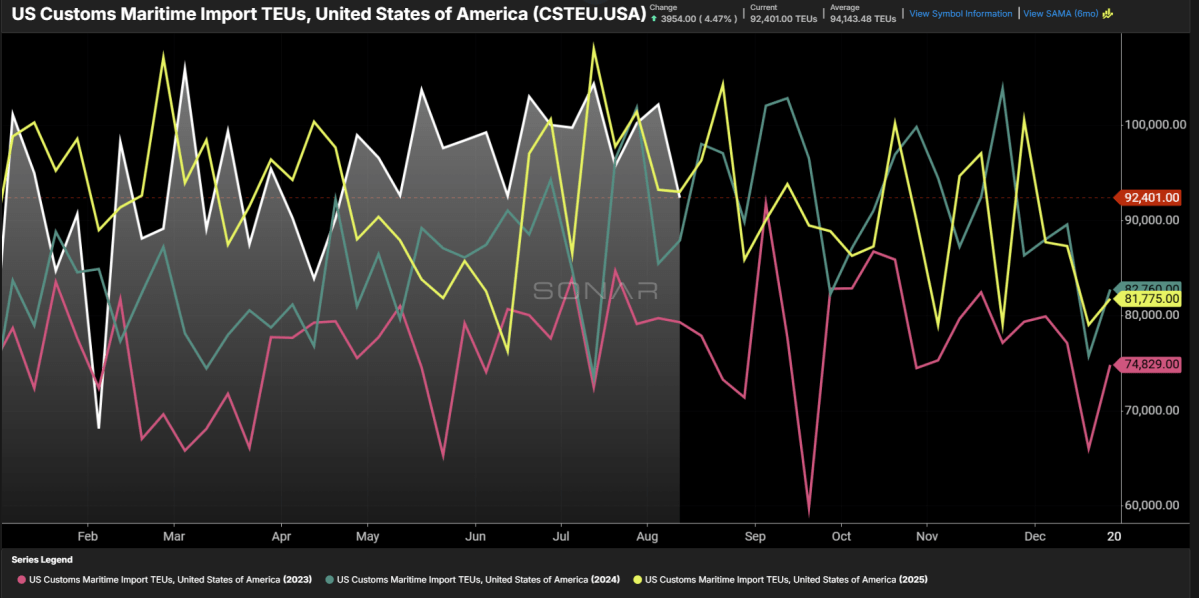
Customs data shows imports began clearing ports earlier than usual, in April and May, with a more even, extended cadence heading into August. This elongated — and perhaps misnamed — peak season looks vastly different from the one seen in 2025, when erratic tariff implementation wreaked havoc on international shipping. The steadier ordering cadence should make it easier for carriers to manage capacity compared with last season.
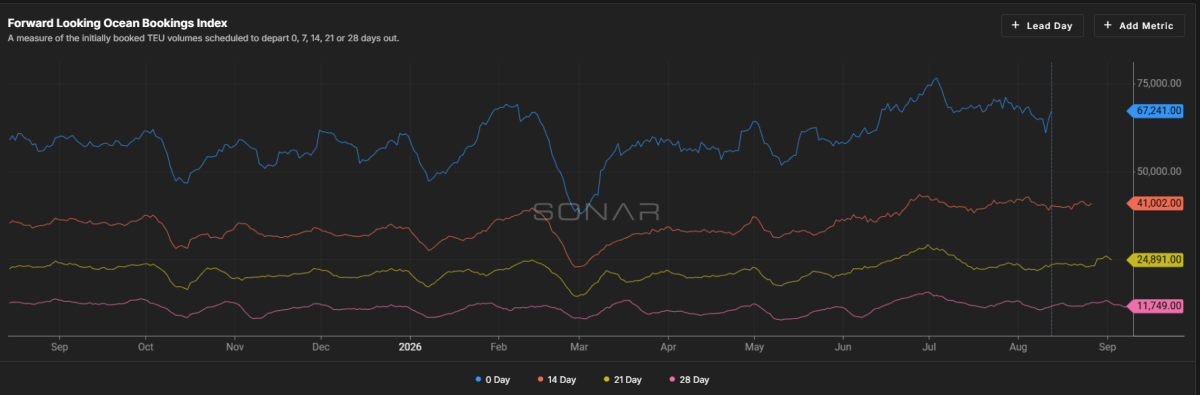
Looking ahead, import demand is expected to ease overall, but booking data with lead times of more than 14 days suggests there could be another surge in the coming weeks — though nothing like what was seen earlier this year.
Also worth noting: ocean rejections are trending lower, but port-pair delays reported by Project44 are on the rise — somewhat conflicting signals.
The explanation for the recent rate volatility is complex, but most of the leading narratives don’t add up to a near-tripling of costs. Demand has been remarkably stable, and little has changed in terms of routing. Competition is limited, with 10 carriers controlling 90% of capacity. Rates aren’t a pure signal of demand, and they may not be the best indicator of supply in this market either.
About the Chart of the Week
The FreightWaves Chart of the Week is a chart selection from SONAR that provides an interesting data point to describe the state of the freight markets. A chart is chosen from thousands of potential charts on SONAR to help participants visualize the freight market in real time. Each week a Market Expert will post a chart, along with commentary, live on the front page. After that, the Chart of the Week will be archived on FreightWaves.com for future reference.
SONAR aggregates data from hundreds of sources, presenting the data in charts and maps and providing commentary on what freight market experts want to know about the industry in real time.
The FreightWaves data science and product teams are releasing new datasets each week and enhancing the client experience.
To request a SONAR demo, click here.
Brokerage Compliance Symposium
The day before F3. Every compliance issue you face - fraud exposure, carrier liability, FMCSA rules, cargo theft, insurance gaps - navigated by attorneys and operators defining best practices in a changing industry.
F3 Awards Dinner
The night before F3. FreightTech100 companies honored. FreightTech 25 and Shipper of Choice winners revealed live. Cocktail reception into dinner and live music - 300 industry leaders in one purpose-built room.
F3: Future of Freight Festival
Industry-defining keynotes, rapid-fire technology demos, and industry leaders networking in experiences across Chattanooga - plus the inaugural F3 Awards Dinner featuring the FreightTech and Shipper of Choice reveals.
The day before F3. Every compliance issue you face - fraud exposure, carrier liability, FMCSA rules, cargo theft, insurance gaps - navigated by attorneys and operators defining best practices in a changing industry.
The Signal at Chattanooga Choo Choo • Chattanooga, TN Register NowThe night before F3. FreightTech100 companies honored. FreightTech 25 and Shipper of Choice winners revealed live. Cocktail reception into dinner and live music - 300 industry leaders in one purpose-built room.
The Signal at Chattanooga Choo Choo • Chattanooga, TN Register NowIndustry-defining keynotes, rapid-fire technology demos, and industry leaders networking in experiences across Chattanooga - plus the inaugural F3 Awards Dinner featuring the FreightTech and Shipper of Choice reveals.
The Signal at Chattanooga Choo Choo • Chattanooga, TN Register Now