




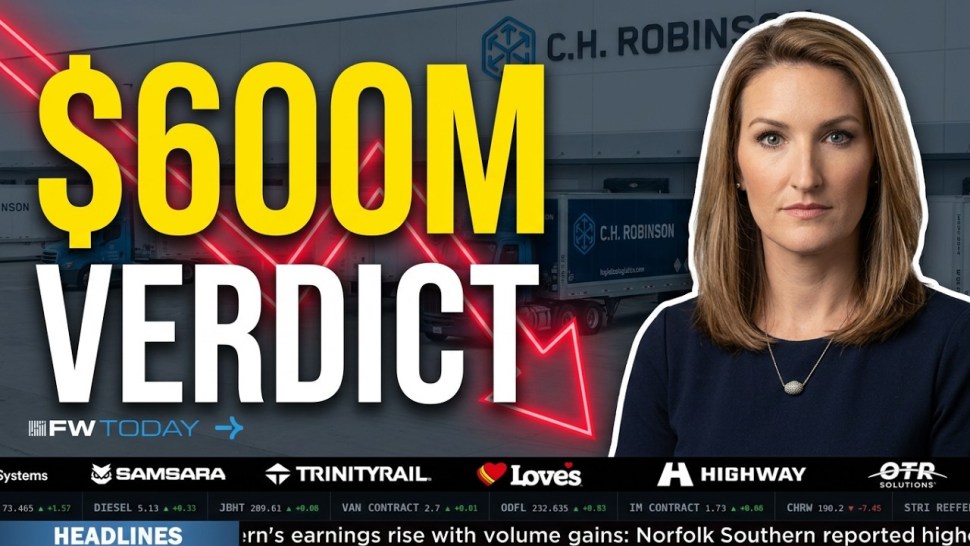
A $600 million nuclear verdict against C.H. Robinson sends shockwaves through the brokerage industry. This landmark post-Montgomery case goes beyond typical carrier liability, with the jury effectively deeming the independent carrier’s driver an employee of C.H. Robinson. John Kingston, Editor at Large for FreightWaves, breaks down the implications for brokers, carriers, and the future of transportation litigation. From shared fault states to the failure of federal defenses, this verdict sets a dangerous new precedent. What does this mean for your risk management?
A Dallas County jury has returned a verdict exceeding $600 million against C.H. Robinson, in what FreightWaves senior editor John Kingston described as the largest collectible nuclear verdict ever recorded against a freight broker — and the first major ruling since the U.S. Supreme Court’s Montgomery decision stripped brokers of their primary federal liability shield earlier this year.
The verdict names three parties: the driver of the truck, who was killed in the accident; Lupus Superior, the motor carrier with roughly 50 trucks; and C.H. Robinson, which brokered the load. Because the driver is deceased and the carrier is unlikely to carry sufficient insurance — Kingston said it “does not have more than a couple million dollars of insurance at most” — the bulk of the judgment is expected to fall on C.H. Robinson. The jury assigned C.H. Robinson 23% of the fault, but under shared-fault rules, it stands to absorb the unpaid shares of the other defendants. The company disclosed the verdict in a filing with the SEC.
The ruling landed with particular force because it demolished one of the brokerage industry’s last remaining defenses: reliance on a carrier’s satisfactory FMCSA safety rating. Lupus Superior held a satisfactory rating both before and after the accident, yet the jury disregarded it entirely. “That fear that was raised in the oral arguments and also in briefs, et cetera, leading up to the Montgomery decision just happened,” Kingston said. “It really happened. It’s not theory anymore.”
“The precedence here is so potentially damaging and we’re so early into the post-Montgomery world that you really don’t want to give up any fights at this point,” Kingston said.
C.H. Robinson is expected to appeal, and the judgment has not yet been affirmed by the Dallas County Court judge. Kingston drew a parallel to the Werner case, which was also a high-dollar Texas verdict later thrown out by the Texas Supreme Court. Reports circulating the morning of the verdict put C.H. Robinson’s insurance limit at $130 million per incident, though Kingston said a settlement at that figure is unlikely given the magnitude of the legal and precedent stakes involved.
The verdict arrived less than three months after the Montgomery ruling, which came down around May 1–2. Kingston noted that more than 6,000 trucking lawsuits are currently working through the court system, and that at least a third of those statistically would have a broker of record — meaning plaintiffs’ attorneys are already amending existing complaints to add broker liability claims. The case also introduced a novel and contested finding: the jury ruled that the truck driver, an employee of Lupus Superior, was also an employee of C.H. Robinson — a conclusion Kingston called “a real reach on the part of a jury.”
For mid-sized and smaller brokers, the implications extend beyond the dollar figure. Kingston pointed out that the legal costs alone for a trial of this magnitude can run into the tens of millions of dollars — expenses that a $100 million broker simply cannot absorb the way C.H. Robinson can. Looking ahead, Kingston flagged a potential new legal strategy drawn from a recent Texas case involving Home Depot, where brokers and shippers may attempt to argue that proximity to the actual accident — being several steps removed from the driver — constitutes a partial defense, though that argument was rejected in the Home Depot ruling.
- A Dallas County jury awarded more than $600 million against C.H. Robinson, with the broker expected to absorb most of the damages due to the carrier’s likely insufficient insurance coverage.
- The verdict is the first major post-Montgomery ruling and nullified the satisfactory FMCSA carrier rating as a viable broker defense, turning a theoretical industry fear into reality.
- With over 6,000 trucking lawsuits currently in the court system and at least a third likely involving a broker of record, plaintiff attorneys are expected to amend existing cases using this verdict as precedent.
Speaker 1 [0:00] Well, John Kingston is back with us to tell us all about probably the biggest nuclear lawsuit story that we’ve ever covered, which is CH Robinson. The damages to— in this lawsuit were over $600 million. John, this hit the wires this morning and the article is completely blown up. And I think a lot of people are like, what does this mean? And what— first of all, give us the background of the story.
Speaker 2 [0:28] Well, wait, wait, when you woke up, did you go look right on freightwaves.com and you saw that sitting up there and you said, hey, wait a second, that wasn’t up there when I went to sleep?
Speaker 1 [0:36] No, John, I didn’t even know about it. I think it was at 9 AM when I was alerted to it. Um, I, I, I don’t remember where I first saw it. I didn’t even know we had reported it because I was doing— I was involved.
Speaker 2 [0:46] I will tell you that, that, that I was alerted to it about 7:30 last night.
Speaker 1 [0:51] Okay, so, um, yeah, I didn’t know about it until 9.
Speaker 2 [0:54] I have no idea.
Speaker 1 [0:55] But it’s been something that we have been covering. Tell, tell us about the background.
Speaker 2 [1:01] Well, so this is, this is, as far as we can tell, the second biggest nuclear verdict, but it’s the first one that I don’t count the $900 million one in Florida where the dude didn’t even show up.
Speaker 1 [1:10] Let’s put that one aside.
Speaker 2 [1:12] So this is $600 million against somebody who’s collectible. Of course, part of the blame was, was, uh, by— was attributed by the jury to the driver who was killed in the accident. The other was to this Lupus Superior, who is a very legitimate carrier. You got to wonder if they can withstand, can, you know, survive. And then the rest of it is C.H. Robinson. But the way it works is that C.H. Robinson will basically pick up the blame of the others, the balance of the others. So, you know, they’re looking at most of the $600 million. Obviously, they’re going to appeal. The judgment has not been affirmed yet by the judge, the Dallas County Court judge. Remember, the Werner case was appealed to the Texas Supreme Court, and that was thrown out. That was also pretty high. So you really wonder whether that would be the case here. I mean, I think for the brokerage industry, there’s a couple of— there’s 2 really very— well, 3 very scary things from it. One is the sheer size of the verdict. And that’s not just scary to the brokerage industry. That’d be scary to carriers and everybody. That’s number one. Number 2, this is the first time that you’ve had a big story like that, big verdict like this, where a company could not pull out the Federal Aviation Administration Authorization Act defense because that’s what went down in Montgomery. And the third is the finding, and I really wonder if this will hold, that the driver in the case, who was an employee of the carrier, Loop is Superior, was in fact an employee of C.H. Robinson. So this has to do really with kind of like— I hate to say independent contractor status because nobody was an independent contractor here, but it just, uh, it sort of gets into the whole question of control. And so this is a whole other issue. I don’t know that that’s going to stand. That one just seems like a real reach on the part of a jury. Yeah, I mean, this is obviously—
Speaker 1 [3:03] yeah, I mean, it is a— it’s going to get appealed We’re going to at some point end up with an appeal, and then maybe another appeal. This whole thing is going to go through an appeal process. Whether the appeal court will hear it, I think, is a big question. Sage Robinson certainly is— this is not any near-term risk to the business. They are in this shared fault environment. They’re 23% at fault, according to the jury. But as I have been told by folks, Matt Leffler, who’s the armchair attorney, he’s a transportation lawyer, has told me that the problem that you end up with shared fault states, even if you’re 1%, the fact is that what will happen is the other parties— one is dead. He’s the driver. He was predominantly at fault. The motor carrier is not going to make it. The guy has 50 trucks. I mean, even when we were at US Express, we had a $100 million lawsuit. That was what, at the time, that was the insurance limits. There’s no way that this carrier is carrying And I don’t know what the insurance limits are, and I hate to speculate on things we don’t know, but there’s no way. I can almost assuredly say that this carrier does not have more than a couple million dollars of insurance at most. It’s going to be really C.H. Robinson that, if this thing doesn’t get thrown out on appeal or reduced on appeal, is going to pick up the majority of it. At least their insurance company will.
Speaker 2 [4:24] Yeah, and there’s almost no chance that at this point, They’re going to try for a settlement. It’s just too big. You know, you can’t help but think about the Werner case. And you don’t know— I don’t know this for a fact, okay? Werner never said this. But you got to think that somewhere along the line, they probably tried to settle. And the plaintiffs got real kind of— I hate to use the word greedy, but we’ll say greedy. They thought they were going to get a big payout. And of course, they ended up getting nothing. But it’s too big. The issues here are too gigantic for C.H. Robinson to walk away from this in any kind of settlement, unless the settlement is at some ridiculous level.
Speaker 1 [4:56] You mean C.H. Robinson or the plaintiff’s attorneys? To walk away.
Speaker 2 [5:01] For C.H. Robinson, when I say walk away, I kind of mean, all right, let’s settle this thing for $400 million. That’s not going to happen.
Speaker 1 [5:07] I mean, I understood there was a report this morning that their insurance limits are $130 million per incident. You don’t think that the insurance company would, or C.H. Robinson, say, let’s settle at $130 million?
Speaker 2 [5:21] You know, I don’t know. It’s crazy for me to speculate, but From the people I spoke to last night, I get the sense that they really view this as, I hate to say existential, ’cause as you said, they’re not going out of business, but that the precedence here is so potentially damaging and we’re so early into the post-Montgomery world that you really don’t wanna give up any fights at this point. It’s your, you know, who else is gonna be in position to negotiate or to carry through big legal procedures that set new precedents in a post-Montgomery world? You know, C.H. Robinson, Echo Global, whatever, you know, RSG.
Speaker 1 [5:55] No, I mean, look, I made this argument on air X, that if CH Robinson, with arguably the best-paid law— you would think, I’m making this stretch assessment, but the amount of money that they spend on legal dealing with these types of cases and have unlimited resources relative to the rest of the competitors— if they ended up getting subject to this, you can only imagine what this looks like for a mid-sized broker that’s a $100 million broker. Because now, They can’t— the kinds of legal bills, and we’re not even talking about the $600 issue, we’re talking about the amount of money it takes when you go to trial of this kind of magnitude. You’re talking tens of millions of dollars potentially.
Speaker 2 [6:37] Yeah, well, I mean, I just think what’s interesting is that the Montgomery decision came down very early May. It was like May 1st, May 2nd. We’re not even out of July.
Speaker 1 [6:46] No, and we— look, we talked about it on Freightways Today, is the fact that Every broker, the day after, the rules have changed. And it’s not the lawsuits going forward. Brokers, some of them have created new safety policies, C.H. Robinson included, changed their entire— got rid of a lot of motor carriers. It’s the fact that there are over 6,000 lawsuits currently in the court system. At least a third of those, just statistically, would have a broker of record. Those lawsuits are getting amended. That’s the— that’s perhaps one of the big risks.
Speaker 3 [7:21] Terrifying.
Speaker 2 [7:22] I think one of the other big issues— I’m sorry, did you—
Speaker 3 [7:26] No, go ahead, John.
Speaker 2 [7:27] One of the other big issues here is that, you know, right in the Supreme Court when the oral arguments were made in Montgomery, it was one of the arguments that was made by the brokerage industry, which the lawyers are pretty much paid for by C.H. Robinson, was No broker, not even a CH Robinson, can go out and re-vet every single carrier out there. And that if you’re looking at a carrier with a satisfactory rating, as this company had before the accident and after the accident, we need to be able to say, okay, that’s— we’re going to rely on that to some degree. That should be a defense of ours. Well, they had a times 2 satisfactory rating and it made no difference at all to the jury. So that fear that was raised in the oral arguments and also, you know, in briefs, et cetera, leading up to the Montgomery decision just happened. It really happened. It’s not theory anymore.
Speaker 1 [8:20] So, John, what compelled the jury if, you know, a lot of brokers have argued over the last couple of months that if the carrier is satisfactory and that is the information that the broker has, that the government is saying, the FMCSA in their records is saying that carrier has a satisfactory rating. What did the jury decide that this, uh, that Sage Robinson did, or this, this, that was so negligent in hiring him?
Speaker 2 [8:48] Well, I don’t know, but let’s remember, I think a key factor here in this case is that the driver died. Okay, so we have absolutely no idea why, what happened to him. Did he have a medical, uh, incident? He had been complaining earlier about not feeling well, or was he on his phone, or did he take drugs, or whatever? And so the jury probably had it was in a position to let its imagination run wild. So it would seem to me if the guy survived and, uh, was able to show later that he had some medical emergency, I wonder if that’s going to result in a $600 million verdict as opposed to somebody who said, yeah, you know, well, I was, I was smoking marijuana at the time. I hate to denigrate this case.
Speaker 3 [9:28] Okay, were there not records of any of that? I mean, and maybe they’re sealed in the court case of did he just never touch the brakes? Were there not an onboard recording device?
Speaker 2 [9:39] Uh, nothing that I heard. No, I mean, I, I took a look over. I mean, some, some of CH— obviously, I— we weren’t there in the courtroom for the testimony, but some of CH Robinson’s arguments were in its motion to dismiss, which was obviously didn’t happen. Uh, and I didn’t see anything like that. I mean, I just, I just think truly nobody really knows what happened here. And no, there’s kind of— I don’t think there’s really any sign that he touched the brakes, that he just plowed right in there.
Speaker 1 [10:05] I mean, unfortunately, accidents happen every single day across the country, particularly fatal accidents with trucks. 5,000 people have died through heavy-duty trucks over the past year. I mean, it’s a— these numbers are absolutely astounding. Plaintiffs’ attorneys are just salivating at the opportunity to get one of these very large brokers into their courtroom because they know that these settlements— John, what I’m reading into this is that every broker is now on notice. This is no longer, as you point out, theoretical. That we could be talking about $100 million in nuclear lawsuits. They’re real now. Whether or not this case gets thrown out on appeal, it’s going to make it more troublesome and bring in more plaintiffs’ attorneys. Because even if this gets reduced, or even if it gets settled, the fact is that the attorney responsible for winning this case is going to be able to parade that to every single plaintiff from this point out. And every plaintiff’s attorney in the country is going to use this as the case to convince people to go all the way.
Speaker 2 [11:08] It’s also kind of interesting that the first bit, as far as we know, the first big one of these post-Montgomery happened to a company that had to disclose it to the world. This could have been against some small privately held broker and we might not know about it for weeks. C.H. Robinson had to file a document with the SEC. It’s a significant development. And so there is a document with the SEC saying they did this. Had it been a smaller broker, maybe we might not know about it for a while. But boy, everybody knows about it now.
Speaker 1 [11:38] 30 seconds. What does this mean for the brokerage industry? What’s your takeaway?
Speaker 2 [11:44] It really dried up very quickly. The issues that are going to be involved in a post-Montgomery world, the lawyers are going to have to find a whole new set of defenses. I mentioned in the story, and we wrote about it a few weeks ago, this Home Depot case where they tried to say a shipper was negligent or shipper was partly liable for an accident. Court said no. The whole idea of being, you know, how many steps away from the actual accident you are as a defense. So look for that. And the Home Depot case was in Texas. So look for that Home Depot defense, we’ll call it that for lack of a better term at this point, to very possibly become something that gets used a lot.
Speaker 1 [12:24] Well, John, thank you so much for coming in and talking to us today. This is a crazy story, one that certainly I think is shocking. Maybe it’s not shocking, just maybe the headline is surprising as quick as it’s happened. We’re going to keep you up to date here at Straightways Today. We cover the stories like this every day at noon, starting at noon.
Brokerage Compliance Symposium
The day before F3. Every compliance issue you face - fraud exposure, carrier liability, FMCSA rules, cargo theft, insurance gaps - navigated by attorneys and operators defining best practices in a changing industry.
F3 Awards Dinner
The night before F3. FreightTech100 companies honored. FreightTech 25 and Shipper of Choice winners revealed live. Cocktail reception into dinner and live music - 300 industry leaders in one purpose-built room.
F3: Future of Freight Festival
Industry-defining keynotes, rapid-fire technology demos, and industry leaders networking in experiences across Chattanooga - plus the inaugural F3 Awards Dinner featuring the FreightTech and Shipper of Choice reveals.
The day before F3. Every compliance issue you face - fraud exposure, carrier liability, FMCSA rules, cargo theft, insurance gaps - navigated by attorneys and operators defining best practices in a changing industry.
The Signal at Chattanooga Choo Choo • Chattanooga, TN Register NowThe night before F3. FreightTech100 companies honored. FreightTech 25 and Shipper of Choice winners revealed live. Cocktail reception into dinner and live music - 300 industry leaders in one purpose-built room.
The Signal at Chattanooga Choo Choo • Chattanooga, TN Register NowIndustry-defining keynotes, rapid-fire technology demos, and industry leaders networking in experiences across Chattanooga - plus the inaugural F3 Awards Dinner featuring the FreightTech and Shipper of Choice reveals.
The Signal at Chattanooga Choo Choo • Chattanooga, TN Register Now