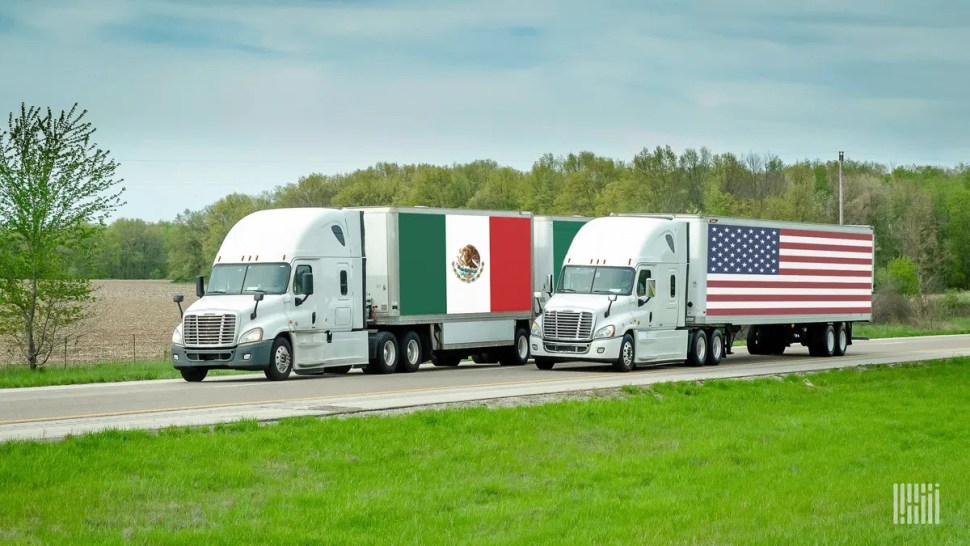
U.S.–Mexico cross-border freight is poised to remain a stabilizing force in North American logistics in 2026, according to executives at Uber Freight.
In an interview with FreightWaves, Mazen Danaf, senior economist at Uber Freight, and José Guerrero, head of U.S. customs operations, said even as broader U.S. trucking markets grapple with thin margins, tariff uncertainty and unpredictable economic crosscurrents — sustained cross-border demand is reshaping how shippers and carriers should prepare for the year ahead.
“In looking at some of the statistical numbers that we’ve had through the ports down to the southern border, there’s been an increase of 15% of exports out of Mexico into the U.S. What does that mean for us? It means that the customers are stabilizing and they’re actually stabilizing their imports,” Guerrero told FreightWaves. “They’re understanding the new normal in a sense where these new tariffs have come into play and how they’re currently managing their tariff situation.”
Capacity tightens, but margins remain under pressure
Danaf said the U.S. trucking market is showing signs of tightening compared to the past two years, driven largely by sustained carrier exits and historically low tractor and trailer orders. Spot rates have recently surged — up more than 10% in a matter of weeks — but he cautioned that the late-year bump may not last.
“On a per-mile basis, spot rates are near operating costs,” Danaf said. “But once you account for empty miles, carriers are still running below break-even on a loaded-mile basis.”
He noted that roughly 15% of miles are typically non-revenue-generating, pushing true costs closer to $2.60 per loaded mile versus spot rates hovering closer to $2.15.
Structural indicators point to continued capacity discipline. Tractor and trailer orders, particularly for sleeper cabs and dry vans, are down double digits year over year and remain below even pandemic-era lows, signaling limited near-term fleet expansion. The reduction has eliminated much of the market’s buffer during demand spikes, contributing to tighter conditions during peak periods.
Danaf said it is premature to declare a full market turn.
“This peak season is tighter than last year,” Danaf said. “Everything that could change the market next year is very uncertain. That’s why our advice for shippers is not to rely on a single forecast, but to adopt a scenario planning approach where they plan for a tight market, plan for a soft market, instead of just focusing on one forecast and considering it to be the ground truth.”
Mexico trade absorbs shocks from tariffs and manufacturing shifts
While some U.S. manufacturing sectors soften under new tariff pressures, Guerrero said cross-border freight with Mexico has held up remarkably well, acting as a stabilizer for freight demand.
Uber Freight data shows Mexican exports to the U.S. are up roughly 15% in recent months, driven broadly by manufacturing flows rather than a single sector. Automotive volumes have taken a hit from new tariff dynamics, Guerrero acknowledged, but importers have adjusted their sourcing strategies.
“What I’’ve been talking to our shippers and customers throughout the year is to know your sourcing,” Guerrero said. “That’s one of the biggest challenges that shippers are encountering today and importers are encountering today where they’re sourcing — get an accurate bill of materials so that you can actually properly assess the whole issue with the derivatives, the steel and aluminum and copper derivatives, because that will definitely impact the duty implications that shippers and importers will have to endure [in 2026].”
Disruptions, theft and compliance now baked into planning
Recurring road blockades, security risks and cargo theft in Mexico remain part of the operating environment, but Guerrero said most shippers now plan around those risks rather than retreat from the market.
“Business continuity planning is central,” Guerrero said. “If a major corridor is blocked, customers want alternate routes, different ports of entry, and backup carriers ready to go.”
Participation in trusted trader programs such as CTPAT in the U.S. and Mexico’s OEA program has become increasingly important, providing faster clearances and tighter accountability across the supply chain.
Regulatory wild cards loom large for 2026
Both executives pointed to regulatory uncertainty — particularly around driver qualifications — as one of the biggest swing factors for 2026.
English-language proficiency enforcement is unlikely to materially disrupt capacity, Danaf said, given that only an estimated 20,000 to 25,000 carriers are affected and most violations do not lead to market exits.
The bigger risk lies with proposed non-domiciled CDL restrictions, which could impact nearly 200,000 carriers if fully implemented.
“That’s a potential game changer,” Danaf said. “But it’s still being challenged in court, so at this point it’s a coin toss.”
Brokerage Compliance Symposium
The day before F3. Every compliance issue you face - fraud exposure, carrier liability, FMCSA rules, cargo theft, insurance gaps - navigated by attorneys and operators defining best practices in a changing industry.
F3 Awards Dinner
The night before F3. FreightTech100 companies honored. FreightTech 25 and Shipper of Choice winners revealed live. Cocktail reception into dinner and live music - 300 industry leaders in one purpose-built room.
F3: Future of Freight Festival
Industry-defining keynotes, rapid-fire technology demos, and industry leaders networking in experiences across Chattanooga - plus the inaugural F3 Awards Dinner featuring the FreightTech and Shipper of Choice reveals.
The day before F3. Every compliance issue you face - fraud exposure, carrier liability, FMCSA rules, cargo theft, insurance gaps - navigated by attorneys and operators defining best practices in a changing industry.
The Signal at Chattanooga Choo Choo • Chattanooga, TN Register NowThe night before F3. FreightTech100 companies honored. FreightTech 25 and Shipper of Choice winners revealed live. Cocktail reception into dinner and live music - 300 industry leaders in one purpose-built room.
The Signal at Chattanooga Choo Choo • Chattanooga, TN Register NowIndustry-defining keynotes, rapid-fire technology demos, and industry leaders networking in experiences across Chattanooga - plus the inaugural F3 Awards Dinner featuring the FreightTech and Shipper of Choice reveals.
The Signal at Chattanooga Choo Choo • Chattanooga, TN Register Now