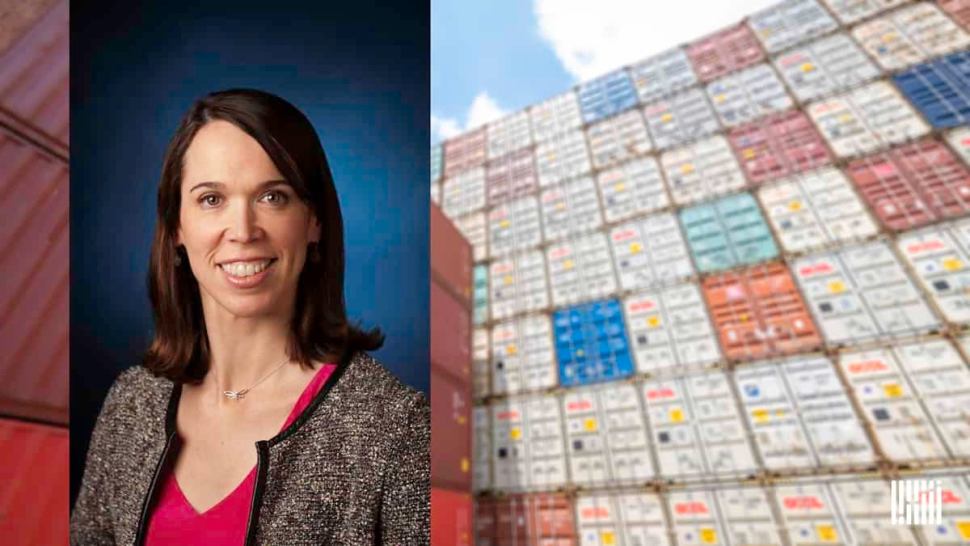
Anne Reinke is stepping into the role as president and CEO of the Transportation Intermediaries Association (TIA) just as the trade group for the 3PL industry is facing an effort that if successful would have an enormous impact on the way brokers would need to conduct their business.
As the Federal Motor Carrier Safety Administration (FMCSA) reviews the thousand-plus comments it received on what is known as the broker transparency rule, Reinke is starting her tenure in the head job at TIA. Her move from the Department of Transportation and an earlier role in the CSX government affairs office in Washington also comes soon after the brokerage industry was the target of serious invective thrown at it from drivers, who blamed it for the low freight rates of the heart of the pandemic.
In an interview with FreightWaves, Reinke said the pandemic had a spillover impact into the trucking sector and specifically the broker-driver relationship.
The first battle that TIA had to fight, she said, was “just to get brokers to be deemed essential workers so they could continue to operate.” That was occurring at a time when “everybody in the transportation space was feeling that pressure and tension, not knowing if the bottom was falling out.”
Drivers might argue that the bottom did fall out, with rates plunging to levels not seen for years. Brokers were blamed by many of them. “The pandemic probably led to some distrust, which we believe was not earned but obviously understandable,” Reinke said.

“I hope that this is something we can resolve,” she added. “I don’t know how this is going to end.”
The changes in the broker transparency rule being sought would require brokers to automatically send an electronic copy of transaction data to all the parties involved in the deal, which can now be requested but rarely is (that’s the request from the Owner-Operator Independent Drivers Association — OOIDA), and also to bar any sort of blackballing against drivers who make such a request (that is what the Small Business in Transportation Coalition is asking).
But even if FMCSA does not change the current broker transparency rule, Reinke said there are other legislative priorities. Not surprisingly, one is the same issue that has sat at the top of the wish list of every transportation-focused trade group seemingly forever: infrastructure.
“I have already reached out to OOIDA to find time to get together,” she said. “I would love to have these discussions where together we can be collaborating going forward.” And infrastructure was the first issue Reinke mentioned.
“We all know how critical it is to have sustained funding sources for highways and waterways,” she said.
Ultimately, the relationship between brokers and drivers is one in which there is an interdependency, Reinke said. And it’s not like she hasn’t seen this before.
During her many years with the Washington office of Class I railroad CSX, Reinke found herself on one side of another divide, that between railroads and shippers. That’s more of a physically connected relationship, and rates are under the regulatory oversight of the Surface Transportation Board. So it isn’t an exact parallel. But those railroad-shipper disputes have been a feature of the rail market since deregulation began with the Staggers Act in 1980.
Reinke talked about the lessons she took from that when it comes to navigating disputes on Capitol Hill. There was what she said was a “core value” at CSX: the ability to not only explain the CSX point of view but also to explain what the opposition believed.
Members of Congress and their staff are “bombarded with information every single day,” Reinke said. What they want out of a company or association representative is “that you need to be an honest broker, and if they can’t trust you, they will never come back to you. So I always conducted myself with the highest integrity and I made sure that I was transparent.”
She conceded, “Some issues are stickier than others.” But it is possible to make a “forceful” argument in a nonantagonistic way, adding that it was possible to find “areas of commonality” between shippers and railroads. An example might be to get shipper backing for railroad arguments on the pace of implementing positive train control.
Brokerage is new to Reinke. She said there had been some interaction on 3PL issues between the industry and CSX and trucking-related issues crossed her desk during her relatively short tenure at DOT but overall it was minor.
She is also now the head of an organization of professionals whose future has always been the subject of debate, with the idea that an army full of human beings, putting together carriers and shippers of freight, is doomed to be disintermediated by technology.
Reinke already has heard about the tension among technology and the old way of doing business in her short time with TIA. “I had a good conversation with a member company who said a lot of small guys still like to use paper,” she said. “That is just a comfort level where others are far more comfortable with mobile tools.”
Reinke is taking over an operation with significant educational offerings for its members, all of which have needed to shift to virtual operations. She said it had been “extraordinarily successful and flexible for those folks who can’t afford the time and resources to come to Virginia (site of the TIA headquarters, across the river from Washington).”
But Reinke added that there are some longer-form courses that are probably better done in person after the pandemic lifts. “You develop a relationship with classmates,” she said. “You can grow together … and form relationships that can be lifelong.”
But like everything else in the age of COVID, the future is murky. “There’s still a lot of uncertainty,” she said. “We’re making it work. It’s just a question of what is sustainable.”
More articles by John Kingston
Shipper confidentiality issue arises during broker transparency hearing at FMCSA
FMCSA poses questions on broker reporting requirements
TIA: Q2 broker margins up over first quarter, down from 2019
Brokerage Compliance Symposium
The day before F3. Every compliance issue you face - fraud exposure, carrier liability, FMCSA rules, cargo theft, insurance gaps - navigated by attorneys and operators defining best practices in a changing industry.
F3 Awards Dinner
The night before F3. FreightTech100 companies honored. FreightTech 25 and Shipper of Choice winners revealed live. Cocktail reception into dinner and live music - 300 industry leaders in one purpose-built room.
F3: Future of Freight Festival
Industry-defining keynotes, rapid-fire technology demos, and industry leaders networking in experiences across Chattanooga - plus the inaugural F3 Awards Dinner featuring the FreightTech and Shipper of Choice reveals.
The day before F3. Every compliance issue you face - fraud exposure, carrier liability, FMCSA rules, cargo theft, insurance gaps - navigated by attorneys and operators defining best practices in a changing industry.
The Signal at Chattanooga Choo Choo • Chattanooga, TN Register NowThe night before F3. FreightTech100 companies honored. FreightTech 25 and Shipper of Choice winners revealed live. Cocktail reception into dinner and live music - 300 industry leaders in one purpose-built room.
The Signal at Chattanooga Choo Choo • Chattanooga, TN Register NowIndustry-defining keynotes, rapid-fire technology demos, and industry leaders networking in experiences across Chattanooga - plus the inaugural F3 Awards Dinner featuring the FreightTech and Shipper of Choice reveals.
The Signal at Chattanooga Choo Choo • Chattanooga, TN Register Now