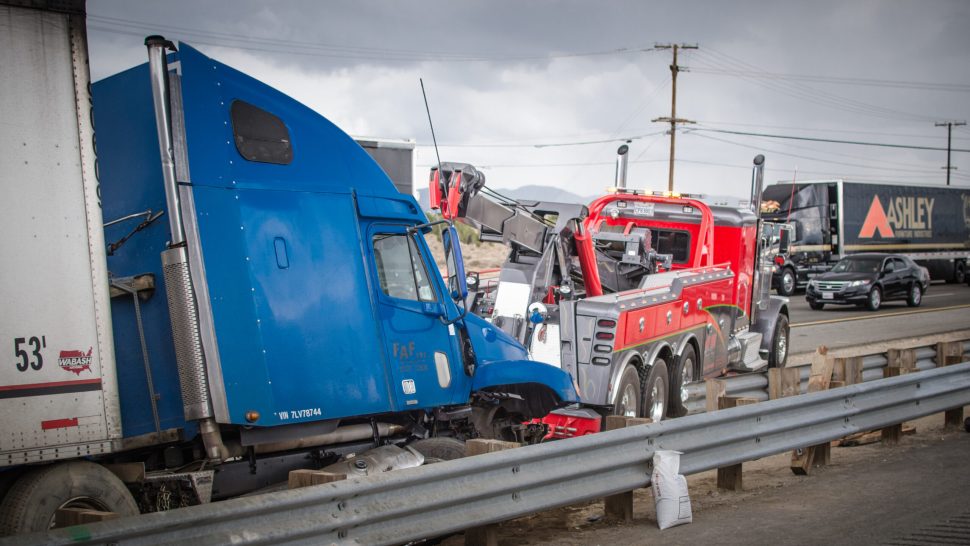
The debate over non-domiciled CDL holders — and immigrant CDL drivers who entered the workforce after 2019 — has exploded across social media. One viral crash video turns into a sweeping accusation. One fraudulent licensing scandal becomes proof of a national crisis. One politician posts a clip, and suddenly the internet decides an entire segment of the trucking workforce is the root cause of rising accidents.
But here’s the part few say out loud: FMCSA does not track crash data by citizenship, immigration status, or CDL category. That means the core question fueling the online fire — whether non-domiciled or immigrant CDL holders are causing more crashes — is something federal crash data simply cannot answer.
So instead of trying to force a yes-or-no conclusion from incomplete data, let’s walk through what we actually know, what’s being assumed, and why social-media narratives have filled the information gap so aggressively.
This isn’t about defending or attacking any group. It’s about understanding the freight landscape with clear eyes — the way small carriers and everyone deserve.
Crash Trends Since 2019: What the Data Actually Shows
Let’s start with the only federal data source that exists: FMCSA’s Motor Carrier Management Information System (MCMIS).
Here’s what the national crash numbers show from 2021–2025:
- Total vehicles involved in crashes dropped
197,913 (2021) → 183,877 (2024) → 131,010 (2025 YTD) - Fatal crash counts also declined
5,972 (2021) → 4,943 (2024) → 3,136 (2025 YTD) - Non-fatal crash involvement decreased significantly
191,941 (2021) → 178,934 (2024) → 127,874 (2025 YTD) - Total injuries fell sharply
91,596 (2021) → 87,931 (2024) → 63,624 (2025 YTD)
So what does that tell us? There is no national spike in crashes that aligns with the growth of non-domiciled CDL issuances. If anything, crash counts have been trending downward during the same time period that NDCDL issuance has grown. Granted, there has also been a drop in actual trucks that are on the highway as well since the start of the freight recession. While citizenship is not a tracked cause, the general fitness of a driver to operate a commercial motor vehicle (CMV) is a major focus.
But here’s the critical part: Because FMCSA does not break out crash data by CDL type or driver citizenship, we cannot attribute any portion of the crash decline — or previous increases — to non-domiciled CDL holders.
The gap in tracking is where social media takes over.
The Non-Domiciled CDL Growth Curve — and Why It’s So Misunderstood
State audits and public CDL registry data show a clear rise in non-domiciled CDL issuances beginning around 2019 and accelerating after 2021. Several factors contributed:
- Increased demand for drivers due to COVID driven demand spikes
- Poorly proven “driver shortage” narratives that have been debunked, but are still used to fuel the rush of drivers into the labor pool
- States aggressively expanding testing availability and lowering testing standards
- The ELDT self certification rule
- Federal allowance for temporary NDCDLs during what was deemed as “driver shortages”
But here’s where things get complicated: Not all states issued NDCDLs at the same rate. Not even close.
Some states issued NDCDLs at levels reaching 30–40% of all CDL applicants (Illinois for instance). Others issued almost none (Arkansas). Some states had well-run processes. Others had major loopholes that later triggered investigations.
This patchwork of state behavior created the perfect environment for confusion. When one state’s audit revealed thousands of NDCDLs issued improperly — while another state issued only a handful — it made the national picture look more dramatic than it was.
And because there is no centralized federal reporting that connects NDCDL issuance to safety outcomes, social media was left to fill in the blanks.
Fraud Cases: Real Problems — But Not Proof of Crash Causation
There is no question that fraudulent CDL issuance has occurred — and continues to occur — across several states.
We have all seen examples that illustrate the breadth:
- Federal indictments in Louisiana involving CDL bribery
- New York DMV workers charged with falsifying CDL exams
- DOT OIG reports documenting long-term CDL fraud investigations
- Cases in which applicants did not take required skills or written tests
Fraud is a real problem. Nobody disputes that. But here’s what the data does not show:
- That drivers involved in fraud schemes caused more crashes
- That improper issuance in one state reflects national performance
- That immigrant or non-domiciled CDL holders are uniquely responsible for safety issues
Fraud undermines trust. It creates legitimate concern. But fraud and crash causation are not the same thing — and the crash data does not support the claim that improperly tested NDCDL recipients have raised national accident rates.
Instead, fraud stories have become fuel for viral stories.
Social Media: Where Anecdotes Become “Evidence”
Now we get to the part most people feel every day — the nonstop stream of viral clips.
A few of the most widely shared videos and tweets we have seen on X, amassed millions of views. Most follow the same storyline:
- A crash involving a truck
- A claim — sometimes without verification — that the driver was an illegal immigrant
- Followed by political commentary
- Then a tidal wave of replies assuming correlation = causation
But here’s the important detail: Many of the viral posts immediately included FMCSA verification of CDL type, citizenship, or test origin. It was simple: Here is a crash, it was “probably an illegal”.
In some of these, the conclusion was assumed, not proven. Meanwhile, social media works on a simple algorithm: visibility = authority
If a video of a crash involving a newly licensed driver gets 3 million views, people assume that’s representative of the entire trucking landscape.
But one viral video ≠ one data point in 800,000+ active CDL holders.
Social media amplifies visibility, not frequency. This is why the public increasingly believes that non-domiciled CDL drivers are behind a wave of crashes — even though national crash data currently does not support such a wave.
Truckers feel this, too. A story that gets 50 views doesn’t shape policy. A story that gets 5 million views does.
So… Are Non-Domiciled CDL Holders More Dangerous?
Here is the most honest, unbiased, current data-grounded answer:
We do not know — because the federal government does not track crashes by NDCDL status, citizenship, or immigration category.
What we can say based on federal crash data:
- Crash rates have been declining since 2021.
- NDCDL issuance has increased since 2019.
- These two trends do not move together in a way that suggests a crisis.
What we cannot say:
- Whether NDCDL drivers are safer
- Whether NDCDL drivers are more dangerous
- Whether immigrant drivers cause a disproportionate share of crashes
- Whether fraud cases correlate with crash risk
So when someone online claims immigrant drivers are increasing crash rates, the correct response is: “Show the data and let’s discuss together.”
Because the data simply does not exist.
Why This Debate Won’t Go Away Anytime Soon
This issue isn’t really about numbers — it’s about:
- trust
- identity
- politics
- frustration inside a bruised freight market
- reliance on social media for fast information
- patchwork state oversight that creates confusion
- real fraud cases that shake confidence in the licensing system
Truckers aren’t irrational for asking questions. They’re operating in an industry under immense pressure, seeing legitimate CDL oversight issues, and watching videos go viral that appear to confirm their fears.
But the job of responsible journalism — and the purpose of this article — is to separate: what feels true from what is measurable.
And right now, what’s measurable does not show a crash trend tied to NDCDL issuance. And this is one of the reasons the FMCSA will have an uphill battle with the courts in proving that in the current national case around NDCDLs.
The Real Problem: A Data System That Can’t Answer the Question
This is the part policymakers don’t acknowledge: The U.S. does not have the tracking system required to know whether NDCDL or immigrant CDL drivers are contributing to crashes.
We have:
- State-level issuance records
- National crash counts
- Scattered fraud investigations
- Viral clips and social media pressure
What we don’t have:
- Crash data linked to driver citizenship
- Crash data linked to non-domiciled CDL status
- A unified federal audit of state CDL implementation
- Transparency around testing pass rates by demographic
- A federal safety performance report by CDL origin
Without those pieces, the entire discussion becomes anecdotal — shaped by whoever has the largest platform, not the strongest evidence.
And until FMCSA modernizes its data collection, we will continue debating shadows.
Final Thought
With everything that is going on, it’s tough not to want to throw on the gloves too. The problem is, it is important to look at things from a factual lens first and draw conclusions based on what you are able to prove.
Don’t mistake narrative for data. Don’t assume visibility equals frequency. Don’t let viral clips rewrite your understanding of the industry.
Yes, there are real problems with CDL oversight. There are fraud cases that undermine safety and trust. There are inconsistent state-level licensing practices that deserve scrutiny.
But there is no public federal evidence showing that non-domiciled or immigrant CDL drivers are driving U.S. crash trends.
So until the government creates a system capable of answering the question definitively, the most honest stance is the one supported by the numbers:
We don’t know — and anyone claiming certainty is not able to substantiate, and as of today, is not reporting a fact.
Brokerage Compliance Symposium
The day before F3. Every compliance issue you face - fraud exposure, carrier liability, FMCSA rules, cargo theft, insurance gaps - navigated by attorneys and operators defining best practices in a changing industry.
F3 Awards Dinner
The night before F3. FreightTech100 companies honored. FreightTech 25 and Shipper of Choice winners revealed live. Cocktail reception into dinner and live music - 300 industry leaders in one purpose-built room.
F3: Future of Freight Festival
Industry-defining keynotes, rapid-fire technology demos, and industry leaders networking in experiences across Chattanooga - plus the inaugural F3 Awards Dinner featuring the FreightTech and Shipper of Choice reveals.
The day before F3. Every compliance issue you face - fraud exposure, carrier liability, FMCSA rules, cargo theft, insurance gaps - navigated by attorneys and operators defining best practices in a changing industry.
The Signal at Chattanooga Choo Choo • Chattanooga, TN Register NowThe night before F3. FreightTech100 companies honored. FreightTech 25 and Shipper of Choice winners revealed live. Cocktail reception into dinner and live music - 300 industry leaders in one purpose-built room.
The Signal at Chattanooga Choo Choo • Chattanooga, TN Register NowIndustry-defining keynotes, rapid-fire technology demos, and industry leaders networking in experiences across Chattanooga - plus the inaugural F3 Awards Dinner featuring the FreightTech and Shipper of Choice reveals.
The Signal at Chattanooga Choo Choo • Chattanooga, TN Register Now