




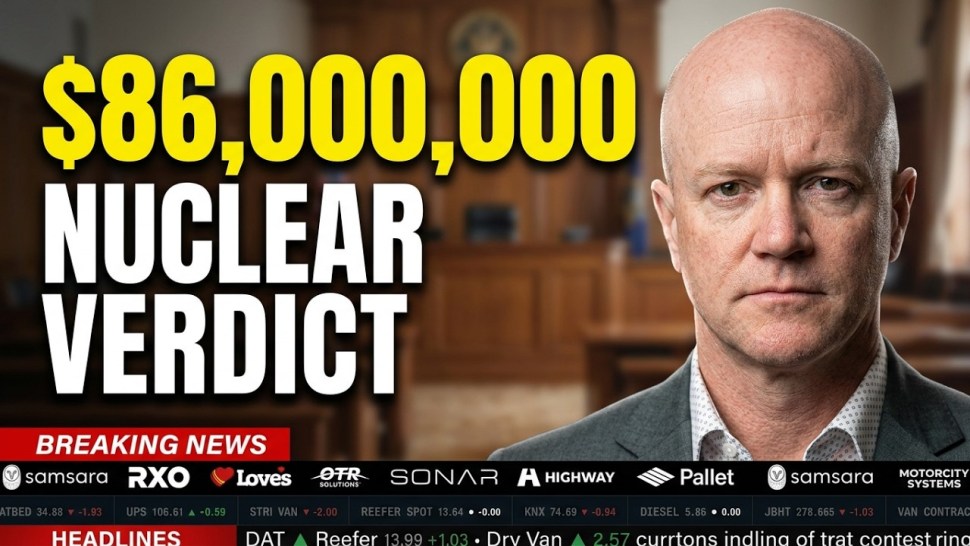
Trucking leaders David Parker (Covenant Logistics) and Max Fuller (U.S. Xpress) unpack the state of the freight market, from the driver shortage to nuclear verdicts. Discover why market stability and tort reform are crucial for carrier survival and what’s driving the “supercycle” in this candid discussion.
A Utah jury awarded an $86 million nuclear verdict against QXO — formerly Beacon Roofing — despite finding the carrier was not negligent, a ruling that Covenant Logistics Group founder and CEO David Parker cited as emblematic of an existential legal threat facing motor carriers and brokers. Parker, speaking on FreightWaves Today alongside stepbrother Max Fuller, co-founder of U.S. Xpress, said the litigation environment has made tort reform the industry’s most urgent political priority.
Parker said Covenant’s insurance costs have surged roughly 300% over the past three to four years while total coverage dropped by 50%. “300% cost for 50% of total coverage,” he said. “I don’t know what kind of insurance any of us got. I mean, it’s like I’m naked on this quarter.” His current policy does not expire until next April, but he said the exposure grows larger with every rate cycle.
“I heard Max say earlier that if we don’t get tort reform, it’s not going to matter. And it’s true. It’s not going to matter.”
Parker said he has traveled to Washington six or seven times since October to push for federal tort reform and has met twice with former President Donald Trump, as well as with the House Judiciary Committee and Rep. Jim Jordan roughly two months ago. He put the current odds of passing meaningful reform at 20%, up from what he described as zero probability for most of his career, attributing the shift largely to Trump’s personal familiarity with litigation. ATA President Chris Spear is leading the industry’s lobbying effort, Parker noted.
On the freight cycle, Parker said DOT enforcement activity — which he dated to October, following a high-profile August accident in Florida — has removed an estimated 2% to 3% of capacity from the market. He placed the cycle at “first base,” describing the ball as having been hit last October, and endorsed the term “supercycle.” Parker said load-to-truck ratios in Covenant’s expedited and brokerage divisions fell from roughly 3-to-1 before July to about 1.5-to-1 during the month, but projected that the following week’s revenue would likely be the company’s highest of the year.
Parker said Covenant has deliberately exited the over-the-road segment — retaining only about 100 OTR trucks — and restructured around four units: expedited, dedicated, freight management, and warehousing. That pivot, which he formalized with his board in 2015, followed two near-insolvencies across his 40 years in business, including a period in 2008 when the stock traded as low as 78 cents per share. The company now carries a market cap approaching $1 billion. He said the strategic shift was triggered in part by a contract with Delta Air Lines, which Covenant has served for 11 years hauling aircraft engines, tires, and brakes, and for which it now also operates a warehouse.
Covenant’s team-truck fleet, once as large as 1,700 to 1,800 units, currently stands at approximately 750 teams, with Parker saying he needs 20 to 30 more to fill open trucks. He said team trucks must generate about $10,000 per week to justify the capital investment, given that Freightliner and Peterbilt prices rise $8,000 to $12,000 with each new model cycle and teams require truck trades roughly every 18 months. The company’s brokerage book runs roughly 70% contracted and 30% spot, a mix Parker said has been painful as carrier rates outpaced contracted pricing. Fuller added that an operating ratio below 92 is essentially breakeven once interest, taxes, and working capital are factored in — a threshold the industry rarely clears.
- A Utah jury awarded an $86 million verdict against QXO despite finding the carrier not negligent, illustrating the unpredictable legal exposure facing carriers and brokers.
- Covenant CEO David Parker reports insurance costs up 300% while total coverage has fallen 50%, and puts the odds of federal tort reform passing at 20%.
- Parker describes the freight supercycle as being at ‘first base,’ with DOT enforcement having removed an estimated 2%–3% of capacity since October.
Speaker 1 [0:00] We have a real treat. We have David Parker, the founder and CEO of Covenant Logistics. David, I have a I have a habit of saying Covenant Transport, so I gotta get.
Speaker 2 [0:08] I do. I do too.
Speaker 1 [0:08] Old habits. Did you have you done this to any of your your ever investor calls?
Speaker 3 [0:13] Yes, I have.
Speaker 1 [0:14] So you guys just had your conference call. Congratulations. I understand this is the biggest revenue in your history.
Speaker 2 [0:20] Yes.
Speaker 1 [0:20] Yeah. So what do you? I mean, obviously the market’s helping them out. What do you attribute that to?
Speaker 2 [0:24] I tell you, at the end of the day, it’s what we started eleven years ago and. Refocusing the company and getting into the various segments. You know, we’re not into the OTR segment, very little. I mean, we may have 100 trucks running in the OTR segment, and we have really focused on the 4 areas that we’re involved in, which is expedited, dedicated, freight management, and warehousing. And we’ve been going down that path for a while.
Speaker 1 [0:52] So that’s a— I mean, obviously over the last, you know, 14 years, you’ve talked about just the transition of the company. It is a very different operator.
Speaker 4 [1:01] Yeah.
Speaker 1 [1:01] If you followed it historically, it’s a very different operator than historically has been. But there is something special about the way you guys have repositioned the business. What, what part of the business are you most proud of in terms of the progress that you’re making right now?
Speaker 2 [1:12] Well, I tell you, number one, I’m proud of all 4 of ’em. If I leave one out, I’ll get in trouble.
Speaker 4 [1:17] Love all your kids equally.
Speaker 3 [1:19] That’s right.
Speaker 2 [1:20] I love all my children.
Speaker 1 [1:21] Everyone, which I have 5 kids, it depends on the moment.
Speaker 2 [1:23] I love ’em all.
Speaker 3 [1:24] Be honest.
Speaker 2 [1:24] I love ’em all equally. But, All of them have made some great headway. I look at our Legacy Dedicated that we had them all down yesterday for meetings and they have just done a great job. I mean, they have turned that thing around so well. I’m proud of them. There’s no doubt that the freight management, which is brokerage as well as a small management of freight, It has been, it’s been tough. We went from doing great until you couldn’t find capacity, and then our margins have squeezed. And, and, and so we continue to, we continue to focus on that to make sure that we can either raise rates or find carriers that do it cheaper. And I got a feeling raising rates is easier.
Speaker 1 [2:13] Yeah, well, look, misery loves company because every public truckload carrier that we’ve covered Has had the one part of their business has struggled, and you can go through the list. I, in fact, I don’t think we’ve covered asset-based carrier that’s done well in brokers. No, revenue is doing well despite all the noise. RXO, we’re going to hear from next week. I would suspect that they’re doing well, but it seems that the asset side of the business, these logistics operations, are there to serve the truck. Julie and I’ve talked about that. Usually it’s a the truck is going to win out in terms of how you guys think about the business.
Speaker 2 [2:48] You know, and that’s interesting because that is one spin. Ours really isn’t. Uh, our assets— keep in mind, we do no OTR, so we’re very focused. So our, our asset side only handles about 0.5%—
Speaker 1 [3:02] Wow.
Speaker 2 [3:02] —of the broker freight.
Speaker 1 [3:04] And, you know, why do you think it’s— why do you think it’s underperforming versus some of the other businesses?
Speaker 2 [3:08] Uh, strictly because, uh, capacity rates Got it. Have gone up faster than we’ve been able to raise.
Speaker 1 [3:15] So you have contracted business that longs towards the side of it.
Speaker 2 [3:17] It’s about, it’s about 70/30.
Speaker 1 [3:19] The spread of it’s hard.
Speaker 2 [3:20] It’s hard.
Speaker 1 [3:20] In this kind of environment.
Speaker 2 [3:21] It’s harder. Now eventually it’s gonna catch up.
Speaker 1 [3:24] Well, I mean, we’re still early cycle. I mean, every, Julie and I were talking earlier on this call, every CEO’s talked to, I think they’ve all, they all use the same words.
Speaker 4 [3:32] Yeah. They read each other.
Speaker 1 [3:32] Yeah. We’re in the early innings. Do you agree with that?
Speaker 2 [3:34] Yes, I do.
Speaker 1 [3:35] Derek says that we’re in the 3rd inning. Where would you describe it?
Speaker 2 [3:37] Yes, I, I, I, I believe that we’ve reached 1st base. I use baseball analogies. So we hit the ball.
Speaker 1 [3:41] We still, we’re still We’re still in the innings, okay.
Speaker 2 [3:44] That’s right. We hit the ball last October. It’s when the DOT really started focusing because of the August accident that happened in Florida that we’re all well aware of. DOT took over in October, and to me, that was hitting the ball, and I believe we’re at first base. I think that we’ve got a long runway.
Speaker 1 [4:03] You think it’s a long, big stadium?
Speaker 2 [4:06] You know, I don’t know if— it may have been you all, to be honest with you, but Whoever invented the term supercycle, I believe it. I believe that’s where we’re at.
Speaker 1 [4:17] Yeah, I think FreightWaves was one of the first to actually describe—
Speaker 2 [4:19] I agree with that.
Speaker 1 [4:20] —that world has set in. Because that’s exactly— I mean, there have been— people have used that term in the past. I think we described it simply because you have the setup that’s very unusual. I mean, the reality is that the driver constraint has always been the capacity constraint. It’s interesting, you go back over the decades, everyone talks about the number of truck counts. And I remember as a kid, and I’d listen to the conversations my dad would have about trucking, and a lot of it was how many trucks got produced, because you couldn’t count the drivers.
Speaker 2 [4:46] Yeah, that’s right.
Speaker 1 [4:47] Now, over the last decade, a lot of the capacity constraints have been truck drivers. But the issue has been this massive immigration that has been unrestricted, and the regulatory environment has allowed for— has eliminated all the barriers to entry, has meant that we didn’t have a normal cycle. That’s all gone away.
Speaker 2 [5:08] It’s all gone.
Speaker 1 [5:08] We talked about just the demographics and how old the— The fact that it is harder to recruit fully vetted, fully registered truck drivers today has made it more challenging.
Speaker 2 [5:22] Yes. And it’s interesting, who would ever remember the days that we’re saying now, boy, I’m glad— I’m having a hard time finding professional drivers. I’m having a hard time getting drivers in the seat. But let me tell you, after the last 4 years, I will take that any day. Let that be my problem.
Speaker 1 [5:38] Pricing power, right? Pricing power. That gives you pricing power. Pricing power.
Speaker 2 [5:41] And it’s not abusive pricing power. It’s given me pricing power to be able to cover my costs.
Speaker 1 [5:47] So I’m going to ask you a question.
Speaker 3 [5:48] Is there a truck driver shortage?
Speaker 2 [5:50] You know, my son-in-law and I argue about this all the time. You know, he has his own recruiting company. I say no. He says yes. Only thing I know is I need drivers.
Speaker 1 [6:01] Okay. Well, there you go.
Speaker 2 [6:02] Yeah. That’s all I know. I need some drivers.
Speaker 1 [6:04] I think the pivot has moved from driver shortage to qualified driver shortage. The drivers themselves By the way, you need to send your messages to your son-in-law, Rob. Yes. That they— for those drivers that are upset about the term driver shortage. But I think even the drivers would agree that there is a qualified problem, a shortage of qualified drivers.
Speaker 2 [6:26] Yeah. Yeah. Yeah. We need more of them.
Speaker 1 [6:28] Julie, when we think about this market and think about just what Covenant is known for, you were at U.S. Express, 2 of the largest team operations. How, when you were reading the earnings, what was your perception in terms of Covenant’s performance?
Speaker 4 [6:44] So, I mean, I think certainly, you know, you can break it out by revenue per tractor per week looked excellent based on my experience. I assume inflated based on the amount of expedited freight and team freight you’re doing. But I also noticed the theme that we’re hearing from everyone else as well, that we’re really working on increased utilization, increased profit. not any interest in growing fleets necessarily right now, more in likely shrinking the asset footprint. So that was sort of the theme that I noticed that I had read, not just in the Covenant earnings, but really kind of across the board a lot.
Speaker 1 [7:20] Is it different, right?
Speaker 2 [7:21] Yes, it is. It’s interesting. You know, we took out 150 teams, trucks out of the expedited side in the first quarter. Now, some of that bit us, in the second quarter because there’s a lot of tail on insurance claims and some other costs that happened in December and January that you don’t have enough revenue to be able to support it.
Speaker 3 [7:45] Right.
Speaker 2 [7:45] And all of a sudden your fixed costs are, are not helping you as much as you would like for them to. Uh, but yeah, we took off. But I’m gonna tell you, in my, my meetings yesterday, guys, there is— because I know that we all sensed in the month of July A little pause, whatever you want to call that.
Speaker 1 [8:01] We talked about it.
Speaker 3 [8:02] It happens every year, though. Every year. Every year.
Speaker 1 [8:04] But do you think it’s— did you feel— because we’ve been talking about this pause, this slowdown. Do you feel like this is a normal season calendar thing or do you think it’s unusual?
Speaker 2 [8:13] No, it’s A, normal. But B, I will tell you that let’s say prior to the month of July, we had 3 loads for every truck. Let’s just say that in whatever division, brokerage or expedited, 3 loads for every truck. In the month of July, it’s not that it became negative, it was 1.5. So we went from 3 to 1.5, and we’re thinking we’re in a depression, and I’m loading all my trucks.
Speaker 4 [8:42] Everyone’s worried about the cycle. I mean, everyone’s worried about overcorrection.
Speaker 1 [8:44] We’re at 14.5% rejections, which a year ago we would’ve killed for.
Speaker 3 [8:49] Absolutely.
Speaker 1 [8:49] And I think it’s hard, you know, we, we’re just waiting. Everybody’s waiting for the cycle.
Speaker 2 [8:53] And I will tell you this though, exciting on, on from my standpoint that I’m hoping is showing something, because I really expect that August will start going back the other way. I really do. And I saw numbers today for projected next week’s revenue that will probably be our highest of the year.
Speaker 1 [9:13] Congratulations.
Speaker 2 [9:14] I hope that comes through. Now, that’s just projections. So, you know, we all throw projections.
Speaker 3 [9:19] If it’s a normal cycle, by mid to late August, You’re going to see record numbers.
Speaker 1 [9:24] Well, we are in late— I mean, it seems like early August. Yeah, I mean, you’re right, it keeps growing. It keeps growing. I mean, my, my memory’s a blur. I’m not sleeping these days. I’m doing other stuff. David, you guys had one of the largest, if not the largest, team operations in, in the entire industry. How many teams are you currently running?
Speaker 2 [9:45] We have about 750 that are in that fleet. And I would say we need, we probably need 20 or 30 more right there because of open trucks. So somewhere, somewhere in that neighborhood.
Speaker 1 [9:58] I mean, at peak, how many teams?
Speaker 2 [10:00] Oh, we were at 1,700, 1,800.
Speaker 1 [10:02] And what were you guys running at peak, Dad?
Speaker 3 [10:04] Well, when we started U.S. Xpress, you know, like 20 or 30-some-odd years ago, we were almost 80%.
Speaker 1 [10:11] But what was the number of team count? What did you guys ever peak at? 2,000? 1,500?
Speaker 3 [10:16] Well, probably somewhere around 2,200, 2,300.
Speaker 1 [10:19] Gotcha. ‘Cause you guys were, it was Covenant, US Xpress, CRST.
Speaker 2 [10:23] That’s right.
Speaker 1 [10:23] And that was probably—
Speaker 2 [10:25] It was the 3.
Speaker 1 [10:25] It was the 3 of you guys that dominated. What happened to the team business over the decades?
Speaker 3 [10:29] If you go back and look at the history, my dad was one of the first people to really get into that long-haul market from Southern California points east. So when David started Covenant, he started real heavy with teams. When I started US Xpress, I was real heavy with teams.
Speaker 1 [10:44] Clyde was definitely—
Speaker 3 [10:45] And to a certain extent, we were bootstrapping that whole market.
Speaker 1 [10:49] Yeah.
Speaker 3 [10:49] Because we had teams and hardly anybody else did.
Speaker 2 [10:52] Yeah. I think to answer your question also though, I think what’s happened over the years, and then we’ve also led an effort in that to right-size from a standpoint that I think the Amazon effect, warehouses got closer, you wanted it next day, et cetera. So that took down the team, side somewhat. But at the end of the day, it comes this. To get the ROI on a team operation, you’ve got to be somewhere in the mid-80s ORs. 85, 86, maybe 87. If you want to get a good ROI, and that’s what we started on and says customers, and my customers know I love them to pieces. I don’t make a dollar without my customers. So thank them for the ones, but we’ve actually gone to our customers and we say, listen, if you do not need these teams and do not want to pay me for these teams, I will get rid of them. And the market answered back in 2020 when the world came to an end. And we went from 1,200 teams down to about where we’re at currently. And we’re continuously asking that question, are you willing to pay? Because these teams, guys, let me tell you. Yeah. Every 18 months. Okay, how much is Freightliner or Peterbilt wanting for a truck? Oh, another eight or ten or twelve thousand more dollars. Think about how often I’m having to trade these trucks, and if you don’t get the ROI, I can put them in my chicken business. I can put them in my dedicated business and run these trucks five years.
Speaker 1 [12:34] So many. So the headaches—it’s interesting. We need to get a segment with David called Hug a Customer because we have a hug a hug a I love them. Web Estes. Sent us a pallet. He was the inaugural chauffeur.
Speaker 4 [12:48] We could do a segment just on the chicken business.
Speaker 1 [12:49] That’s right.
Speaker 3 [12:50] Honestly.
Speaker 1 [12:50] We’ll get into the chicken business in a while. We know Clyde and Max aren’t eating chicken. Didn’t— Clyde didn’t. You know, it’s interesting because you talk about the challenges of you’re running these things, you’re high utilization. But the idea with teams is you do get a lot of miles. What you’re saying is a little different. It’s the CapEx side that is— you have to constantly replace them.
Speaker 2 [13:08] That’s right. We’ve got to get the revenue. I mean, these guys, these trucks need to be generating about $10,000 a week. On these trucks, not $8,500 a week.
Speaker 1 [13:17] So I’ve known you guys both for years.
Speaker 4 [13:19] And the drivers work so hard.
Speaker 2 [13:20] They work so hard. It’s a hard job.
Speaker 3 [13:22] Well, and you’re also talking about, you know, you said first quarter was kind of down on teams. Well, that’s every year. So it cycles in and out.
Speaker 2 [13:29] In and out.
Speaker 3 [13:29] So you have to adjust, constantly adjust up and down.
Speaker 2 [13:32] That’s right.
Speaker 3 [13:33] In order to keep that count at the right count.
Speaker 1 [13:35] So I’m going to ask both of you guys, by the way, they are stepbrothers. Clyde Fuller, Frank Caviar did a Fantastic.
Speaker 2 [13:43] It was good.
Speaker 1 [13:44] A fantastic cover on Freight Alley. The credit— this is a Countrywide. There’s Clyde. He’s the bigger than life character, sort of like Boss Hogg is how I describe him. Big old cigars, bigger than life and bigger than reality. But he had these old cabovers that, in my opinion, went hard. Both of you guys growing up, I’ve known you both my whole life. There was this rivalry in Chattanooga of building 2 big companies, 2 big trucking companies, a family The team dynamic plays into it, but the truck count was also a piece of that. Who had the most teams? Who had the most trucks? David, you’ve talked about this change in direction, the fact that you guys have become disciplined. When did you decide that the number of trucks just did not matter?
Speaker 2 [14:29] Yeah, when my profits told me that. You know, I mean, first of all, in 40 years of being in business, I’ve been broke 2 times and just didn’t shut the doors. And every company probably at one time or another has been broke and just didn’t shut the doors. And so you’re continuously looking about how do I revamp the company and how do I make sure that we’re on the— we’re going to be longevity and that you’re going to continue going. And so it was all along those kind of lines that made us make all those kind of decisions that says, here’s who we need to be when we grow up. And so in 2015, when I made that decision, went to the board, and what I told the board that day was this. I’m so tired of the ups and downs of my earnings. Up— let me tell you one good thing about a team operation. When it’s running like a third shift manufacturing, you’re printing money.
Speaker 3 [15:19] Mm-hmm.
Speaker 2 [15:20] But let me tell you, let the weather in January, let the GDP go to 1 instead of 2.5, and you don’t have the freight, you are not making those widgets 3 shifts. And all of a sudden, that cost Took too many people on payroll, too many people, too many mechanics to fix my trucks. The cost just kills you.
Speaker 3 [15:40] It does.
Speaker 2 [15:40] And your margin, you can literally go from 83 ORs to 97 ORs in a week.
Speaker 1 [15:47] Well, Wall Street is awarding you. This is in 2008, your stock was as low as 78 cents a share.
Speaker 3 [15:54] Yeah.
Speaker 1 [15:54] There was a belief, this is 2008, high liquidity price.
Speaker 3 [15:58] Absolutely, we were gone.
Speaker 1 [15:58] You guys might file bankruptcy at some point.
Speaker 3 [15:59] Yeah.
Speaker 1 [16:00] You were on bankruptcy watch.
Speaker 3 [16:01] Yeah, that’s right.
Speaker 1 [16:02] You’ve now got nearly a billion-dollar market cap. Your stock has been— I mean, it’s right up to the right. We’re up and to the right. Wall Street is rewarding you, but you’re a smaller— I mean, revenue’s there, but in terms of total truck count, you’re smaller. When you decided to go on this journey, how painful was it to think, am I making the right decision in terms of getting out of the OTR business?
Speaker 2 [16:23] Yeah, it wasn’t. Again, so in 2015, I went to the board and I said, I don’t know what this means, but here’s what we’re going to do. I’m going to get deeper in the supply chain. Have no idea what it means. Thank the Lord Delta Airlines came up there. And Delta, which we’re still with them 11 years later, Delta wanted our teams to haul their engines and their tires out of Atlanta, Georgia that had to be in LaGuardia, had to be in Minneapolis and Chicago, Detroit next day.
Speaker 3 [16:49] Yes.
Speaker 2 [16:50] But they also wanted me to do Chattanooga, Tennessee and Columbia, South Carolina and Auburn, Alabama. Every location for Delta went to. And so when you land in Atlanta and you look over there where they’re working on planes, we got people in there and have for 11 years. Since then, we’re now operating a warehouse for Delta Airlines. And that started it. It was a blessing. I don’t know if Delta sold me or I sold Delta because they were scaring me when they was telling me what they wanted me to do in 2015. David, if my flight’s delayed or it’s a maintenance problem, the first thing I do is, is this, is this, is this plane because of tires or brakes? Okay, that’s where all of its tires and brakes— tires and brakes. Interesting. If it’s tires and brakes, it’s me.
Speaker 1 [17:35] By the way, we need those. We need tires and brakes. We got to have brakes especially. I’ve had my brakes fail on my own airplane as a pilot. Tort reform is a big conversation. Yeah, um, it, you know, we have been covering back to back. Matt Leffler, uh, And I are going to get into torts. So he’s— he is going to talk about this whole legal situation happening for 8. But this all comes down to the fact that no matter where you’re at in this, you are subject to these massive, massive lawsuits. What are you hoping that the government does about tort?
Speaker 2 [18:07] You know, I heard Max say earlier that if we don’t get tort reform, it’s not going to matter. I’m paraphrasing. That’s right. And it’s true. It’s not going to matter. That’s why I believe we have to get it. I am so happy with what DOT, but I’m happy with what ATA. Chris Spears is doing a wonderful— leading this effort. I have probably been to Washington 6 or 7 times since October, and I’m very blessed in one side to have Ben Carson on my board. That allows me to get some meetings when I need some meetings. And we are running with that effort to get tort reform. And I will tell you, we’ve went from forever, forever, all of our careers, 0% chance of getting tort reform. I got it at 20% only because of Donald Trump, only because he knows it’s affected him in court cases. Yeah. Only because he knows how hard it has been. And we’ve been fortunate enough to meet with him 2 times. We’ve been fortunate enough to meet with the Judiciary Committee 2 months ago. We have met with Jim Jordan 2 months ago. We are— we’re going. We’re going. And I think I’m happy at 20% chance.
Speaker 3 [19:34] Well, look, it’s got to happen. It’s got to happen. If it doesn’t happen, we’re not going to have an industry at all. Yes.
Speaker 1 [19:39] You can’t have this.
Speaker 3 [19:41] The losses are coming on so strong and so hard against these carriers and it’s destroying their balance sheets.
Speaker 2 [19:48] Yes, it is.
Speaker 1 [19:49] Well, the risk is, I mean, the insurance numbers are piling up. How much does insurance cost you more? Are you having to deal with insurance changes over the last—
Speaker 2 [19:56] Let me tell you, thank the Lord, a couple of things. Ours does not expire until next April, but in the last 3 or 4 years, we’ve got 50% of insurance And my costs are up about 300%. 300% cost for 50% of total coverage. And guys, I’m going to tell you, I don’t know what kind of insurance any of us got. I mean, it’s like I’m, I’m naked on this quarter. We’re dividing it by 2 on this quarter. As it goes up, the exposure just gets larger and larger.
Speaker 3 [20:31] Well, the problem is that the courts are awarding such Such large awards that the insurance companies have to continue to increase their charges. And the carriers are having to, in order to keep the costs down, are having to take bigger exposures. And I mean, that’s a big problem for this industry. We’ve got a problem with returns anyway. And then you compound it with that. I mean, it’s got to happen.
Speaker 1 [20:58] I got to tell you, Having been around this industry, grown up in a trucking family, have diesel in my blood, the thought of having to deal with this unknown risk of what this means, the pressure, I just— for any operator who’s got risk out there and these existential risks, it just seems like it’s a lot to stomach.
Speaker 2 [21:21] It is. And as Max can relate to, and all of us can relate to, and that is What’s the first thing we wake up of a morning? The first thing we do is get our phone to see if we had any bad accidents, right?
Speaker 4 [21:32] I used to do that every morning.
Speaker 2 [21:33] Every morning. And the first thing is going to be—
Speaker 4 [21:36] I don’t miss that every morning, like checking if I got any alerts or emails overnight of anything.
Speaker 1 [21:40] What do I need to know? I mean, that, that, look, I, I think there’s an argument that some of the unregulated parties that are out there Having more regulation, more risk management is important. There’s definitely— this industry has gotten too loose. But when you’re talking about the fact that we’ve covered multiple stories, there’s the Utah nuclear lawsuit with now QXO, one of Brad Jacobs’ companies, Beacon Roofing.
Speaker 3 [22:11] Yeah.
Speaker 1 [22:12] The jury decided that the driver was not negligent, or the carrier was not negligent. Still, Matt Leffler, we have Matt Leffler. Matt, that whole story was absolutely insane that the jury decided that the carrier wasn’t negligent, but then still awarded an $86 million nuclear judgment against QXO. What, what was that nonsense?
Speaker 3 [22:38] The key to remember in all this is that juries get it wrong, trial courts get it wrong, and that’s why you have an appellate process. Ultimately, these things take years to unpack. There’ll be the same case with C.H. Robinson in Dallas. So even though you might get a verdict like, that doesn’t make any sense, there’s going to be appeals, there’ll be change. But you might not hear that for a year or 2 years down the road. That’s why it’s so dangerous for motor carriers and brokers right now. You just don’t know where the cards are going to land.
Speaker 1 [23:03] You just never know what the risks are. And that’s the issue. I mean, there’s so many cases in terms of just this unknown risk. And a lot of times, it’s just up to the jury emotion. These plaintiffs’ attorneys get all fired up and get people fired up. It’s a big issue. Matt Loeffler and I are going to dive into that. Stay tuned later for Afraid Expectations. Real quick, I want to ask David a couple more questions. Production, just calm down. We don’t need the music just yet. We’ll get there. David, what is it that you’re most excited about right now in this industry?
Speaker 2 [23:34] Where the cycle is, and quote, the supercycle that I think is at the beginning stages. That’s the most exciting thing.
Speaker 1 [23:41] You think this is going on for years? You think it turns over in a year?
Speaker 2 [23:44] No, no, no. Here’s what I believe. I believe what the DOT has done is unbelievable from a standpoint, and you’ve had Derek Barnes here, and that is we don’t care how much money a trucking company makes. We don’t care how much money the customer makes, a shipper, a manufacturer. Here’s what we do care about is that the motoring public knows that the safety is on the interstate when they pass a truck. That’s their whole goal. And they don’t care about What that means, he is driving that process. Doing that, I believe, has taken out somewhere between 2% and 3% of capacity. Keep in mind, 2% moves the market.
Speaker 1 [24:24] Look, John Kingston, our oil reporter who’s been reporting on commodities his whole life, has argued, and he educated us, it is not the percentage that matters, it’s the incremental. As he says, the incremental barrel of oil sets the oil price. Same thing in trucking. You need to— in any market, if you have one more load than you have a truck, People will pay whatever. And that’s why these markets can flip 20%, 30% in a given hour.
Speaker 2 [24:46] Absolutely. So let’s say that they’ve taken out 2% to 3% of capacity. I’m saying we’re at first base.
Speaker 1 [24:53] Because there’s a lot more coming.
Speaker 2 [24:54] I think there’s a lot more.
Speaker 3 [24:55] And you and I are aligned on that totally.
Speaker 1 [24:58] Yeah, a lot more is coming. The regulators, whether we’re talking state government— and look, we’ve had conversation with Derek Farrars. We’ve had conversation with DOT. The fact is that just like the STB, and we had our rail summit earlier this week, we had the benefit of Union Pacific and Norfolk’s CEOs here in Chattanooga, along with the chair of the STB. What they’ve said is one of their roles as the STB is to stabilize the economics of the rail industry, because they will— and they’ve said this is one of their charters— if they don’t stabilize the economics of the railroads, and we all saw what happened in the ’80s.
Speaker 2 [25:32] Yes.
Speaker 1 [25:33] then you’re going to have safety issues. And so having an economic return, given the benefit of companies that operate safely to make investments— and that’s the other problem. When you can’t operate safe, and you’ve got to deal with a lot of the cost increases, inflationary issues, and you haven’t made a profit because of this excess amount of capacity, even though— look, companies like Covenant, companies like US Express—
Speaker 3 [25:58] Yeah.
Speaker 1 [25:59] The companies that we’re covering, they have no choice but to make these safety investments.
Speaker 3 [26:03] You have to.
Speaker 1 [26:03] But it’s that mid-market carrier that oftentimes will sacrifice the investments in training and in equipment. Matt Leffler likes to remind us that 1/5 of all trucks on the road are not roadworthy because they’re just trying to stay in business. And that is not what you want if you’re a safety regulator. Your responsibility is to keep the truck safe on the road, but the companies must make a return. And you’re talking to— we’re bragging about the fact that— I know this is great, and I don’t mean to dismiss it— a 96% OR, I know, pathetic. Like, that is not great. No, in the world of companies. Congratulations, by the way.
Speaker 2 [26:43] But that’s the fact. I know it’s pitiful. Tells you everything you need to know about how— how hard it is to do better.
Speaker 3 [26:48] Well, yes, what people don’t understand about ORs Is you almost have to make at least a 92 just to break even.
Speaker 2 [26:56] That’s right.
Speaker 3 [26:56] Because you’ve got to pay your working capital. Most shippers think when you say 92 that you’re making an 8% profit. That’s not true. You’ve got interest, you’ve got taxes, you’ve got all kinds of things that gets added to it. And it really takes at least a 92 to break even. You know, and this industry doesn’t break even very often.
Speaker 1 [27:13] I would love to track— we should do this at some point. We’ll have you back, David. to track the history of Covenant and US Xpress and other carriers and how many times you guys actually got to 92. Because like the history is—
Speaker 2 [27:26] All 5 times.
Speaker 1 [27:28] You have these businesses that are among the most successful, have all the benefits in the world, and you’re just struggling to have oxygen.
Speaker 2 [27:37] I know.
Speaker 1 [27:38] It is a difficult, brutal, brutal—
Speaker 2 [27:39] But it’s getting better.
Speaker 1 [27:40] It is getting better. I do hope that—
Speaker 4 [27:42] That’s the closer of that. is that the FMCSA, the DOT, we know that they’ve asked for our data. They use it to ensure freight market health, right?
Speaker 1 [27:50] I got a text. I don’t know if Derek wants me to share this, but I’m going to anyways. I was sitting down here with Weston Walp, our county mayor, Mitch Patel, who runs— he’s one of the local hoteliers in town. And I get a text message from Derek, call me. And I’m like, okay, the guy in charge of the FMCSA, the primary regulator, I probably should step out of this meeting. Like, no offense against Weston Wampler, our county mayor. I thought that maybe Derek Barnes is a little bit more important. So I step out, and I’m like, what’s up, man? He goes, I need to know how rates are today. So I told him the NTI rate. And he goes, what were they pre-regulation? Or I mean, pre-COVID? And I told him the rate, the NTI rate. And I said, Derek, what’s going on? He goes, the White House wants to know. And I think this goes back to the fact that the regulators— and I use the STB as the example of this— understand that when you don’t make a profit, when this industry isn’t making a profit, we clearly know you aren’t making the kinds of investments.
Speaker 4 [28:51] You can’t invest in safety. You can’t invest in quality drivers.
Speaker 1 [28:56] It’s not the big companies that are cutting the corners. It’s the mid-level operators, those family businesses with hundreds— Carol Former went bankrupt. They went bankrupt because there’s too many drivers on the road, and many of them were unregulated. And what’s not What’s not fair, David, is that the government allowed non-regulated entities, non-regulated drivers to make lots of money. Super Ego rented money.
Speaker 2 [29:21] Yeah. Yeah.
Speaker 1 [29:22] They weren’t operating compliantly. You guys are just struggling to survive.
Speaker 2 [29:25] That’s right. Absolutely.
Speaker 1 [29:26] Man, we could do this all day long. But Matt Leffler is in the box waiting to talk about the biggest story in freight, which is all of the regulatory lawsuits. And because we are generous here at FreightWaves Today, we are giving you free legal information, not, not advice, as Matt Leffler likes to remind us. If you listen to— if you’re using Matt Leffler as your attorney and you’re not paying him, you need a real attorney. I mean, you’re a real attorney.
Speaker 4 [30:01] He’s a real attorney. He’s just not working for me.
Speaker 1 [30:03] You’re a real attorney. What was your quote? Your favorite quote?
Speaker 3 [30:06] If you think you need a lawyer, you probably do. And I’m not your lawyer unless you’re paying me, then I’d love to represent you. So yes, I am a real-life lawyer, but I’m not your lawyer. That’s—
Speaker 1 [30:14] No one is paying you on FreightWaste Today, so just use his advice. That’s the disclaimer. Uh, we’ll be right back with Freight Expectations. David, thank you so much for coming in.
Speaker 3 [30:22] Glad to be here.
Speaker 1 [30:23] Always, uh, congratulations on a great quarter. We look forward to, uh, to have you back next quarter to tell us all the great things.
Speaker 2 [30:29] Come back anytime.
Speaker 1 [30:30] It is fun to talk to the two of you guys. I, I, the newspaper, I bought the Times Free Press. For our audience that doesn’t know, it’s the local newspaper, uh, here in Chattanooga. They’re gonna do a story on Sunday. I was talking to the reporter, he’s in this, this conversation about the history of the family. And, uh, we were talking, I was telling him about, um, Clyde and, and David and Max, uh, you, you guys. And, uh, he asked a question, was it always friendly? I said, not so much.
Speaker 3 [30:59] Yeah.
Speaker 1 [30:59] And, uh, so, In the ’90s and the early 2000s, there was a lot more rivalry. You guys were arm wrestling and competing.
Speaker 2 [31:08] You know, the thing is though, Max and I always loved each other. We do. We do.
Speaker 3 [31:12] We always loved each other. If I couldn’t haul the freight, I want him to haul it. That’s right.
Speaker 1 [31:15] I don’t know if that’s true. We’re gonna go back and find some people to dispute that. We’re gonna fact check that all because I know better than that. There’s a story behind it. There’s a great story behind it. We’ll be right back.
Brokerage Compliance Symposium
The day before F3. Every compliance issue you face - fraud exposure, carrier liability, FMCSA rules, cargo theft, insurance gaps - navigated by attorneys and operators defining best practices in a changing industry.
F3 Awards Dinner
The night before F3. FreightTech100 companies honored. FreightTech 25 and Shipper of Choice winners revealed live. Cocktail reception into dinner and live music - 300 industry leaders in one purpose-built room.
F3: Future of Freight Festival
Industry-defining keynotes, rapid-fire technology demos, and industry leaders networking in experiences across Chattanooga - plus the inaugural F3 Awards Dinner featuring the FreightTech and Shipper of Choice reveals.
The day before F3. Every compliance issue you face - fraud exposure, carrier liability, FMCSA rules, cargo theft, insurance gaps - navigated by attorneys and operators defining best practices in a changing industry.
The Signal at Chattanooga Choo Choo • Chattanooga, TN Register NowThe night before F3. FreightTech100 companies honored. FreightTech 25 and Shipper of Choice winners revealed live. Cocktail reception into dinner and live music - 300 industry leaders in one purpose-built room.
The Signal at Chattanooga Choo Choo • Chattanooga, TN Register NowIndustry-defining keynotes, rapid-fire technology demos, and industry leaders networking in experiences across Chattanooga - plus the inaugural F3 Awards Dinner featuring the FreightTech and Shipper of Choice reveals.
The Signal at Chattanooga Choo Choo • Chattanooga, TN Register Now