




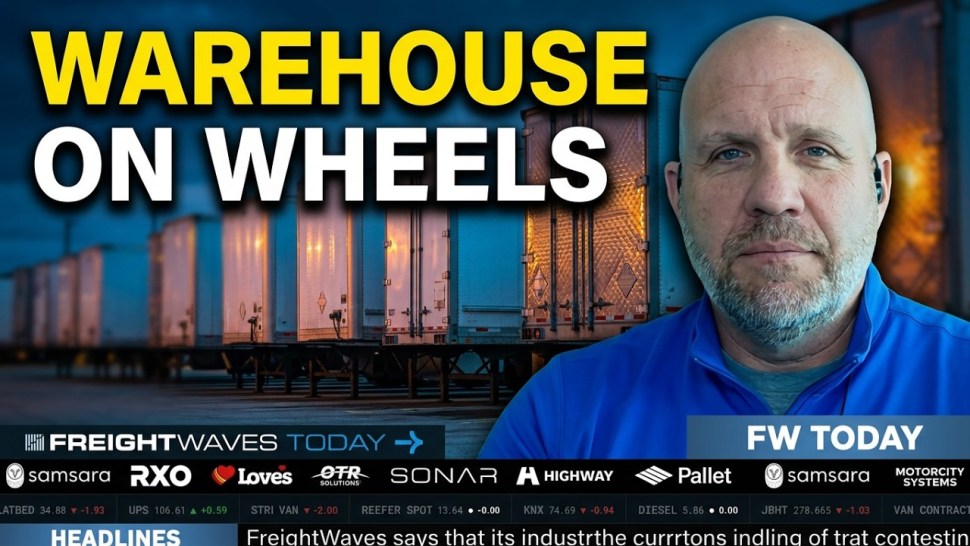
John Brooks, CEO of Warehouse on Wheels, shares how his company is revolutionizing industrial storage by repurposing end-of-life over-the-road trailers. Discover their rapid growth, cost-effective solutions, and how they provide critical flexibility in today’s unpredictable supply chain. Learn about their unique business model and the newly released Supply Chain Activity Index. #SupplyChainInnovation #LogisticsSolutions
Warehouse on Wheels CEO John Brooks wants to double his company’s footprint to 100 locations and 100,000 trailers, he told FreightWaves, building on a run that has taken the Houston-area firm from 2 locations and roughly 4,000 trailers when it launched in November 2017 to 37 locations and 35,000 trailers today, serving 6,000 customers across a network that now stretches from Montreal to Monterrey, Mexico.
The company’s model is straightforward: acquire end-of-life over-the-road trailers, repaint them, certify them federally, and rent them to manufacturers, retailers, and distributors as flexible storage at rates Brooks says run 2 to 4 times cheaper per square foot than traditional warehouse space. Contracts are 30-day evergreen agreements — not the five-, seven-, or 10-year leases typical of industrial real estate — a structure Brooks said is a key competitive advantage. The company targets an 8x return on invested capital over the life of each trailer.
“When we win a heart and mind, we rarely lose it. And so a customer may have 50 trailers, they may size down to 25 or up to 100, but they never really give up that solution once they’ve had a chance to experience what we offer,” Brooks said.
Warehouse on Wheels is preparing to open a Chicago location within two weeks, a market Brooks described as central to the company’s strategy of positioning assets along the eight major U.S. transportation corridors and in smaller towns adjacent to those routes. The company is backed by private equity sponsor Windpoint Partners, which came on board in 2021 after an initial partnership with Milton Street Capital.
Alongside its expansion, the company recently released a Supply Chain Activity Index designed to measure the flow of goods through the supply chain rather than serve as another pricing benchmark. The index draws on a basket of widely tracked indicators combined with on- and off-ramp activity across Warehouse on Wheels’ own trailer fleet. Scored on a 0-to-100 scale with 50 as neutral, the index registered 42.2 in June, indicating contraction. Brooks said he expects the July reading to improve but cautioned that conditions outside of AI-related infrastructure spending remain subdued.
“There is still a general malaise, in our opinion,” Brooks said, describing a “wait-but-still-move mindset” among supply chain operators who need to show quarterly growth to shareholders but are not making large inventory bets. He drew a contrast with 2018, when the first round of tariffs triggered a significant build-ahead in inventories, saying this cycle has instead produced smaller, more cautious purchasing decisions.
Operationally, Brooks said neither land nor used trailers represent a significant constraint on growth. The company typically needs only 3 to 5 acres of gravel per location, and the post-COVID used trailer market has produced ample supply from private carriers deflating and modernizing their fleets. Average rental periods currently run around 20 to 24 months. The company’s “55 and 55” standard — trailers must look presentable from 55 feet away at 55 miles per hour — governs how each acquired unit is refurbished before going to work for a customer.
- Warehouse on Wheels grew from 2 locations and 4,000 trailers in 2017 to 37 locations and 35,000 trailers today, with a goal of 100 locations and 100,000 trailers.
- The company’s Supply Chain Activity Index scored 42.2 in June, below the neutral level of 50, with Brooks citing a ‘general malaise’ in the goods economy outside AI infrastructure spending.
- End-of-life trailers yield an 8x return on invested capital over their useful life, renting at 2 to 4 times less per square foot than traditional warehouse space on 30-day evergreen contracts.
Speaker 1 [0:00] We’re gonna talk about trailers. We like to call them warehouse on wheels, and nobody, nobody more than to call them warehouse on wheels named his company after it. John Brooks is the CEO of the company Warehouse on Wheels. Welcome, John. How are you today, sir?
Speaker 2 [0:14] I’m very good. Thank you all for having me. I appreciate it.
Speaker 1 [0:17] All right, so Warehouse on Wheels is trailers. Tell us a little bit about the business.
Speaker 2 [0:22] Yeah, so in 2017, I started the business with our first 2 locations and about 4,000 trailers. And today we’re at 37 locations and 35,000 trailers. We’ve built the business through a multitude of networks from now Montreal, Canada to Monterrey, Mexico. And our purpose is we take end-of-life over-the-road trailers and we repurpose them for flexible industrial storage into the supply chains of our 6,000 customers.
Speaker 1 [0:50] So the idea here is that these trailers that have are no longer, they may be roadworthy, but they’re no longer really in the best of shape to be roadworthy. You’re using them for storage. What’s the advantage of that over a traditional warehouse?
Speaker 2 [1:06] Yeah, so from an economic standpoint, we’re generally 2 to 4 times less expensive on a per square footage basis, and we only require a 30-day evergreen contract, so not a 5, 7, 10-year lease. So the unit economics clearly lean in our favor. And to your point, yes, the trailers are roadworthy. We take those trailers in, we give them a fresh coat of paint, a fresh Federal, so they’re safe, dark, and dry and ready to go to work.
Speaker 1 [1:31] What is the advantage? So cost advantages, but in other commodities, is there any commodities that work better for these trailers or is it all price?
Speaker 2 [1:41] You know, I think it’s a matter of just solving that short-term pain point in the supply chain. You know, You know, we’re all just one tweet away from our silent partners in Washington or some other disruption in the supply chain. And when that happens, that’s really when our assets show up and serve best, is solving that short-term need, that pressure relief valve, that easy button for the guys and gals on the dock that are dealing with issues every day.
Speaker 3 [2:05] Yeah, I think it makes a ton of sense. The flexibility there has to be incredibly beneficial. So you recently released a Supply Chain Activity Index. So can you tell us what it actually measures, what it does, and what prompted you all to come up with the index?
Speaker 2 [2:23] Yeah, we felt like we needed to share with the world kind of our view of the supply chain and how well or how things are performing, I guess. With 6,000 customers across a multitude of industries from automotive manufacturer to retail, we thought we had a view. And so our index is really designed to highlight the level of goods activity throughout the supply chain. It’s, it’s not another pricing index. And so what we did is we, we took a basket of measures that everybody already respects. I just saw it on the Sonar update. I’m looking forward to our July refresh because I think it’ll even be more positive. And then we compared that to the on-off-ramp activity within our own business, and we think that it forms a view of how the underlying supply chain activity and goods are moving.
Speaker 3 [3:09] So it runs 0 to 100, if I’m correct. 50 is neutral. June was— where was June? Oh, 42.2. I see it in the graphic. It’s hard to see. You said you’re looking forward to—
Speaker 1 [3:25] The lines are real small.
Speaker 3 [3:26] Yeah. Well, it says 42.2 very large. I know. It’s up there, but it is—
Speaker 1 [3:30] not just your eyes. Mine too.
Speaker 3 [3:32] I got new contacts yesterday. They might be worse. Anyway. So tell us, so we’re below neutral. So what does that mean for the supply chain overall? What are you expecting for July?
Speaker 2 [3:41] Well, I think it really lines up with even the headline that was in the Journal this morning about how our economy is almost becoming over-indexed to the AI-related infrastructure build. And so when you look through to the goods economy and think about housing starts and other just durable goods orders outside of the AI infrastructure build, there is still a general malaise, in our opinion. There’s a— I sometimes call it this wait-but-still-move mindset that people need to grow, they need to perform quarter over quarter for their shareholders, but no one’s making any real big bets. It’s a lot like the information you guys just shared from Sonar about inventory levels. They’re below ideal. And so, yes, I believe there will be a restocking as we build towards hopefully a more traditional peak season, but at this point, outside of those AI-related builds and components, there’s a general malaise out there.
Speaker 3 [4:34] So I want to continue to tie this together. Trailers being rented or then being, I guess, sent back to you, whatever the right words are for that, across your 37 locations. So why is that a clean read on freight flow as a whole versus just sort of inventory levels?
Speaker 2 [4:54] It’s definitely indexed to inventory levels for sure. But I think it also represents the lack of front-end flow. The fact that when you think about 2018, for example, the first time we dealt with this sort of tariff approach to things, there was a real focus and a real build-ahead, if you will, on inventories. Whereas this time, as the administration came back in and started implementing these things, I think people took a bit of a wait-and-see attitude. They would take smaller bites at the apple, but it wasn’t the big wave of goods. So in our minds, it’s an indicator of the totality of the activity within the supply chain from raw materials to ultimately getting it on the shelves.
Speaker 3 [5:38] So with it being sort of a relatively low number right now, still in contraction below 50%, I think it’s really interesting and I want your take on, despite that, you guys have had tremendous growth to 37 locations now and 38,000, 36,000 trailers I read. So how do you reconcile those 2 things?
Speaker 2 [5:58] Well, we’ve been consolidating the space first and foremost. I was a customer back in the day and saw an opportunity that I felt like this was a portion of the trailer’s life that was a bit neglected. There were a lot of small mom-and-pop players out there serving this use case of storage and local cartage, and we went upon the mission of building a bigger version of that. a national footprint, or in this case, even now an international footprint. So that’s really been the driver behind the growth. And then quite honestly, as we build brand and solution awareness and people come to understand the true economics of the solution, when we win a heart and mind, we rarely lose it. And so a customer may have 50 trailers, they may size down to 25 or up to 100, but they never really give up that solution once they’ve had a chance to experience what we offer.
Speaker 1 [6:48] John, what is the— you got shoes framed in the background. What is special about those shoes? They look like Air Jordans. Am I reading that right?
Speaker 2 [6:55] They are. Much to my wife’s chagrin, I have a Jordan problem.
Speaker 1 [7:00] Okay.
Speaker 2 [7:01] And I’m pretty sure it’s ’cause I couldn’t afford ’em as a kid, but those are actually custom Warehouse— oh, the wrong way— custom Warehouse on Wheels Jordans. And I couldn’t bring myself to wear ’em and scuff ’em up, so they’re a great conversation piece with my management book there from Michael Scott as well, ’cause I’m a big Office fan.
Speaker 1 [7:17] And you’ve got a bunch of, it looks like trucks in the background too, a nice toy collection.
Speaker 2 [7:21] So each time we buy a brand, we have kept that regional brand. And so that’s the family of brands under Warehouse On Wheels. So our customers know us as Meisler Trailer Rental, First In Trailer Service, Advantage Trailer Rental. So Warehouse On Wheels really represents at this point the holding company of that family of brands.
Speaker 1 [7:39] That’s kind of fun. You do a deal, a transaction, and you get a new toy. There you go. I think that’s every man’s dream is like deal, business, let’s make some money. Well, it’s better than a diltoy. You know, those that don’t know what a diltoy is, like a plaque. This is actually even cooler.
Speaker 2 [7:54] A tombstone, yeah. I’ve got enough of those too from my 7 tours with different private equity firms, but yeah, I like the trucks better.
Speaker 1 [8:00] Now, are you guys private equity backed, or did you found it and funded it yourself?
Speaker 2 [8:05] So we’re private equity backed. We’re on our second sponsor. So myself and a group called Milton Street Capital outta Houston started building the business together, and then in 2021, we joined forces with Windpoint Partners, our current sponsor.
Speaker 1 [8:19] Is it harder to find the land? Is that the big issue, or is it the trailers themselves that are the sort of growth constraint?
Speaker 2 [8:25] To be honest with you, neither are that hard because when we go to a market, we generally only need 3 to 5 acres of gravel. It’s pretty simple. And then the used trailer market, now that we’ve come off the COVID abnormalities, there’s a plethora of used trailers in the market. And so that’s really our sources. We’re buying from the private carriers as they defleet and then modernize their fleets.
Speaker 1 [8:48] And would you, in terms of picking a new location, other than, I know you’re buying existing locations, are you scouting out new locations that you guys will open?
Speaker 2 [8:56] Yeah, we just launched. We’ll launch in the next 2 weeks in Chicago, of all places. We’re kind of slow to get there, but really, you think about us along the 8 major corridors of transportation, and then probably in smaller towns just adjacent to those main thoroughfares. That’s really where we thrive.
Speaker 1 [9:13] John, you’re a brave man to put an industrial asset in Chicago, but it is the epicenter of freight, not as big and important as Chattanooga is, but it is certainly up there. Right, totally agree. In terms of growth, what is the constraint on growth? Is it capital? Is it customer demand? What slows you guys down?
Speaker 2 [9:39] Yeah, I mean, I think we’ve got to be good stewards of the capital. Again, we’re private equity owned, so there’s not an infinite checkbook, but I think for us, there’s really been little to no constraints. I mean, to go from 2 locations in roughly essentially 2018, we started in November of ’17, to 37 today, I think is a real testament to what the model can be. And my vision for the organization is 100 locations and 100,000 trailers, and that’s what we’re building towards.
Speaker 1 [10:06] Wow. And then do you have any metrics you can share with us in terms of what a trailer does in terms of monthly yield or annual yield?
Speaker 2 [10:13] Yeah, absolutely. So, you know, the way we do things and operate, you know, we’re generally providing kind of an 8x money-on-invested-capital return on these trailers. So we’ve really built quite a mousetrap that I’m pretty proud of and something that we’re continuing to scale.
Speaker 1 [10:31] So 8x, is that over the life of that trailer? Yes, over the life of the trailer. So when you’re looking for, When you’re buying an asset, you’re looking for it to basically yield 8 times what you guys invested.
Speaker 2 [10:42] Absolutely. And if you think about it, our use case is so much different than the over-the-road. The trailer rolls to the site, it gets loaded, it’s generally stored close to the site, or maybe comes back to our yard to be stored. So it really minimizes the wear and tear on the asset, which allows that asset then to have a substantial useful life under our ownership.
Speaker 3 [11:01] But John, does it make so much sense? Because at that point in the life of the asset is when the maintenance costs begin to rise, right?
Speaker 2 [11:07] Yeah.
Speaker 3 [11:07] But you’re not gonna have to do nearly as much.
Speaker 1 [11:09] It’s a great business model.
Speaker 3 [11:10] I’m really into it. Yeah, as long as they are watertight.
Speaker 1 [11:12] Well, that’s the thing I was wondering.
Speaker 3 [11:15] And he mentioned that.
Speaker 2 [11:16] Safe, dark, and dry is what we like to say.
Speaker 3 [11:18] Say it again. What? Dark and dry?
Speaker 2 [11:20] Safe, dark, and dry.
Speaker 3 [11:22] Safe, dark, and dry.
Speaker 1 [11:22] So I am just curious, is there certain commodities that this isn’t ideal for? Obviously, a fridge isn’t.
Speaker 2 [11:29] Yeah, anything temperature controlled really doesn’t fit for us, but Again, we’re supporting everyone from automotive manufacturers through apparel production through to retail. Plastics manufacturers are a big customer as well because, again, in that business, a lot of times it’s optimizing the raw material input, so playing the commodities market, and then optimizing the throughput volume so you don’t have to change over tools and so forth. That trailer flexibility to allow you to store that staged or even finished product Gives you a tremendous lever to play as you manage those other key components of your process.
Speaker 3 [12:04] I don’t even think through the course of them, even through the course of a month, it would be like, you know, end of month, end of quarter, getting it off your yard and into one of these trailers wherever it needs to go. Like, I would think the flexibility has got to be the biggest selling part.
Speaker 1 [12:17] Brilliant. John, I imagine permitting is so much easier than building a physical building, particularly in certain districts where they don’t, you know, they’re not welcoming industrial real estate. You have the advantage of, you know, you have portable units and they’re classified as trailers. I imagine that gives you an enormous amount of advantage in permitting.
Speaker 2 [12:35] It absolutely helps. We’re actually, we’ve got our Ecovadis score, so we’re recognized as an environmentally friendly solution because not only are we helping you avoid the construction of the warehouse and the infrastructure and all the burden that goes with that, we’re also helping to keep some of these trailers out of the scrapyard, relatively speaking. And so Again, viewed very positively from an ESG standpoint. I like to say that we make the procurement guys happy, we make the CFO happy, and we darn sure make the operators happy.
Speaker 1 [13:03] One man’s junk is another man’s treasure. That is the great thing here is these old units. I have to imagine, John, if we went to one of your yards, we would see some old school trucking names out there. Like, you know, we used to own a company called Paragon Leasing, which is a trailer leasing company. Occasionally, Julie, around town you’ll see a Southwest Motor Freight trailer that’s out there. It always makes me happy. Usually it’s been stripped.
Speaker 3 [13:28] Yeah, and you could just still see like the— Yeah, the ghost.
Speaker 1 [13:32] Yeah, the ghost of the freight.
Speaker 2 [13:33] Well, I have a rule.
Speaker 3 [13:34] It’s—
Speaker 2 [13:35] I have all these Brooksisms, as you guys will get to know me, and one of them is 55 and 55. I want the trailer to look good at 55 feet away and 55 miles an hour. So we give it a fresh coat of paint all the way around, a fresh branding, and then a fresh federal. So again, back to my earlier point, it shows up safe, dark, and dry, ready to go to work, and it needs to look good from that distance.
Speaker 1 [13:55] So those ghosts of trailers past, those libraries that are gone on to— are, are no longer there?
Speaker 2 [14:01] Our intention is to cover those up. Now, will one slip through the cracks? And, and with all our acquisitions, quite honestly, there are some trailers we’ve probably acquired that I haven’t even seen yet in our hold period because they stay on rent that long. Our, our average rental period right now is probably about 20, 24 months. So, wow.
Speaker 3 [14:17] And can those shippers transfer those between different facilities of theirs, or is it for a specific location?
Speaker 2 [14:24] They’re licensed and federally certified, so they can roll on the road, and we’ll help move them for them if they need us to.
Speaker 1 [14:30] Amazing business. I love businesses that just require creativity, brilliance, leverage capital, recycling. John’s got an amazing business. We’re big fans of yours, John, here. I am.
Speaker 2 [14:44] Well, I am fans of yours as well. What you guys have built here and the service you provide to those of us in the space, I honestly am sincerely grateful for that.
Speaker 1 [14:52] Well, likewise. Well, if you get ahold of an old Roadway trailer, just give us a holler. I’m looking for one. I think those are cool. I’ll send you pictures. I want the OG one, not the YRC one. I want the old school Roadway. And it’s really its prime right before the big acquisition. John, thank you so much for coming on Freightways Today. We’ll have to have you back.
Speaker 2 [15:13] Thank you all very much.
Speaker 1 [15:14] Have a good day.
Brokerage Compliance Symposium
The day before F3. Every compliance issue you face - fraud exposure, carrier liability, FMCSA rules, cargo theft, insurance gaps - navigated by attorneys and operators defining best practices in a changing industry.
F3 Awards Dinner
The night before F3. FreightTech100 companies honored. FreightTech 25 and Shipper of Choice winners revealed live. Cocktail reception into dinner and live music - 300 industry leaders in one purpose-built room.
F3: Future of Freight Festival
Industry-defining keynotes, rapid-fire technology demos, and industry leaders networking in experiences across Chattanooga - plus the inaugural F3 Awards Dinner featuring the FreightTech and Shipper of Choice reveals.
The day before F3. Every compliance issue you face - fraud exposure, carrier liability, FMCSA rules, cargo theft, insurance gaps - navigated by attorneys and operators defining best practices in a changing industry.
The Signal at Chattanooga Choo Choo • Chattanooga, TN Register NowThe night before F3. FreightTech100 companies honored. FreightTech 25 and Shipper of Choice winners revealed live. Cocktail reception into dinner and live music - 300 industry leaders in one purpose-built room.
The Signal at Chattanooga Choo Choo • Chattanooga, TN Register NowIndustry-defining keynotes, rapid-fire technology demos, and industry leaders networking in experiences across Chattanooga - plus the inaugural F3 Awards Dinner featuring the FreightTech and Shipper of Choice reveals.
The Signal at Chattanooga Choo Choo • Chattanooga, TN Register Now