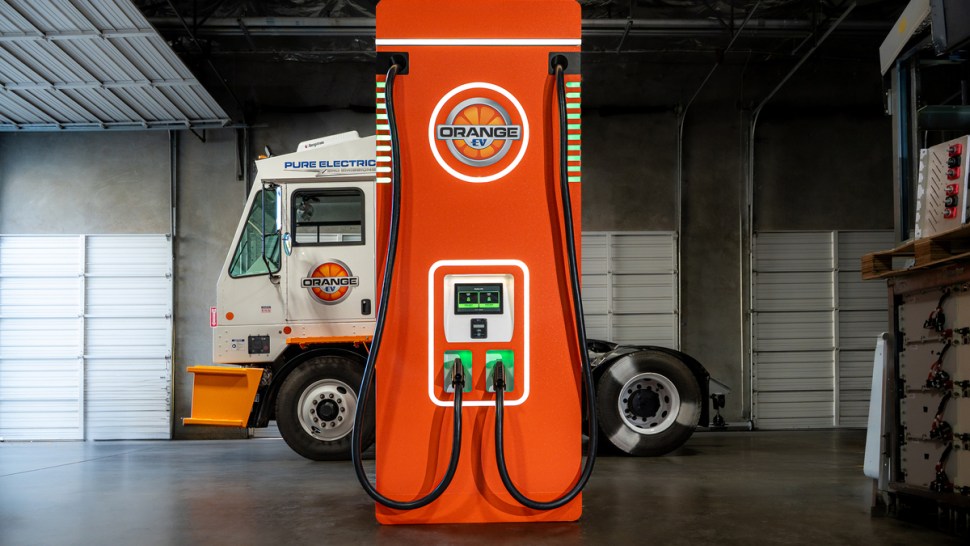
Orange EV and OptiGrid on Monday unveiled the Orange Juicer, a battery-integrated DC fast charger designed to eliminate the primary obstacles preventing rapid fleet electrification: lengthy utility upgrade delays and prohibitive infrastructure costs. The announcement came during the IANA Intermodal EXPO 2025 in Long Beach, Calif., on Sept. 15.
The Orange Juicer, an eight-foot-tall certified unit, functions on what Tyler Phillipi, CEO of OptiGrid, described to FreightWaves as a “garden hose in, fire hose out” principle. The system accepts whatever AC power format is available at the site and stores it in the battery, then delivers high-capacity DC charging on demand.
This approach optimizes existing electrical infrastructure while eliminating power loss through multiple AC-to-DC conversions. According to Kurt Neutgens, CEO of Orange EV, this creates multiple advantages: “The biggest thing is I can do a lot more trucks now with the same power. With the same power, I can do almost 10 times more trucks charging.”
“As we try to expand, we run into grid issues,” explained Neutgens. “One of the things that has helped us expand so quickly compared to others is that we don’t need that much grid, our footprint is already smaller compared to an over-the-road truck. And yet, as we grow more and more, that grid problem starts to show up.”
The Orange Juicer addresses this by allowing power to flow continuously at lower rates into its battery storage, then delivering that energy at up to 200 kW when vehicles need charging. This asynchronous approach means fleet operators can charge multiple vehicles during breaks without overwhelming the electrical system.
The charging solution also provides resilience during grid instability or outages. “When the grid is having issues, or it’s unstable, or there’s rolling blackouts, or there’s huge demand charges … this just gives them that buffer,” Phillipi noted.
Orange EV has more than 1,500 yard hostlers already operating in the U.S. and Canada and nearly 10 million operational hours logged.
With Orange EV trucks already delivering approximately $60,000 in annual diesel savings per vehicle, pairing them with the Orange Juicer creates a quicker path to fleet electrification.
According to Neutgens, there are additional total cost of ownership benefits outside of diesel savings when one adds maintenance cost savings. “In a two-shift operation over a 10-year period, our customers are experiencing a $500,000 benefit per truck. That’s full price, no incentives.”
The Orange Juicer, powered by OptiGrid technology, will be commercially available in the fourth quarter of 2025 and is currently being showcased at the IANA Intermodal EXPO in Long Beach, Calif., through Sept. 17.
F3: Future of Freight Festival
Industry-defining keynotes, rapid-fire technology demos, and industry leaders networking in experiences across Chattanooga - plus the inaugural F3 Awards Dinner featuring the FreightTech and Shipper of Choice reveals.
Industry-defining keynotes, rapid-fire technology demos, and industry leaders networking in experiences across Chattanooga - plus the inaugural F3 Awards Dinner featuring the FreightTech and Shipper of Choice reveals.
The Signal at Chattanooga Choo Choo • Chattanooga, TN Register Now